
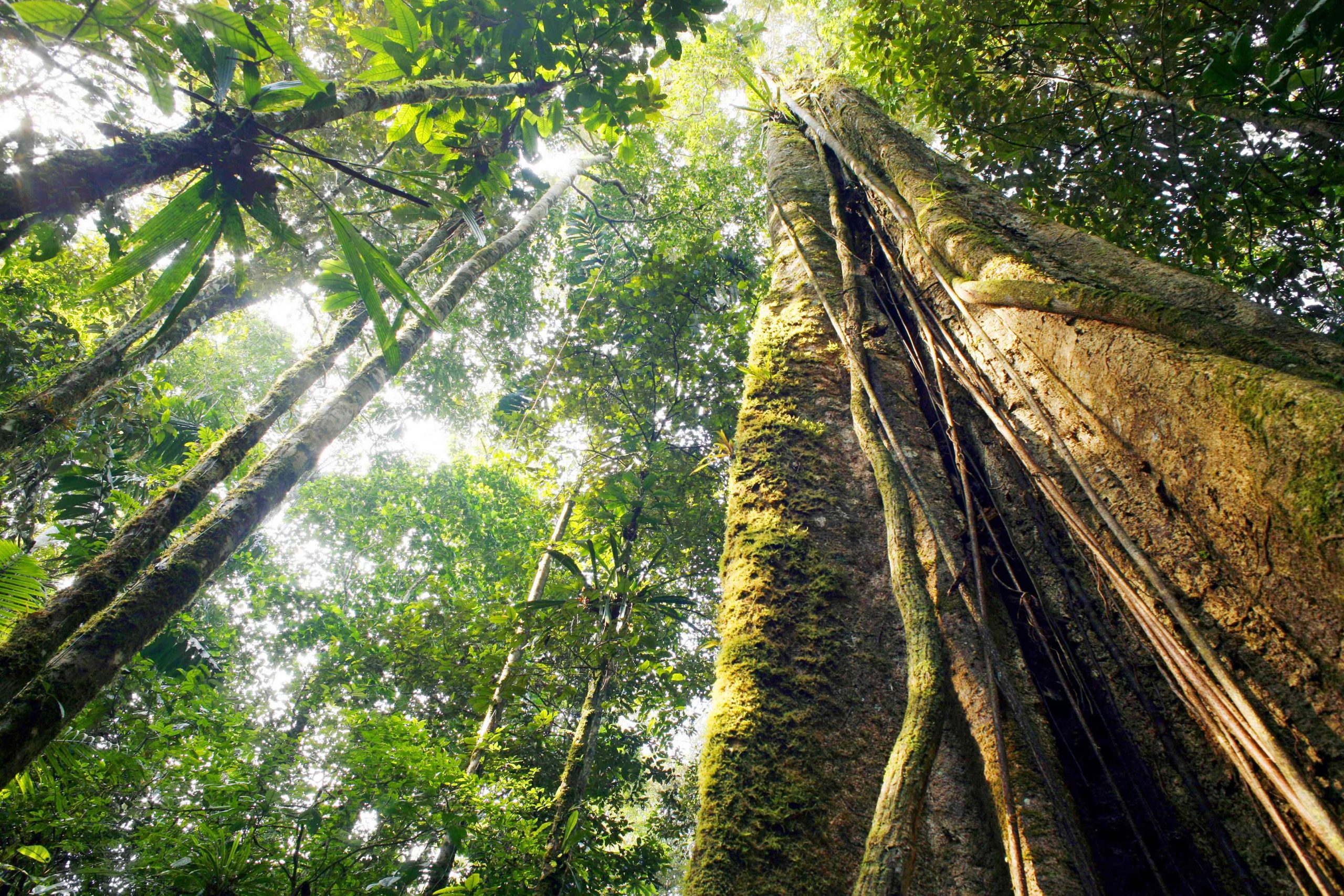
The capacity of the Amazon forest to store carbon in a changing climate will ultimately be determined by how fast trees die – and what kills them. Now, a huge new study has unraveled what factors control tree mortality rates in Amazon forests and helps to explain why tree mortality is increasing across the Amazon basin.
This large analysis found that the mean growth rate of the tree species is the main risk factor behind Amazon tree death, with faster-growing trees dying off at a younger age. These findings have important consequences for our understanding of the future of these forests. Climate change tends to select fast-growing species. If the forests selected by climate change are more likely die younger, they will also store less carbon.
The study, co-led by the Universities of Leeds and Birmingham in collaboration with more than 100 scientists, is the first large-scale analysis of the causes of tree death in the Amazon and uses long-term records gathered by the international RAINFOR network.
The results, published in Nature Communications, show that species-level growth rates are a key risk factor for tree mortality.
“Understanding the main drivers of tree death allows us to better predict and plan for future trends – but this is a huge undertaking as there are more than 15,000 different tree species in the Amazon,” said lead author Dr. Adriane Esquivel-Muelbert, of the Birmingham Institute for Forest Research.
Dr. David Galbraith, from the University of Leeds added “We found a strong tendency for faster-growing species to die more, meaning they have shorter life spans. While climate change has provided favorable conditions for these species, because they also die more quickly the carbon sequestration service provided by Amazon trees is declining.”
Tree mortality is a rare event so to truly understand it requires huge amounts of data. The RAINFOR network has assembled more than 30 years of contributions from more than 100 scientists. It includes records from 189 one-hectare plots, each visited and monitored on average every 3 years. Each visit, researchers measure all trees above 10cm in diameter as well as the condition of every tree.
In total more than 124,000 living trees were followed, and 18,000 tree deaths recorded and analyzed. When trees die, the researcher follows a fixed protocol to unravel the actual cause of death. “This involves detailed, forensic work and amounts to a massive ‘CSI Amazon’ effort conducted by skilled investigators from a dozen nations,” noted Prof. Oliver Phillips, from the University of Leeds.
Dr. Beatriz Marimon, from UNEMAT, who coordinates multiple plots in central Brazil added: “Now that we can see more clearly what is going on across the whole forest, there are clear opportunities for action. We find that drought is also driving tree death, but so far only in the South of the Amazon. What is happening here should serve as an early warning system as we need to prevent the same fate overtaking trees elsewhere.”
Reference: “Tree mode of death and mortality risk factors across Amazon forests” by Adriane Esquivel-Muelbert, Oliver L. Phillips, Roel J. W. Brienen, Sophie Fauset, Martin J. P. Sullivan, Timothy R. Baker, Kuo-Jung Chao, Ted R. Feldpausch, Emanuel Gloor, Niro Higuchi, Jeanne Houwing-Duistermaat, Jon Lloyd, Haiyan Liu, Yadvinder Malhi, Beatriz Marimon, Ben Hur Marimon Junior, Abel Monteagudo-Mendoza, Lourens Poorter, Marcos Silveira, Emilio Vilanova Torre, Esteban Alvarez Dávila, Jhon del Aguila Pasquel, Everton Almeida, Patricia Alvarez Loayza, Ana Andrade, Luiz E. O. C. Aragão, Alejandro Araujo-Murakami, Eric Arets, Luzmila Arroyo, Gerardo A. Aymard C., Michel Baisie … Vincent Vos, Roderick Zagt, Pieter Zuidema and David Galbraith, 9 November 2020, Nature Communications.
DOI: 10.1038/s41467-020-18996-3
The research was funded by the Natural Environment Research Council and included contributions from 10 UK universities as well as scientists from across South America in Bolivia, Brazil, Colombia, Ecuador, French Guiana, Guyana, Peru and Venezuela.
The Birmingham Institute for Forest Research aims to provide fundamental science, social science and cultural research of direct relevance to forested landscapes anywhere in the world.
RAINFOR is a long-term, international collaboration to understand the dynamics of Amazon ecosystems. RAINFOR has developed a collective framework to systematically monitor Amazon forests from the ground-up during our time of unprecedented change.
Never miss a breakthrough: Join the SciTechDaily newsletter.
Follow us on Google and Google News.