
Close Menu
    Facebook X (Twitter) Instagram
    SciTechDaily
    • Biology
    • Chemistry
    • Earth
    • Health
    • Physics
    • Science
    • Space
    • Technology
    Facebook X (Twitter) Pinterest YouTube RSS
    SciTechDaily
    Home»Space»New Images From Juno’s Recent Flyby of Jupiter’s Great Red Spot
    Space

    New Images From Juno’s Recent Flyby of Jupiter’s Great Red Spot

    By DC Agle, Jet Propulsion LaboratoryJuly 13, 2017No Comments4 Mins Read
    Facebook Twitter Pinterest Telegram LinkedIn WhatsApp Email Reddit
    Share
    Facebook Twitter LinkedIn Pinterest Telegram Email Reddit
    Enhanced-Color Image of Jupiter’s Great Red Spot
    This enhanced-color image of Jupiter’s Great Red Spot was created by citizen scientist Jason Major using data from the JunoCam imager on NASA’s Juno spacecraft. Credit: NASA/JPL-Caltech/SwRI/MSSS/Jason Major

    The JunoCam imager aboard NASA’s Juno Spacecraft captured new images of Jupiter’s Great Red Spot, revealing a tangle of dark, veinous clouds weaving their way through a massive crimson oval.

    Juno snapped the new pics of the most iconic feature of the solar system’s largest planetary inhabitant during its Monday (July 10) flyby. The images of the Great Red Spot were downlinked from the spacecraft’s memory on Tuesday and placed on the mission’s JunoCam website Wednesday morning.

    “For hundreds of years scientists have been observing, wondering and theorizing about Jupiter’s Great Red Spot,” said Scott Bolton, Juno principal investigator from the Southwest Research Institute in San Antonio. “Now we have the best pictures ever of this iconic storm. It will take us some time to analyze all the data from not only JunoCam, but Juno’s eight science instruments, to shed some new light on the past, present and future of the Great Red Spot.”
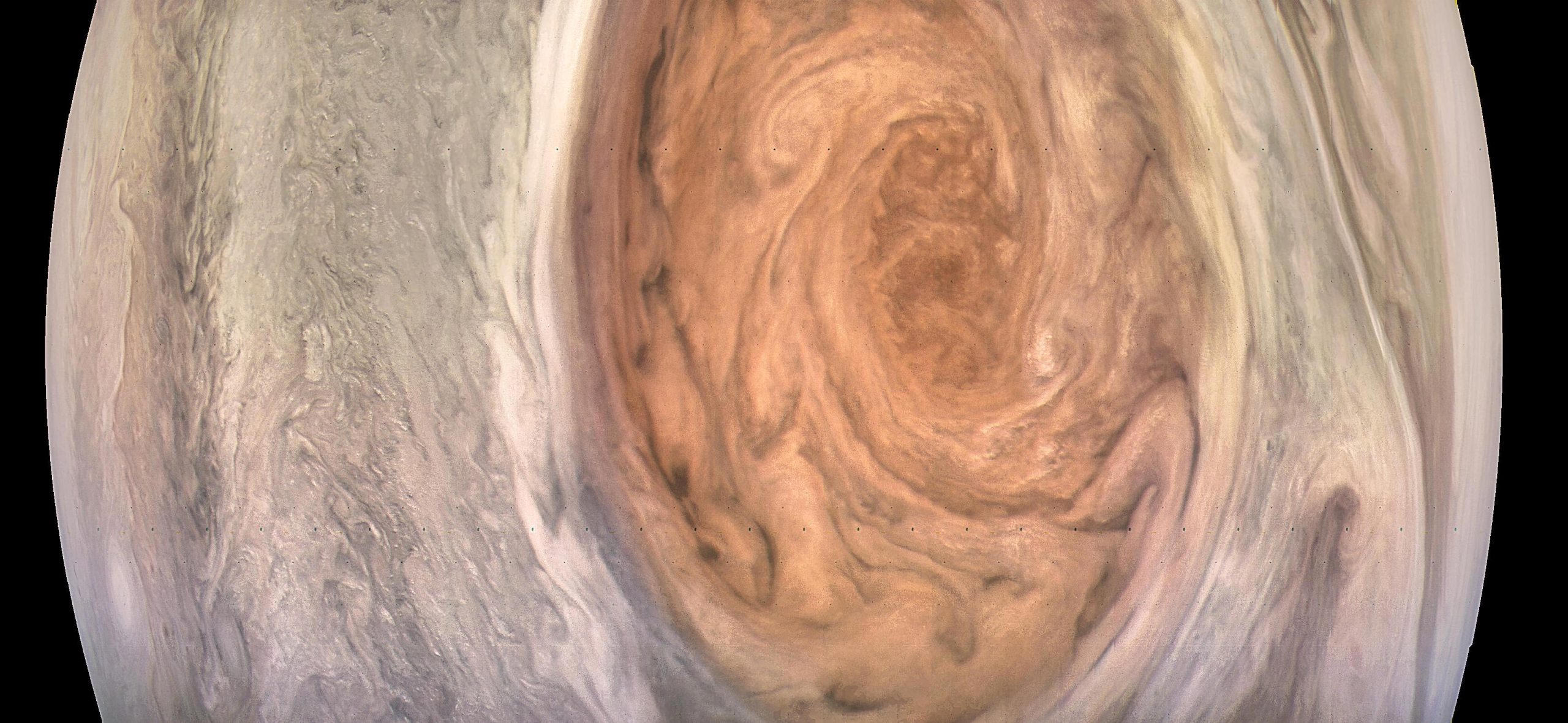
    Jupiter's Great Red Spot Revealed
    This enhanced-color image of Jupiter’s Great Red Spot was created by citizen scientist Kevin Gill using data from the JunoCam imager on NASA’s Juno spacecraft. Credit: NASA/JPL-Caltech/SwRI/MSSS/Kevin Gill

    As planned by the Juno team, citizen scientists took the raw images of the flyby from the JunoCam site and processed them, providing a higher level of detail than available in their raw form. The citizen-scientist images, as well as the raw images they used for image processing, can be found at: https://www.missionjuno.swri.edu/junocam/processing

    “I have been following the Juno mission since it launched,” said Jason Major, a JunoCam citizen scientist and a graphic designer from Warwick, Rhode Island. “It is always exciting to see these new raw images of Jupiter as they arrive. But it is even more thrilling to take the raw images and turn them into something that people can appreciate. That is what I live for.”

    Measuring in at 10,159 miles (16,350 kilometers) in width (as of April 3, 2017) Jupiter’s Great Red Spot is 1.3 times as wide as Earth. The storm has been monitored since 1830 and has possibly existed for more than 350 years. In modern times, the Great Red Spot has appeared to be shrinking.
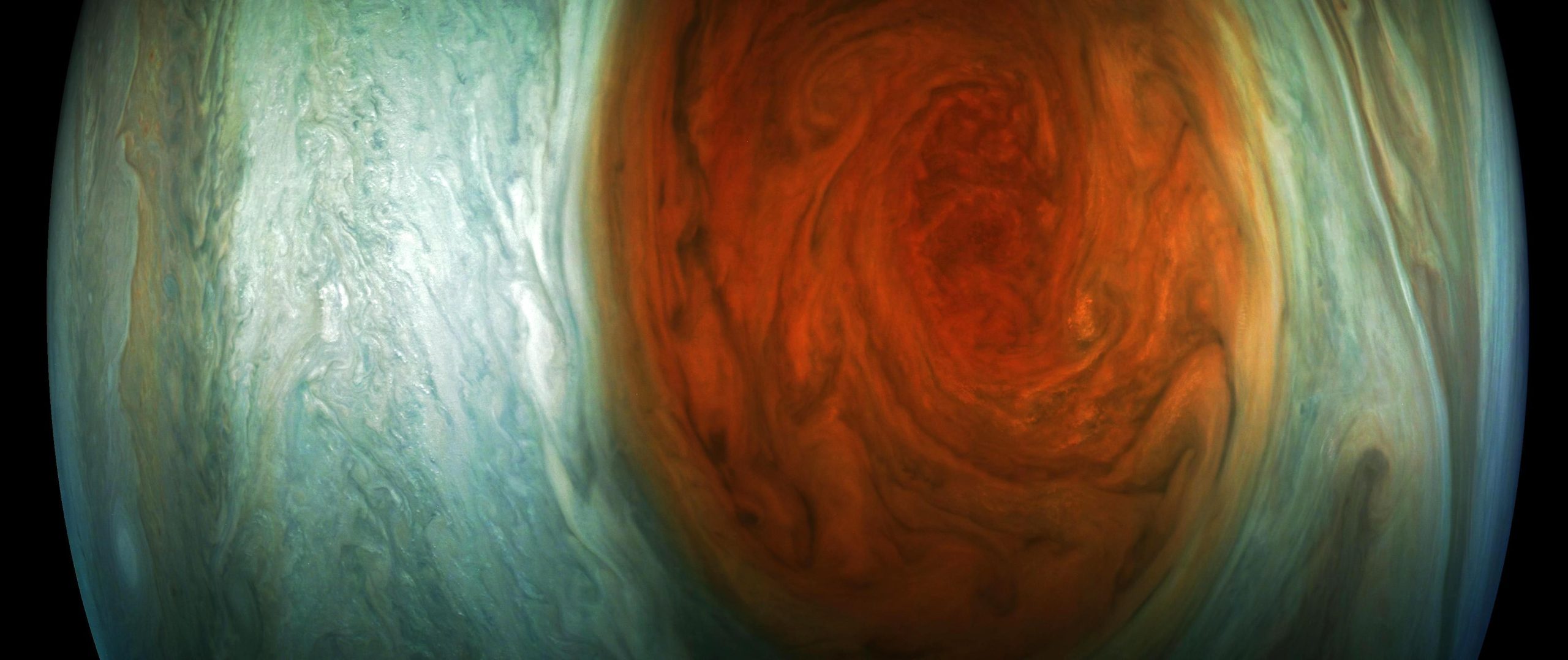
    Jupiter's Great Red Spot (Enhanced Color)
    This enhanced-color image of Jupiter’s Great Red Spot was created by citizen scientist Gerald Eichstädt using data from the JunoCam imager on NASA’s Juno spacecraft. Credit: NASA/JPL-Caltech/SwRI/MSSS/Gerald Eichstädt

    All of Juno’s science instruments and the spacecraft’s JunoCam were operating during the flyby, collecting data that are now being returned to Earth. Juno’s next close flyby of Jupiter will occur on September 1.

    Juno reached perijove (the point at which an orbit comes closest to Jupiter’s center) on July 10 at 6:55 p.m. PDT (9:55 p.m. EDT). At the time of perijove, Juno was about 2,200 miles (3,500 kilometers) above the planet’s cloud tops. Eleven minutes and 33 seconds later, Juno had covered another 24,713 miles (39,771 kilometers), and was passing directly above the coiling, crimson cloud tops of the Great Red Spot. The spacecraft passed about 5,600 miles (9,000 kilometers) above the clouds of this iconic feature.

    Juno launched on August 5, 2011, from Cape Canaveral, Florida. During its mission of exploration, Juno soars low over the planet’s cloud tops — as close as about 2,100 miles (3,400 kilometers). During these flybys, Juno is probing beneath the obscuring cloud cover of Jupiter and studying its auroras to learn more about the planet’s origins, structure, atmosphere, and magnetosphere.

    Early science results from NASA’s Juno mission portray the largest planet in our solar system as a turbulent world, with an intriguingly complex interior structure, energetic polar aurora, and huge polar cyclones.

    “These highly-anticipated images of Jupiter’s Great Red Spot are the ‘perfect storm’ of art and science. With data from Voyager, Galileo, New Horizons, Hubble and now Juno, we have a better understanding of the composition and evolution of this iconic feature,” said Jim Green, NASA’s director of planetary science. “We are pleased to share the beauty and excitement of space science with everyone.”

    Never miss a breakthrough: Join the SciTechDaily newsletter.
    Follow us on Google and Google News.

    Astronomy Juno Spacecraft Planetary Science
    Share. Facebook Twitter Pinterest LinkedIn Email Reddit

    Related Articles

    Juno Mission Prepares for Jupiter Flyby

    Juno Images Provide an Unprecedented View of Jupiter

    A Billion or More Jupiter-Like Worlds Could Be Orbiting Stars in the Milky Way

    First In-orbit View from NASA’s Juno Spacecraft

    Juno Spacecraft in Orbit Around Jupiter

    Hubble Telescope Views Vivid Auroras in Jupiter’s Atmosphere

    NASA Juno Mission Trailer – Jupiter: Into the Unknown

    ScienceCasts Video: Close Encounters with Jupiter

    NASA’s Juno Spacecraft Adjusts Flight Path for Jupiter

    Leave A Reply Cancel Reply

    • Facebook
    • Twitter
    • Pinterest
    • YouTube

    Don't Miss a Discovery

    Subscribe for the Latest in Science & Tech!

    Trending News

    Breakthrough Bowel Cancer Trial Leaves Patients Cancer-Free for Nearly 3 Years

    Natural Compound Shows Powerful Potential Against Rheumatoid Arthritis

    100,000-Year-Old Neanderthal Fossils in Poland Reveal Unexpected Genetic Connections

    Simple “Gut Reset” May Prevent Weight Gain After Ozempic or Wegovy

    2.8 Days to Disaster: Scientists Warn Low Earth Orbit Could Suddenly Collapse

    Common Food Compound Shows Surprising Power Against Superbugs

    5 Simple Ways To Remember More and Forget Less

    The Atomic Gap That Could Cost the Semiconductor Industry Billions

    Follow SciTechDaily
    • Facebook
    • Twitter
    • YouTube
    • Pinterest
    • Newsletter
    • RSS
    SciTech News
    • Biology News
    • Chemistry News
    • Earth News
    • Health News
    • Physics News
    • Science News
    • Space News
    • Technology News
    Recent Posts
    • Total Solar Eclipse Made Cities Go Eerily Quiet Beneath the Surface
    • This Common Plant Could Be an Unexpected New Source of Protein
    • Birds in Cities Fear Women More Than Men and Scientists Don’t Know Why
    • Scientists Warn That This Common Pet Fish Can Wreck Entire Ecosystems
    • Scientists Just Made Carbon Capture Much Cheaper and Easier
    Copyright © 1998 - 2026 SciTechDaily. All Rights Reserved.
    • Science News
    • About
    • Contact
    • Editorial Board
    • Privacy Policy
    • Terms of Use

    Type above and press Enter to search. Press Esc to cancel.