
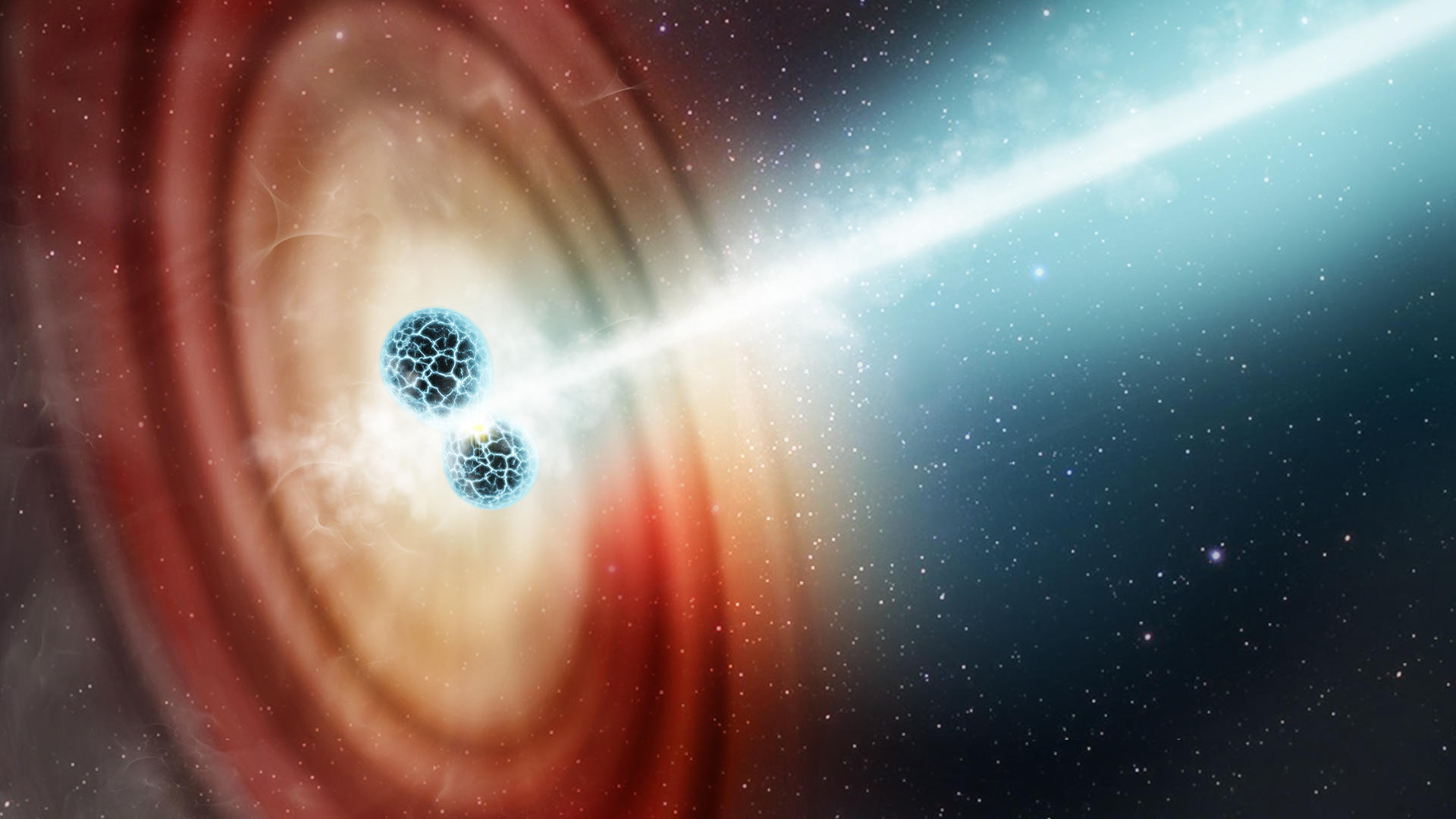
Over 299,000,000 Meters a Second — an Ultra-Fast Jet Blasting From a Star Crash
Neutron stars are the surviving “trash-compacted” cores of massive stars that exploded. Despite weighing more than our Sun, they would fit inside New York City. At this unimaginable density, a single teaspoon of surface material would weigh at least 4 billion tons on Earth.
If that doesn’t make your mind spin, just imagine what happens when two of these condensed cannon balls collide head-on. They ripple the very fabric of time and space in a phenomenon called gravitational waves, which can be measured by detectors on the ground on Earth.
The explosive event, named GW170817, was observed in August 2017. The blast released energy comparable to that of a supernova explosion. It was the first combined detection of gravitational waves and gamma radiation from a neutron star merger.
In the aftermath of the smashup, a blowtorch jet of radiation was ejected at nearly the speed of light, slamming into the material surrounding the obliterated pair. Hubble was on the scene of the explosion just two days after the collision. Astronomers used Hubble to measure the motion of a blob of material the jet slammed into. As the jet rocketed away from the site of the explosion, the blob moved outward like a leaf caught on a stream of water from a garden hose.
The incredible precision, gleaned from Hubble and radio telescopes, needed to measure the blob’s trajectory, was equivalent to measuring the diameter of a 12-inch pizza placed on the Moon as seen from Earth. This was a major watershed in the ongoing investigation of neutron star collisions that keep ringing throughout the universe.
Two neutron stars, the surviving cores of massive stars that exploded, collided sending a ripple through the fabric of time and space in a phenomenon called gravitational waves. In the aftermath, a blowtorch jet of radiation was ejected at nearly the speed of light, slamming into the material surrounding the obliterated pair. Astronomers used Hubble to measure the motion of a blob of material the jet slammed into. Credit: NASA’s Goddard Space Flight Center; Lead Producer: Paul Morris
Neutron Star Collision Creates Superluminal Jet
Astronomers using NASA’s Hubble Space Telescope have made a unique measurement indicating that a jet was blasted across space at speeds faster than 99.97% the speed of light by a titanic collision between two neutron stars.
The explosive event, dubbed GW170817, occurred in August 2017. The blast generated energy comparable to a supernova explosion. It was the first time gravitational waves and gamma rays were detected together from a binary neutron star merger.
This was a significant turning point in the research of these extraordinary collisions. In addition to the discovery of gravitational waves, 70 observatories across the world and in space saw the aftermath of this merger across a large swath of the electromagnetic spectrum. This signaled an important development in the area of Time Domain and Multi-Messenger Astrophysics, which makes use of a number of “messengers” including gravitational waves and light to analyze the progression of the universe through time.
Just two days later, scientists quickly aimed Hubble toward the explosion’s location. The neutron stars collapsed into a black hole, whose strong gravity started to attract matter toward it. This material spun rapidly, generating jets that moved outward from its poles. The roaring jet slammed into and swept up debris from the widening shell of explosion debris. This included a material blob from which a jet emerged.
Even though the event occurred in 2017, it has taken scientists several years to figure out how to analyze the Hubble data as well as data from other telescopes to paint this complete picture.
The Hubble observation was combined with observations from multiple National Science Foundation radio telescopes working together for very long baseline interferometry (VLBI). The radio data were taken 75 days and 230 days after the explosion.
“I’m amazed that Hubble could give us such a precise measurement, which rivals the precision achieved by powerful radio VLBI telescopes spread across the globe,” said Kunal P. Mooley of Caltech in Pasadena, California, lead author of a paper that was recently published in the journal Nature.
The authors used Hubble data together with data from ESA’s (the European Space Agency) Gaia satellite, in addition to VLBI, to achieve extreme precision. “It took months of careful analysis of the data to make this measurement,” said Jay Anderson of the Space Telescope Science Institute in Baltimore, Maryland.
By combining the different observations, they were able to pinpoint the explosion site. The Hubble measurement showed the jet was moving at an apparent velocity of seven times the speed of light. The radio observations show the jet later decelerated to an apparent speed of four times faster than the speed of light.
The Science Behind Superluminal Motion
In reality, nothing can exceed the speed of light, so this “superluminal” motion is an illusion. Because the jet is approaching Earth at nearly the speed of light, the light it emits at a later time has a shorter distance to go. In essence, the jet is chasing its own light. In actuality, more time has passed between the jet’s emission of the light than the observer thinks. This causes the object’s velocity to be overestimated – in this case seemingly exceeding the speed of light.
“Our result indicates that the jet was moving at least at 99.97% the speed of light when it was launched,” said Wenbin Lu of the University of California, Berkeley.
The Hubble measurements, combined with the VLBI measurements, announced in 2018, greatly strengthen the long-presumed connection between neutron star mergers and short-duration gamma-ray bursts. That connection requires a fast-moving jet to emerge, which has now been measured in GW170817.
This work paves the way for more precision studies of neutron star mergers, detected by the LIGO, Virgo, and KAGRA gravitational wave observatories. With a large enough sample over the coming years, relativistic jet observations might provide another line of inquiry into measuring the universe’s expansion rate, associated with a number known as the Hubble constant.
At present, there is a discrepancy between Hubble constant values as estimated for the early universe and the nearby universe – one of the biggest mysteries in astrophysics today. The differing values are based on extremely precise measurements of Type Ia supernovae by Hubble and other observatories, and Cosmic Microwave Background measurements by ESA’s Planck satellite. More views of relativistic jets could add information for astronomers trying to solve the puzzle.
Reference: “Optical superluminal motion measurement in the neutron-star merger GW170817” by Kunal P. Mooley, Jay Anderson and Wenbin Lu, 12 October 2022, Nature.
DOI: 10.1038/s41586-022-05145-7
The Hubble Space Telescope is a project of international cooperation between NASA and ESA. NASA’s Goddard Space Flight Center in Greenbelt, Maryland, manages the telescope. The Space Telescope Science Institute (STScI) in Baltimore, Maryland, conducts Hubble science operations. STScI is operated for NASA by the Association of Universities for Research in Astronomy, in Washington, D.C.
Never miss a breakthrough: Join the SciTechDaily newsletter.
Follow us on Google and Google News.
12 Comments
The HEAVENS DECLARE THE GLORY OF GOD! The Fool has said in his Heart that there is not a GOD!
Look at the trees! Tell me that it is not evidence of Klombadrov! ONLY FOOLS DENY THAT KLOMBADROV IS THE ONE TRUE GOD! Christians have no proof of their god, but Klombadrov’s holy book proves he exists.
Strange that the distance of this event from Earth is not mentioned in the article! A quick search indicates about 130 million light years.
The supernova merging event ĢW170817 has at initial point of time has rapid rotation rate to eject a jet at a speed seven times velocity of light.But,sooner this jet speed decreased to four times the velocity of light.Thus,the rotation graduall0y comes to a balanced state to give the speed of jet nearly to the velocity of light.This is òf coùrse due to the constant nature of quantum property of the matter.
How did you arrive at an initial rate of 7 times the speed of light?
“initial point of time has rapid rotation rate to eject a jet at a speed seven times velocity of light”.
Unintelligible blabber that means nothing. The jet was travelling at an APPARENT superluminal velocity, not at an actual superluminal velocity. This dumb indian is posting dumb shit to inflate his ego. Pay no attention to this moron.
Definitely hìgher jet velocity indicates accelerated expansion rate of unìverse.Here,ìn expĺosive event GW17⁰817,without change in the pattern of gravitational wave the the higher jet velocity at initial point of time of merging and gradually coming to normal speed is due to rotation.Rotation has no visible gravitational effect,so evolution of gravitational wave is simply due to physics of visible matter.
Rotation evolves from the dynamics of the stars and galaxy,when effected by the positions of other galaxies.
Lets just think on the idea that material can move faster than the speed of light….. Because in our reality on our little earth and our little minds have no idea what kind of energy is released in an event like that. Lets just say that the measurements were accurate and there was no discrepancy in speed. Wouldn’t that expand our ability to calculate things in the universe more realistically.
J.Kelley rightly has quest about apparent inreased velocity of light due to rotation.Rotation dynamics of stars and galaxy is unlike Einstein’s General Relativity,deals with Orientation of galaxies evolves Dark Energy/Dark Matter.
There is God!
Science explains how. The Bible explains why.