
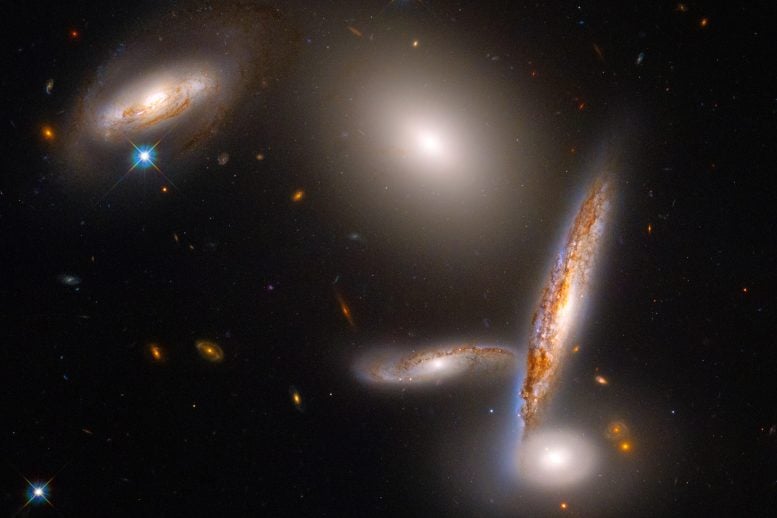
NASA’s Hubble captured Hickson Compact Group 40, a tight group of galaxies that will merge into one. Scientists study the group’s evolution and dark matter interactions.
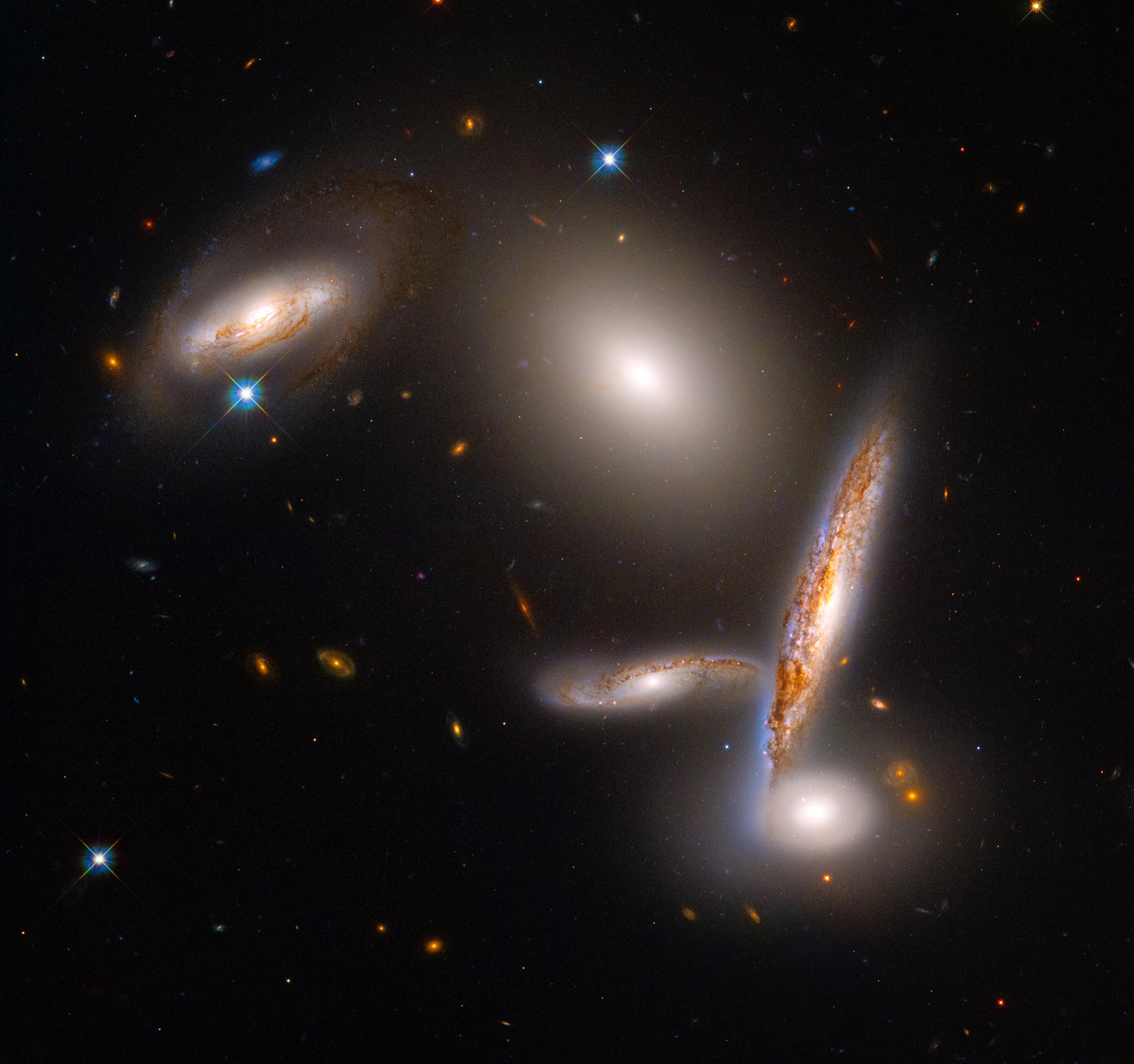
NASA is celebrating the Hubble Space Telescope’s 32nd birthday with a spectacular look at The Hickson Compact Group 40, an unusual close-knit collection of five galaxies.
This menagerie includes three spiral-shaped galaxies, an elliptical galaxy, and a lenticular (lens-like) galaxy. Somehow, these different galaxies crossed paths in their evolution to create an exceptionally crowded and eclectic galaxy sampler.
Gravitational Dance and Dark Matter Influence
Caught in a leisurely gravitational dance, the whole group is so crowded that it could fit within a region of space that is less than twice the diameter of our Milky Way’s stellar disk.
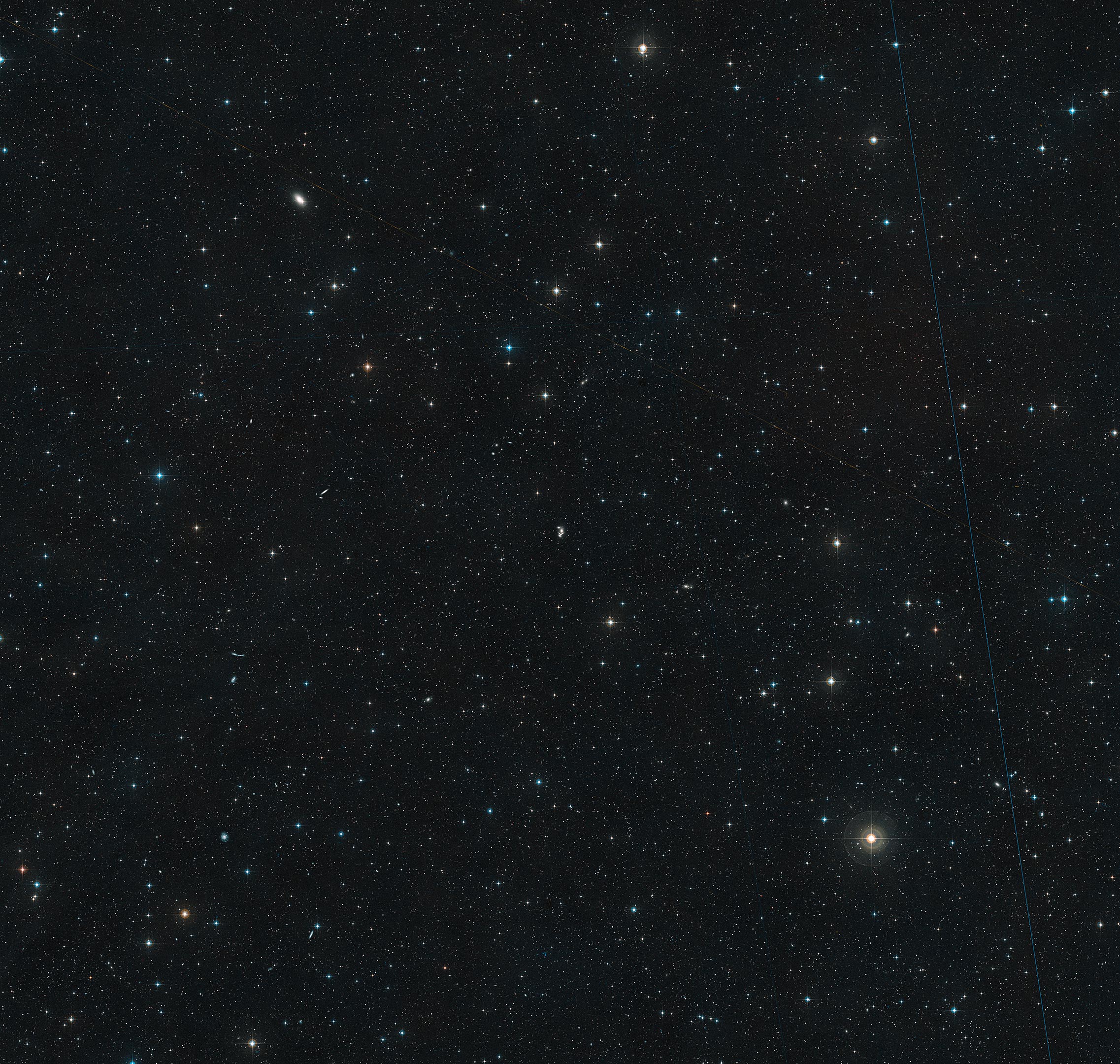
Though such cozy galaxy groupings can be found in the heart of huge galaxy clusters, these galaxies are notably isolated in their own small patch of the universe, in the direction of the constellation Hydra.
NASA is commemorating the Hubble Space Telescope’s 32nd birthday with a breathtaking view of five galaxies known as the Hickson Compact Group 40. This amazing assembly includes a giant elliptical galaxy, glowing with blended light from billions of stars. Several spiral galaxies show prominent dusty lanes that outline their winding spiral arms, regions where star formation is active. We see one galaxy oriented edge-on, showing off its prominent dust along its flattened starry disk. Credit: NASA’s Goddard Space Flight Center
One possible explanation is that there’s a lot of dark matter (an unknown and invisible form of matter) associated with these galaxies. If they come close together, then the dark matter can form a big cloud within which the galaxies are orbiting. As the galaxies plow through the dark matter they feel a resistive force due to its gravitational effects. This slows their motion and makes the galaxies lose energy, so they fall together.
Therefore, this snapshot catches the galaxies at a very special moment in their lifetimes. In about 1 billion years they will eventually collide and merge to form a giant elliptical galaxy.
Astronomers have studied this compact galaxy group not only in visible light, but also in radio, infrared, and X-ray wavelengths. Almost all of them have a compact radio source in their cores, which could be evidence for the presence of supermassive black holes. X-ray observations show that the galaxies have been gravitationally interacting due to the presence of a lot of hot gas among the galaxies. Infrared observations reveal clues to the rate of new star formation.
The Significance of Hickson Compact Group 40
Though over 100 such compact galaxy groups have been cataloged in sky surveys going back several decades, Hickson Compact Group 40 is one of the most densely packed. Observations suggest that such tight groups may have been more abundant in the early universe and provided fuel for powering black holes, known as quasars, whose light from superheated infalling material blazed across space. Studying the details of galaxies in nearby groups like this helps astronomers sort out when and where galaxies assembled themselves, and what they are assembled from.
“I remember seeing this on a sky survey and saying, ‘Wow look at that!'” said Paul Hickson of the University of British Columbia, Vancouver, Canada. “All that I was using at the time was a big plastic ruler and a magnifying glass while looking over sky survey prints.” He re-discovered the group by browsing through a collection of peculiar galaxies first published by Halton Arp in 1966.
Discovery and Legacy of Hubble
Hubble was deployed into orbit around Earth by NASA astronauts aboard the space shuttle Discovery, on April 25, 1990. The telescope has taken 1.5 million observations of approximately 50,000 celestial targets to date. This treasure trove of knowledge about the universe is stored for public access in the Mikulski Archive for Space Telescopes, at the Space Telescope Science Institute in Baltimore, Maryland.
Hubble’s unique capabilities in observing visible and ultraviolet light are a critical scientific complement to the infrared-light observations of the recently launched Webb Space Telescope, which will begin science observations this summer.
For more on this topic, see Celebrating the Hubble Space Telescope’s 32nd Birthday With a Stunning Galaxy Grouping.
The Hubble Space Telescope is a project of international cooperation between NASA and ESA (European Space Agency). NASA’s Goddard Space Flight Center in Greenbelt, Maryland, manages the telescope. The Space Telescope Science Institute (STScI) in Baltimore, Maryland, conducts Hubble science operations. STScI is operated for NASA by the Association of Universities for Research in Astronomy, in Washington, D.C.
Never miss a breakthrough: Join the SciTechDaily newsletter.
Follow us on Google and Google News.