

Highly magnetic neutron star is wandering our Milky Way galaxy.
Astronomers using NASA’s Hubble Space Telescope have tracked a rare and fast-moving magnetar – called SGR 0501+4516 – as it speeds through the Milky Way. Its origin remains unknown, and based on current data, it may be the best evidence yet of a magnetar that didn’t form from a supernova explosion, as most are thought to do.
Only about 30 magnetars are known to exist in our galaxy. These unusual objects are a type of neutron star — the ultra-dense core left behind after a massive star dies. What makes magnetars unique is their incredibly powerful magnetic fields, which can be up to a trillion times stronger than Earth’s.
If one came within half the distance of the Moon, its magnetic field would be strong enough to erase every credit card on Earth. And if a person got within 600 miles, the magnetar’s extreme forces would tear apart the very atoms in their body.
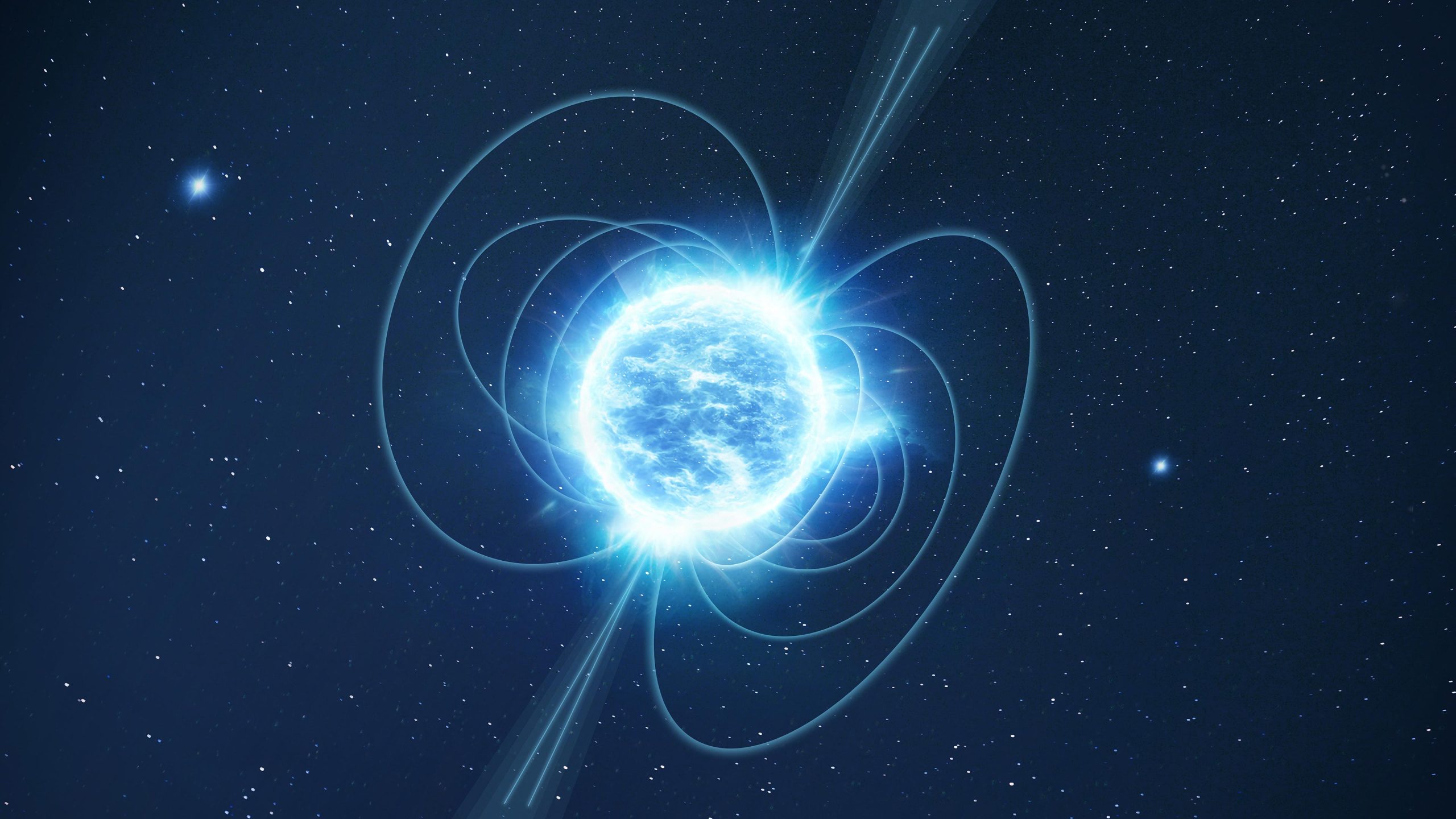
NASA’s Hubble Tracks a Roaming Magnetar of Unknown Origin
Using NASA’s Hubble Space Telescope, astronomers have tracked a rare and fast-moving magnetar named SGR 0501+4516 as it travels through the Milky Way. What makes this object especially intriguing is its mysterious origin. Unlike most magnetars, which are thought to form in supernova explosions, this one shows no clear connection to any known supernova remnant – making it a strong candidate for having formed through a different, more unusual process. Its strange nature could even help scientists understand fast radio bursts – brief, powerful flashes of radio waves that remain one of astronomy’s biggest mysteries.
“Magnetars are neutron stars – the dead remnants of stars – composed entirely of neutrons. What makes magnetars unique is their extreme magnetic fields,” said Ashley Chrimes, lead author of the discovery paper published in the April 15 journal Astronomy & Astrophysics. Chrimes is a European Space Agency Research Fellow at the European Space Research and Technology Center in the Netherlands.
A Magnetic Force of Nature
These fields are no joke — a magnetar’s magnetic force can be up to a trillion times stronger than Earth’s. If one passed within half the distance of the Moon, its magnetic field could erase every credit card on Earth. And if a person came within 600 miles of it, the magnetar’s extreme forces would literally tear atoms apart.
The magnetar’s strangeness was identified with the help of Hubble’s sensitive instruments as well as precise benchmarks from ESA’s (European Space Agency) Gaia spacecraft.
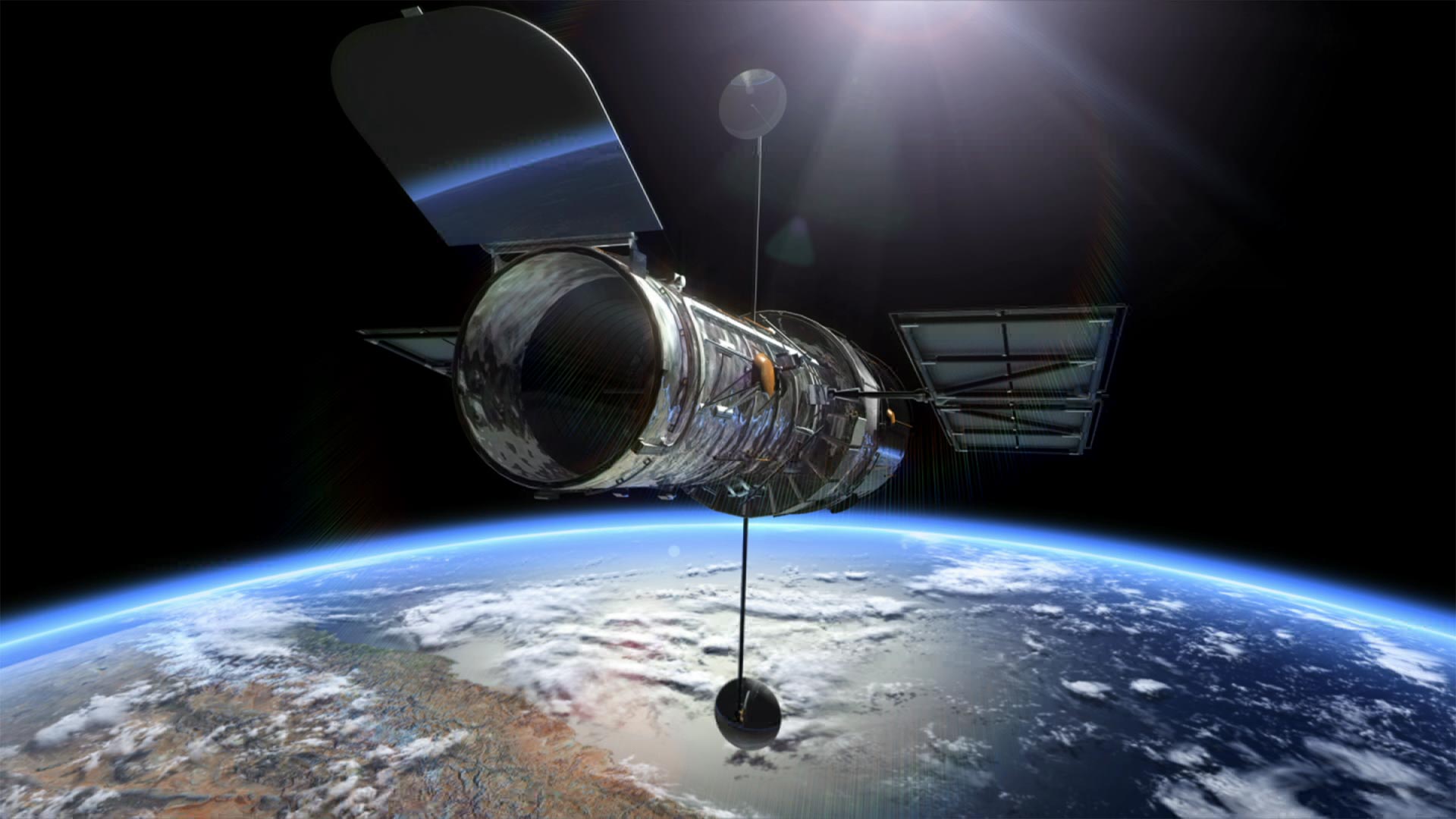
First Glimpses of a Galactic Mystery
Initially, the mysterious magnetar was discovered in 2008 when NASA’s Swift Observatory spotted brief, intense flashes of gamma rays from the outskirts of the Milky Way. The source, which turned out to be one of only about 30 known magnetars in the Milky Way, was dubbed SGR 0501+4516.
Because magnetars are neutron stars, the natural explanation for their formation is that they are born in supernovae, when a star explodes and can collapse down to an ultra-dense neutron star. This appeared to be the case for SGR 0501+4516, which is located close to a supernova remnant called HB9. The separation between the magnetar and the center of the supernova remnant on the sky is just 80 arcminutes, or slightly wider than your pinky finger when viewed at the end of your outstretched arm.
A Decade of Hubble Observations
But a decade-long study with Hubble cast doubt on the magnetar’s birthplace. After initial observations with ground-based telescopes shortly after SGR 0501+4516’s discovery, researchers used Hubble’s exquisite sensitivity and steady pointing to spot the magnetar’s faint infrared glow in 2010, 2012, and 2020. Each of these images was aligned to a reference frame defined by observations from the Gaia spacecraft, which has crafted an extraordinarily precise three-dimensional map of nearly two billion stars in the Milky Way. This method revealed the subtle motion of the magnetar as it traversed the sky.
“All of this movement we measure is smaller than a single pixel of a Hubble image,” said co-investigator Joe Lyman of the University of Warwick, United Kingdom. “Being able to robustly perform such measurements really is a testament to the long-term stability of Hubble.”
The Motion That Changed Everything
By tracking the magnetar’s position, the team was able to measure the object’s apparent motion across the sky. Both the speed and direction of SGR 0501+4516’s movement showed that the magnetar could not be associated with the nearby supernova remnant. Tracing the magnetar’s trajectory thousands of years into the past showed that there were no other supernova remnants or massive star clusters with which it could be associated.
If SGR 0501+4516 was not born in a supernova, the magnetar must either be older than its estimated 20,000-year age, or it may have formed in another way. Magnetars may also be able to form through the merger of two lower-mass neutron stars or through a process called accretion-induced collapse. Accretion-induced collapse requires a binary star system containing a white dwarf: the core of a dead Sun-like star. If the white dwarf pulls in gas from its companion, it can grow too massive to support itself, leading to an explosion — or possibly the creation of a magnetar.
A Radical Rebirth
“Normally, this scenario leads to the ignition of nuclear reactions, and the white dwarf exploding, leaving nothing behind. But it has been theorized that under certain conditions, the white dwarf can instead collapse into a neutron star. We think this might be how SGR 0501 was born,” added Andrew Levan of Radboud University in the Netherlands and the University of Warwick in the United Kingdom.
A Clue to Cosmic Flashes
SGR 0501+4516 is currently the best candidate for a magnetar in our galaxy that may have formed through a merger or accretion-induced collapse. Magnetars that form through accretion-induced collapse could provide an explanation for some of the mysterious fast radio bursts, which are brief but powerful flashes of radio waves. In particular, this scenario may explain the origin of fast radio bursts that emerge from stellar populations too ancient to have recently birthed stars massive enough to explode as supernovae.
“Magnetar birth rates and formation scenarios are among the most pressing questions in high-energy astrophysics, with implications for many of the universe’s most powerful transient events, such as gamma-ray bursts, super-luminous supernovae, and fast radio bursts,” said Nanda Rea of the Institute of Space Sciences in Barcelona, Spain.
What Comes Next
The research team has further Hubble observations planned to study the origins of other magnetars in the Milky Way, helping to understand how these extreme magnetic objects form.
Reference: “The infrared counterpart and proper motion of magnetar SGR 0501+4516” by A. A. Chrimes, A. J. Levan, J. D. Lyman, A. Borghese, V. S. Dhillon, P. Esposito, M. Fraser, A. S. Fruchter, D. Götz, R. A. Hounsell, G. L. Israel, C. Kouveliotou, S. Mereghetti, R. P. Mignani, R. Perna, N. Rea, I. Skillen, D. Steeghs, N. R. Tanvir, K. Wiersema, N. J. Wright and S. Zane, 15 April 2025, Astronomy & Astrophysics.
DOI: 10.1051/0004-6361/202453479
The Hubble Space Telescope is one of the most powerful and influential astronomical observatories ever built. Launched in 1990, it has been operating for more than 30 years and continues to deliver groundbreaking discoveries that reshape our understanding of the universe. Hubble is a joint project between NASA and the European Space Agency (ESA), reflecting decades of international collaboration. Managed by NASA’s Goddard Space Flight Center in Maryland – with operational support from Lockheed Martin Space and scientific coordination from the Space Telescope Science Institute in Baltimore—Hubble has captured some of the most iconic images in astronomy and provided crucial insights into everything from the age of the universe to the behavior of black holes and distant galaxies.
Never miss a breakthrough: Join the SciTechDaily newsletter.
Follow us on Google and Google News.