
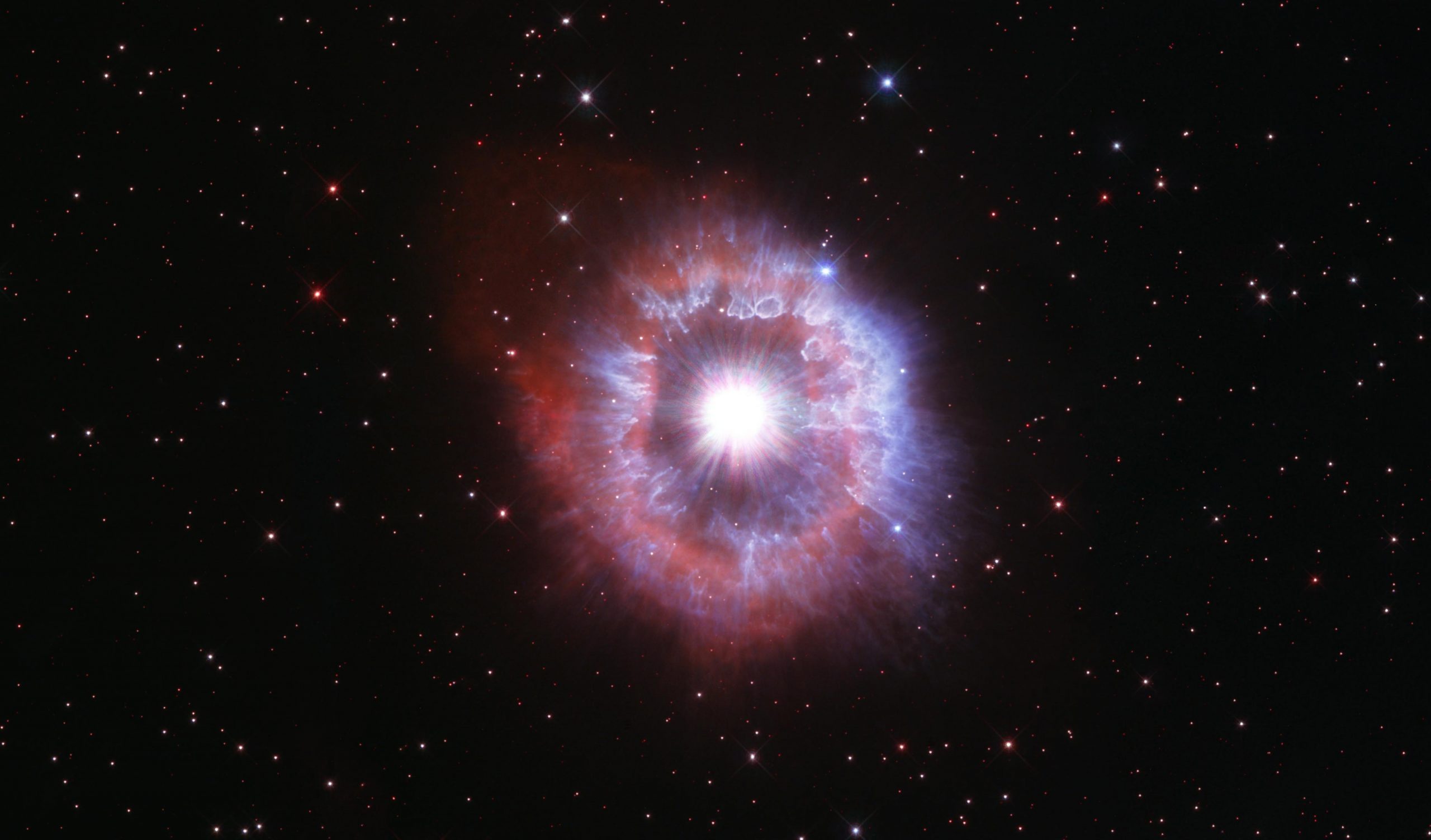
Petulant Star Ejects Spectacular Bubble of Glowing Gases
The mighty blue giant AG Carinae is not your normal star. One of the brightest stars in our Milky Way galaxy, AG Carinae is sizzling hot, shining with the brilliance of 1 million suns. You would need super sunscreen if you lived in the star’s vicinity. The star is up to 70 times heftier than our Sun and burns fuel at a ferocious rate.
Its opulence means that the mammoth star is living life in the fast lane. Pouring out so much energy takes a toll on the stellar behemoth. It is prone to convulsive fits, expanding in size like a hot air balloon and shedding its outer layers of material into space. One or more giant eruptions 10,000 years ago created the beautiful, expanding shell of dust and gas seen here. Stars like this one are rare: less than 50 reside in our local group of neighboring galaxies.
The Hubble Space Telescope snapped an image of this particularly large outburst to commemorate the 31st anniversary of the Earth-orbiting observatory’s launch into space.
In celebration of the 31st anniversary of the launching of NASA’s Hubble Space Telescope on April 24, 1990, astronomers aimed the renowned observatory at a brilliant “celebrity star,” one of the brightest stars seen in our galaxy, surrounded by a glowing halo of gas and dust. Hubble’s senior project scientist, Dr. Jennifer Wiseman, takes us on a tour of this stunning new image, describes the telescope’s current health, and summarizes some of Hubble’s contributions to astronomy from the past year. Credit: NASA’s Goddard Space Flight Center
In celebration of the 31st anniversary of the launching of NASA’s Hubble Space Telescope, astronomers aimed the renowned observatory at a brilliant “celebrity star,” one of the brightest stars seen in our galaxy, surrounded by a glowing halo of gas and dust.
The price for the monster star’s opulence is “living on the edge.” The star, called AG Carinae, is waging a tug-of-war between gravity and radiation to avoid self-destruction.
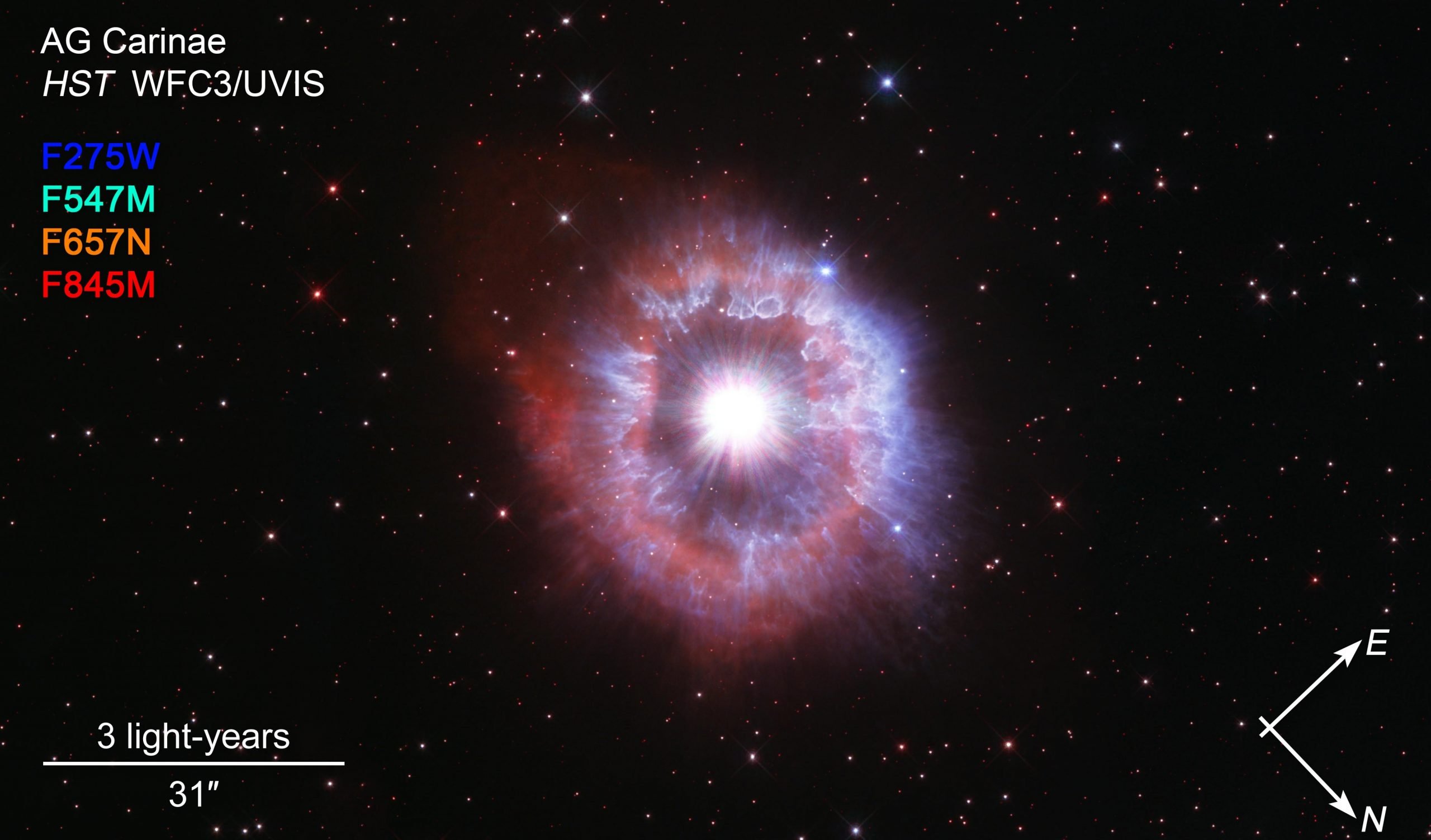
The expanding shell of gas and dust that surrounds the star is about five light-years wide, which equals the distance from here to the nearest star beyond the Sun, Proxima Centauri.
The huge structure was created from one or more giant eruptions about 10,000 years ago. The star’s outer layers were blown into space—like a boiling teapot popping off its lid. The expelled material amounts to roughly 10 times our Sun’s mass.
The Tempestuous Nature of Luminous Blue Variables
These outbursts are the typical life of a rare breed of star called a luminous blue variable, a brief convulsive phase in the short life of an ultra-bright, glamorous star that lives fast and dies young. These stars are among the most massive and brightest stars known. They live for only a few million years, compared to the roughly 10-billion-year lifetime of our Sun. AG Carinae is a few million years old and resides 20,000 light-years away inside our Milky Way galaxy.
Luminous blue variables exhibit a dual personality: They appear to spend years in quiescent bliss and then they erupt in a petulant outburst. These behemoths are stars in the extreme, far different from normal stars like our Sun. In fact, AG Carinae is estimated to be up to 70 times more massive than our Sun and shines with the blinding brilliance of 1 million suns.
“I like studying these kinds of stars because I am fascinated by their instability. They are doing something weird,” said Kerstin Weis, a luminous blue variable expert at Ruhr University in Bochum, Germany.
This visualization starts with a wide-field view of the Carina constellation and zooms down to the Hubble Space Telescope view of the massive star, AG Carinae. One of the brightest stars in our galaxy, AG Carinae undergoes eruptions that have ejected a small nebula of gas and dust. The sequence then transitions from the 2D Hubble image to a 3D model that shows the structure of the surrounding nebula. The 3D model is based on Hubble images and spectroscopic data of the nebula’s motion. The emission from ionized gas glows red, while the dust reflects the light of the star and appears bluish-white. Credit: Video: NASA, ESA, STScI, Leah Hustak (STScI), Frank Summers (STScI), Alyssa Pagan (STScI), Joseph DePasquale (STScI), Greg T. Bacon (STScI), Music: Joseph DePasquale (STScI)
Major outbursts such as the one that produced the nebula occur once or twice during a luminous blue variable’s lifetime. A luminous blue variable star only casts off material when it is in danger of self-destruction as a supernova. Because of their massive forms and super-hot temperatures, luminous blue variable stars like AG Carinae are in a constant battle to maintain stability.
It’s an arm wrestling contest between radiation pressure from within the star pushing outward and gravity pressing inward. This cosmic match results in the star expanding and contracting. The outward pressure occasionally wins the battle, and the star expands to such an immense size that it blows off its outer layers, like a volcano erupting. But this outburst only happens when the star is on the verge of coming apart. After the star ejects the material, it contracts to its normal size, settles back down, and becomes quiescent for a while.
Shaping a Nebula With Stellar Winds
Like many other luminous blue variables, AG Carinae remains unstable. It has experienced lesser outbursts that have not been as powerful as the one that created the present nebula.
Although AG Carinae is quiescent now, as a super-hot star it continues pouring out searing radiation and powerful stellar wind (streams of charged particles). This outflow continues shaping the ancient nebula, sculpting intricate structures as outflowing gas slams into the slower-moving outer nebula. The wind is traveling at up to 670,000 miles per hour (1 million km/hr), about 10 times faster than the expanding nebula. Over time, the hot wind catches up with the cooler expelled material, plows into it, and pushes it farther away from the star. This “snowplow” effect has cleared a cavity around the star.
The red material is glowing hydrogen gas laced with nitrogen gas. The diffuse red material at upper left pinpoints where the wind has broken through a tenuous region of material and swept it into space.
The most prominent features, highlighted in blue, are filamentary structures shaped like tadpoles and lopsided bubbles. These structures are dust clumps illuminated by the star’s reflected light. The tadpole-shaped features, most prominent at left and bottom, are denser dust clumps that have been sculpted by the stellar wind. Hubble’s sharp vision reveals these delicate-looking structures in great detail.
The image was taken in visible and ultraviolet light. Ultraviolet light offers a slightly clearer view of the filamentary dust structures that extend all the way down toward the star. Hubble is ideally suited for ultraviolet-light observations because this wavelength range can only be viewed from space.
Massive stars, like AG Carinae, are important to astronomers because of their far-reaching effects on their environment. The largest program in Hubble’s history—the Ultraviolet Legacy Library of Young Stars as Essential Standards (ULLYSES)—is studying the ultraviolet light of young stars and the way they shape their surroundings.
Luminous blue variable stars are rare: less than 50 are known among the galaxies in our local group of neighboring galaxies. These stars spend tens of thousands of years in this phase, a blink of an eye in cosmic time. Many are expected to end their lives in titanic supernova blasts, which enrich the universe with heavier elements beyond iron.
Hubble Trivia
- Launched on April 24, 1990, NASA’s Hubble Space Telescope has made more than 1.5 million observations of about 48,000 celestial objects.
- In its 31-year lifetime, the telescope has racked up more than 181,000 orbits around our planet, totaling over 4.5 billion miles (7.2 billion kilometers).
- Hubble observations have produced more than 169 terabytes of data, which are available for present and future generations of researchers.
- Astronomers using Hubble data have published more than 18,000 scientific papers, with more than 900 of those papers published in 2020.
The Hubble Space Telescope is a project of international cooperation between NASA and ESA (European Space Agency). NASA’s Goddard Space Flight Center in Greenbelt, Maryland, manages the telescope. The Space Telescope Science Institute (STScI) in Baltimore, Maryland, conducts Hubble science operations. STScI is operated for NASA by the Association of Universities for Research in Astronomy in Washington, D.C.
Never miss a breakthrough: Join the SciTechDaily newsletter.
Follow us on Google and Google News.
12 Comments
Perhaps it’s too early & my coffee hasn’t kicked in yet. But, in the third picture showing the directions North & East…. If I’m facing north, how can east be on my left?
Stars are inanimate objects and do not “battle to maintain stability”. Can you tone it down maybe 20 or 30 notches?
Babu G. Ranganathan*
(B.A. Bible/Biology)
JUST BECAUSE SCIENCE CAN EXPLAIN how an airplane works doesn’t mean that no one designed or made the airplane. And just because science can explain how life or the universe works doesn’t mean there was no Designer and Maker behind them.
Natural laws may explain how the order in the universe works and operates, but mere undirected natural laws cannot explain the origin of that order. Once you have a complete and living cell then the genetic code and biological machinery exist to direct the formation of more cells from raw materials such as amino acids and other chemicals, but how could life or the cell have naturally originated when no directing code and mechanisms existed in nature? Read my Internet article: HOW FORENSIC SCIENCE REFUTES ATHEISM.
WHAT IS SCIENCE? Science simply is knowledge based on observation. No human observed the universe coming by chance or by design, by creation or by evolution. These are positions of faith. The issue is which faith the scientific evidence best supports.
SCIENCE SHOWS THAT THE UNIVERSE CANNOT BE ETERNAL because it could not have sustained itself eternally due to the law of entropy (increasing and irreversible net energy decay, even in an open system). Even a hypothetical oscillating universe could not continue to oscillate eternally! Einstein’s General Theory of Relativity shows that space, matter, and time all are physical and all had a beginning. Space even produces particles because it’s actually something, not nothing. What about the Higgs boson (the so-called “God Particle”)? The Higgs boson, even if it existed, would not have created mass from nothing, but rather it would have converted energy into mass. Einstein showed that all matter is some form of energy. Even time had a beginning! Time is not eternal.
The law of entropy doesn’t allow the universe to be eternal. If the universe were eternal, everything, including time (which modern science has shown is as physical as mass and space), would have become totally entropied by now and the entire universe would have ended in a uniform heat death a long, long time ago. The fact that this hasn’t happened already is powerful evidence for a beginning to the universe.
Popular atheistic scientist Stephen Hawking admits that the universe had a beginning and came from nothing but he believes that nothing became something by a natural process yet to be discovered. That’s not rational thinking at all, and it also would be making the effect greater than its cause to say that nothing created something. The beginning had to be of supernatural origin because science teaches us from the First Law of Thermodynamics that natural laws and processes do not have the ability to bring something into existence from nothing.
The supernatural origin of the universe cannot be proved by science but science points to a supernatural intelligence and power for the origin and order of the universe. Where did God come from? Obviously, unlike the universe, God’s nature doesn’t require a beginning.
The disorder in the universe can be explained because of chance and random processes, but the order can be explained only because of intelligence and design.
Gravity may explain how the order found in the precise and orderly courses of thousands of billions of stars is maintained, but gravity cannot explain the origin of that order.
Some evolutionary astronomers believe that trillions of stars crashed into each other leaving surviving stars to find precise orderly orbits in space. Not only is this irrational, but if there was such a mass collision of stars then there would be a super mass residue of gas clouds in space to support this hypothesis. The present level of residue of gas clouds in space doesn’t support the magnitude of star deaths required for such a hypothesis. And, as already stated, the origin of stars cannot be explained by the Big Bang because of the reasons mentioned above. It’s one thing to say that stars may decay and die into random gas clouds, but it is totally different to say that gas clouds form into stars.
Even the father of Chaos theory admitted that the “mechanisms” existing in the non-living world allow for only very rudimentary levels of order to arise spontaneously (by chance), but not the kind or level of order we find in the structures of DNA, RNA, and proteins. Yes, individual amino acids have been shown to come into existence by chance but not protein molecules which require that the various amino acids be in a precise sequence just like the letters found in a sentence.
Some things don’t need experiment or scientific proof. In law there is a dictum called prima facie evidence. It means “evidence that speaks for itself.”
An example of a true prima facie would be if you discovered an elaborate sand castle on the beach. You don’t have to experiment to know that it came by design and not by the chance forces of wind and water.
If you discovered a romantic letter or message written in the sand, you don’t have to experiment to know that it was by design and not because a stick randomly carried by wind put it there. You naturally assume that an intelligent and rational being was responsible.
It’s interesting that Carl Sagan would have acknowledged sequential radio signals in space as evidence of intelligent life sending them, but he wouldn’t acknowledge the sequential structure of molecules in DNA (the genetic code) as evidence of an intelligent Cause. Read my popular Internet article, HOW DID MY DNA MAKE ME.
I encourage all to read my popular Internet articles:
NATURAL LIMITS TO EVOLUTION
HOW FORENSIC SCIENCE REFUTES ATHEISM
Visit my latest Internet site: THE SCIENCE SUPPORTING CREATION (This site answers many arguments, both old and new, that have been used by evolutionists to support their theory)
Author of popular Internet article, TRADITIONAL DOCTRINE OF HELL EVOLVED FROM GREEK ROOTS
*I have given successful lectures (with question and answer period afterwards) defending creation before evolutionist science faculty and students at various colleges and universities. I’ve been privileged to be recognized in the 24th edition of Marquis “Who’s Who in The East” for my writings on religion and science.
Nice try. But science itself is fake. God created all things. Man thinks he is is wise. Wisdom comes from fearing God.
To much CGI fakery for the dumbed down masses eyes. Wake up
Btw. The disorder of the universe is not disorder at all because we do not live on a spinning marble. We have water above and below us and NASA the great decievers dam well knows this along with all the Elite decievers. Its Solid above us. Order out of choas is their motto. Gain some wisdom. Seek God and he will open your eyes to the deception we are being fed in a daily basis.
Dude, you need to upgrade your code. GPT-3 obsoleted Markov word salad.
You have some nice points, and we agree that science is built on top of some greater truth that cannot be known. But you seem to be arguing that this ignorance deserves to be treated with faith. Why? The inability to explain the origins of natural laws doesn’t at all mean that a person should start entertaining superstition or inventing answers. We can practice science – and also live our lives – without needing to know everything.
God.
God.
@DJQ:You look at the sky from below, so the compass points appear to be mirrored. If you lie on your back with your head pointing north, east is indeed on your left.
There is no designer. If you want to believe that there is, then please go ahead. Belief?
A human concept to explain the unexplainable, having a feeling, emotions, soul, whatever you like to call it. No one has the answer as yet so let’s turn back to what our ancestors came up with and trust in their conclusions. They wrote books and made sure everyone must read them, they can be interpreted in many ways so keeping their relevance alive. Now many are convinced these are the answers but still there is debate.
Why the debate?
No answer of course, that’s it!
There’s no reason for an answer, it’s just humans looking for an answer.
This universe you see briefly and then you don’t. A sun is born, shines, then dies.
More to come…
Two things:
1: For the more quasi-religious commenters, scientific facts are true even if you don’t believe in them. The fact that you won’t acknowledge them matters not at all to the universe and the natural laws that govern it. We may not have a clear picture of the whole yet but so far we seem to be on the right track. No grand design needed.
2: Drop a plate and let it shatter on the floor, then wait for it to reassemble itself. It may indeed happen but has never ever happened so far. So which is more likely, that somehow reality is wrong or that you are?