
2D Materials Combine, Becoming Polarized and Giving Rise to Photovoltaic Effect
For the first time, researchers have discovered a way to obtain polarity and photovoltaic behavior from certain nonphotovoltaic, atomically flat (2D) materials. The key lies in the special way in which the materials are arranged. The resulting effect is different from, and potentially superior to, the photovoltaic effect commonly found in solar cells.
Solar power is considered a key technology in the move away from fossil fuels. Researchers continually innovate more efficient means to generate solar energy. And many of these innovations come from the world of materials research. Research Associate Toshiya Ideue from the University of Tokyo’s Department of Applied Physics and his team are interested in the photovoltaic properties of 2D materials and their interfaces where these materials meet.
“Quite often, interfaces of multiple 2D materials exhibit different properties to the individual crystals alone,” said Ideue. “We have discovered that two specific materials which ordinarily exhibit no photovoltaic effect do so when stacked in a very particular way.”
Turning Nonpolar Materials into Solar Generators
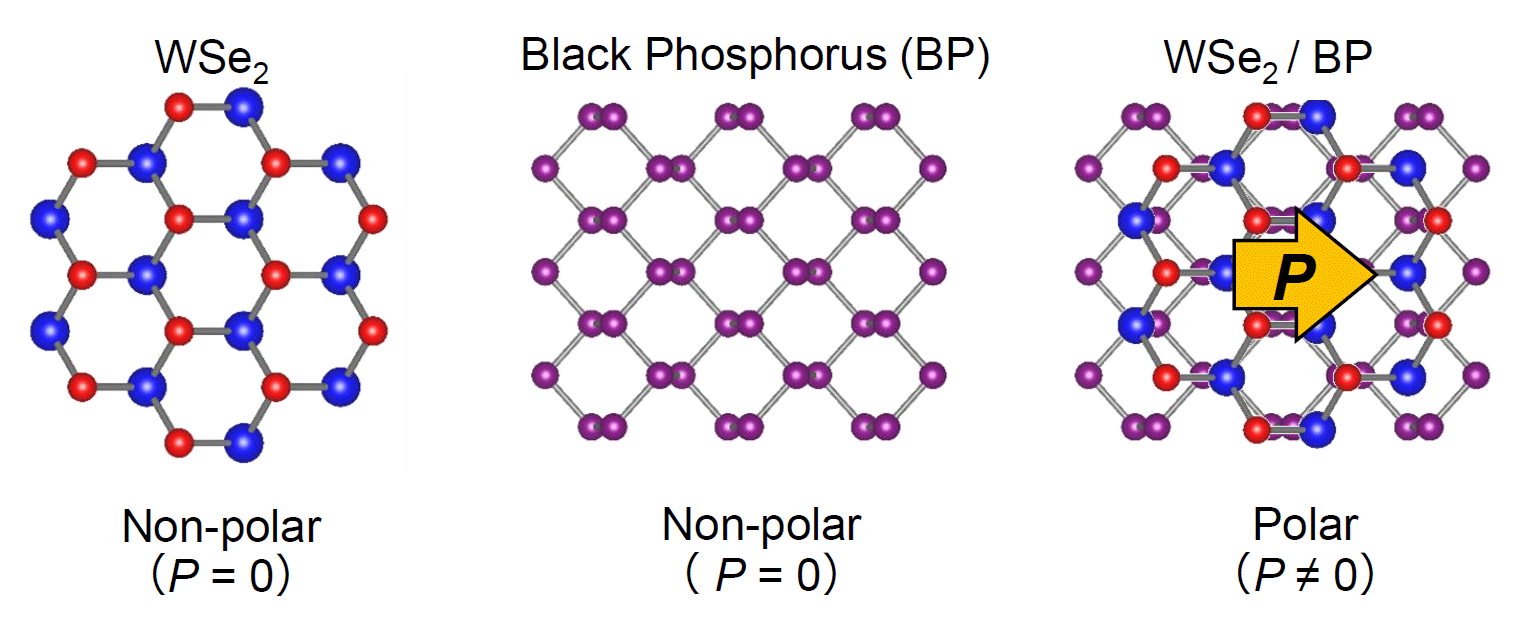
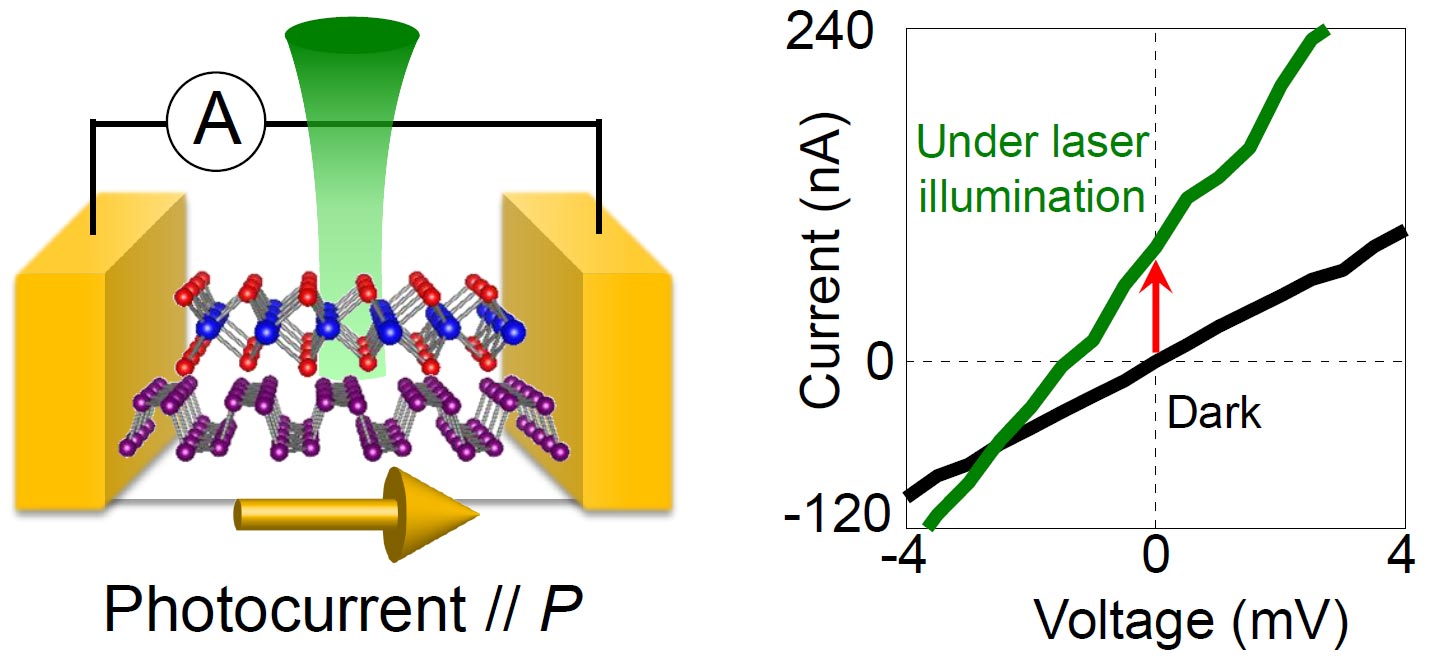
The two materials are tungsten selenide (WSe2) and black phosphorus (BP), both of which have different crystal structures. Originally, both materials are nonpolar (do not have a preferred direction of conduction) and do not generate a photocurrent under light. However, Ideue and his team found that by stacking sheets of WSe2 and BP together in the right way, the sample exhibited polarization, and when a light was cast on the material, it generated a current. The effect takes place even if the area of illumination is far from the electrodes at either end of the sample; this is different from how the ordinary photovoltaic effect works.
Key to this behavior is the way the WSe2 and BP are aligned. The crystalline structure of BP has reflective, or mirror, symmetry in one plane, whereas WSe2 has three lines of mirror symmetry. When the symmetry lines of the materials align, the sample gains polarity. This kind of layer stacking is delicate work, but it also reveals to researchers new properties and functions that could not be predicted just by looking at the ordinary form of the materials.
“The biggest challenge for us will be to find a good combination of 2D materials with higher electric-generation efficiency and also to study the effect of changing the angles of the stacks,” said Ideue. “But it’s so rewarding to discover never-before-seen emergent properties of materials. Hopefully, one day this research could improve solar panels. We would like to explore more unprecedented properties and functionalities in nanomaterials.”
Reference: “A van der Waals interface that creates in-plane polarization and a spontaneous photovoltaic effect” by Takatoshi Akamatsu, Toshiya Ideue, Ling Zhou, Yu Dong, Sota Kitamura, Mao Yoshii, Dongyang Yang, Masaru Onga, Yuji Nakagawa, Kenji Watanabe, Takashi Taniguchi, Joseph Laurienzo, Junwei Huang, Ziliang Ye, Takahiro Morimoto, Hongtao Yuan and Yoshihiro Iwasa, 2 April 2021, Science.
DOI: 10.1126/science.aaz9146
Funding: JSPS Grants-in-Aid for Scientific Research, A3 Foresight Program, Grant-in-Aid for Challenging Research (Exploratory), Grant-in-Aid for Scientific Research on Innovative Areas, Grants-in-Aid for Scientific Re
Never miss a breakthrough: Join the SciTechDaily newsletter.
Follow us on Google and Google News.
2 Comments
artificial solar panels on electronics desktop computers and laptops and mobile devices wireless recharging the batteries.
Great job to all. Now let’s not pass up on my thoughtful insights due to poverty and our current covid outbreaks by missing out on this. I just seen a post similar to mine with a solid nonocrystal that when in concrete is able to conduct heat. I’ve been holding out for gready reasons to pay back school for one but putting this aside, let’s all advance together. OK ok putting crystals in paint as a flake of sorts and charging its structure to form a link before the dry process will allow us to have a simi layer for separation in say positive on one side and negative on the other. Batteries then can be put on one side in this chain linked system with the solar panel array on the outer structure. Ya simple for electronics, charging systems, especially the hungry vehicles to be at higher than normal speeds to date as seen in the skys.
Engineer Now?