
The Red Hypergiant VY Canis Majoris Is Enshrouded in Huge Clouds of Dust
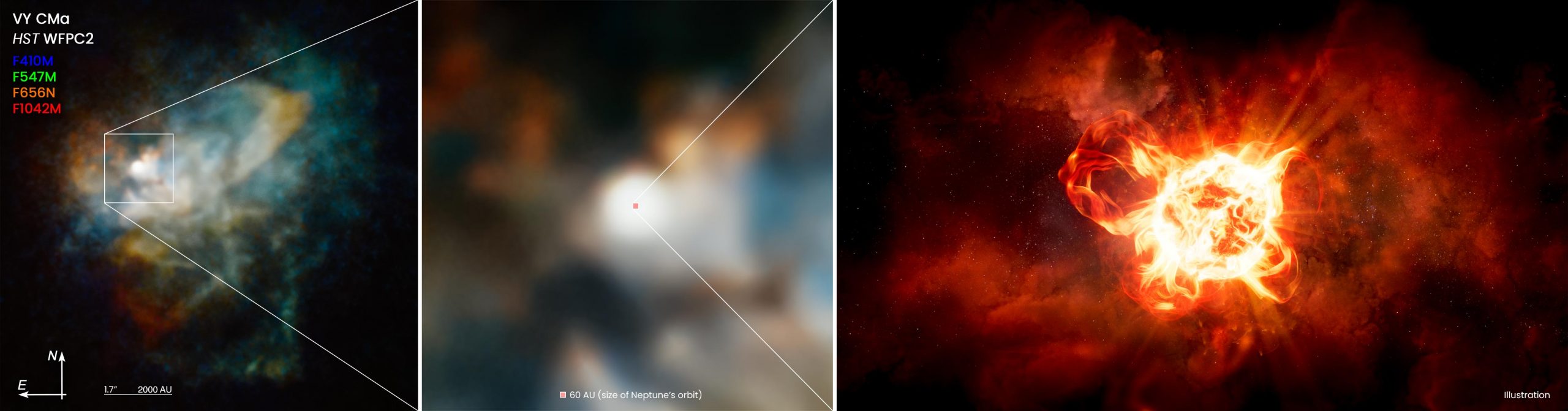
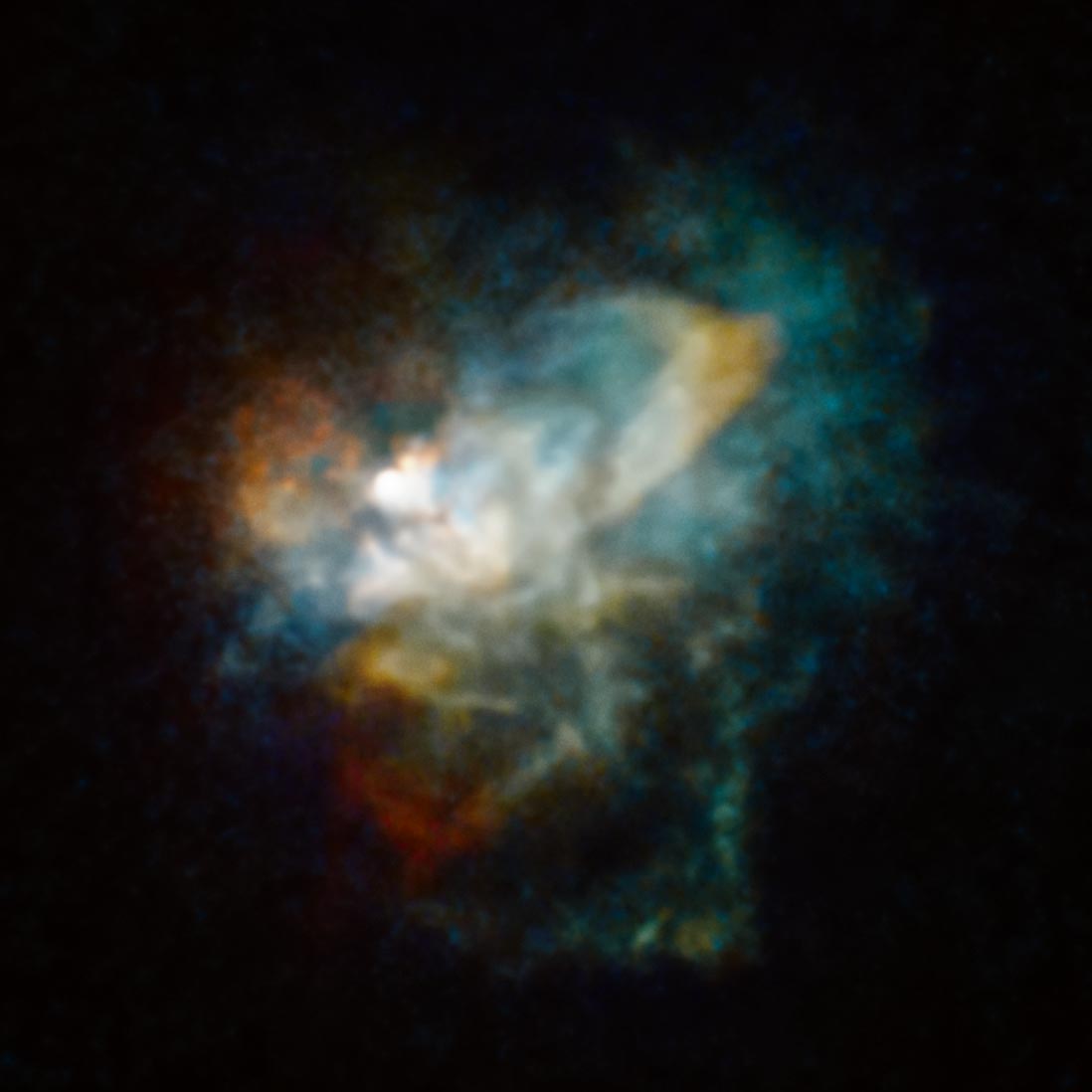
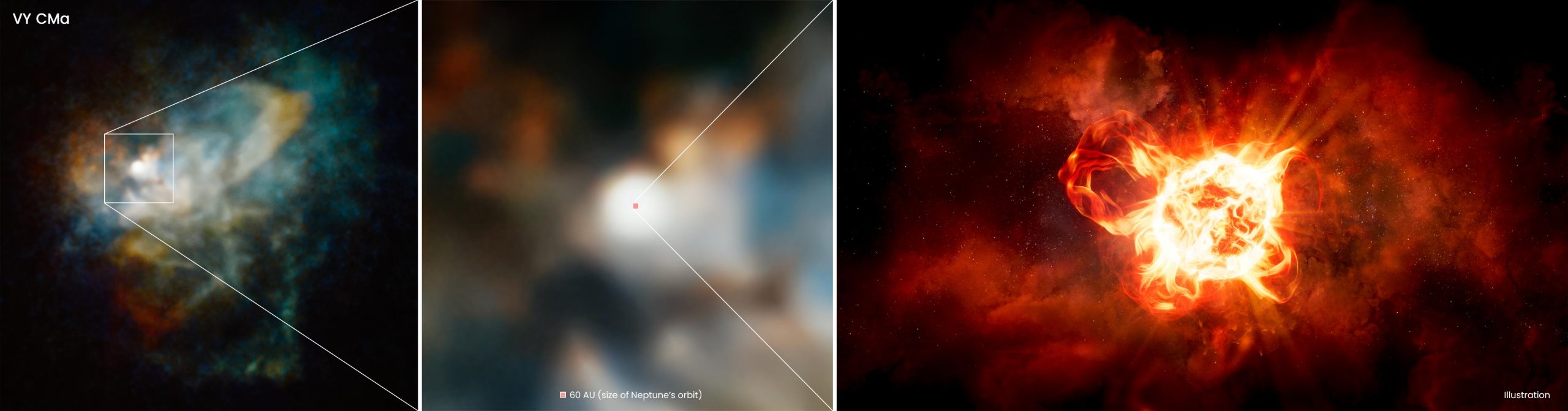
Stars come in an extraordinary range of sizes. One of the most colossal is VY Canis Majoris. If placed in the middle of our solar system it would engulf all the planets out to Saturn’s orbit. This monster, appropriately called a red hypergiant, is as bright as 300,000 Suns. Yet it is so far away that, 200 years ago, it could be seen only as a faint star in the winter constellation of the Great Dog. Since then, it has faded and is no longer visible to the naked eye. Astronomers used Hubble to get a close-up look at the star and discovered the reason for the dimming. The star is expelling huge clouds of dust in the final stages of its life. Eventually, the bloated star may explode as a supernova, or may simply collapse and form a black hole.
Last year, astronomers were puzzled when Betelgeuse, the bright red supergiant star in the constellation Orion, dramatically faded, but then recovered. The dimming lasted for weeks. Now, astronomers have turned their sights toward a monster star in the adjoining constellation Canis Major, the Great Dog.
The red hypergiant VY Canis Majoris—which is far larger, more massive, and more violent than Betelgeuse—experiences much longer, dimmer periods that last for years. New findings from NASA’s Hubble Space Telescope suggest the same processes that occurred on Betelgeuse are happening in this hypergiant, but on a much grander scale.
“VY Canis Majoris is behaving a lot like Betelgeuse on steroids,” explained the study’s leader, astrophysicist Roberta Humphreys of the University of Minnesota, Minneapolis.
As with Betelgeuse, Hubble data suggest the answer for why this bigger star is dimming. For Betelgeuse, the dimming corresponded to a gaseous outflow that may have formed dust, which briefly obstructed some of Betelgeuse’s light from our view, creating the dimming effect.
“In VY Canis Majoris we see something similar, but on a much larger scale. Massive ejections of material which correspond to its very deep fading, which is probably due to dust that temporarily blocks light from the star,” said Humphreys.
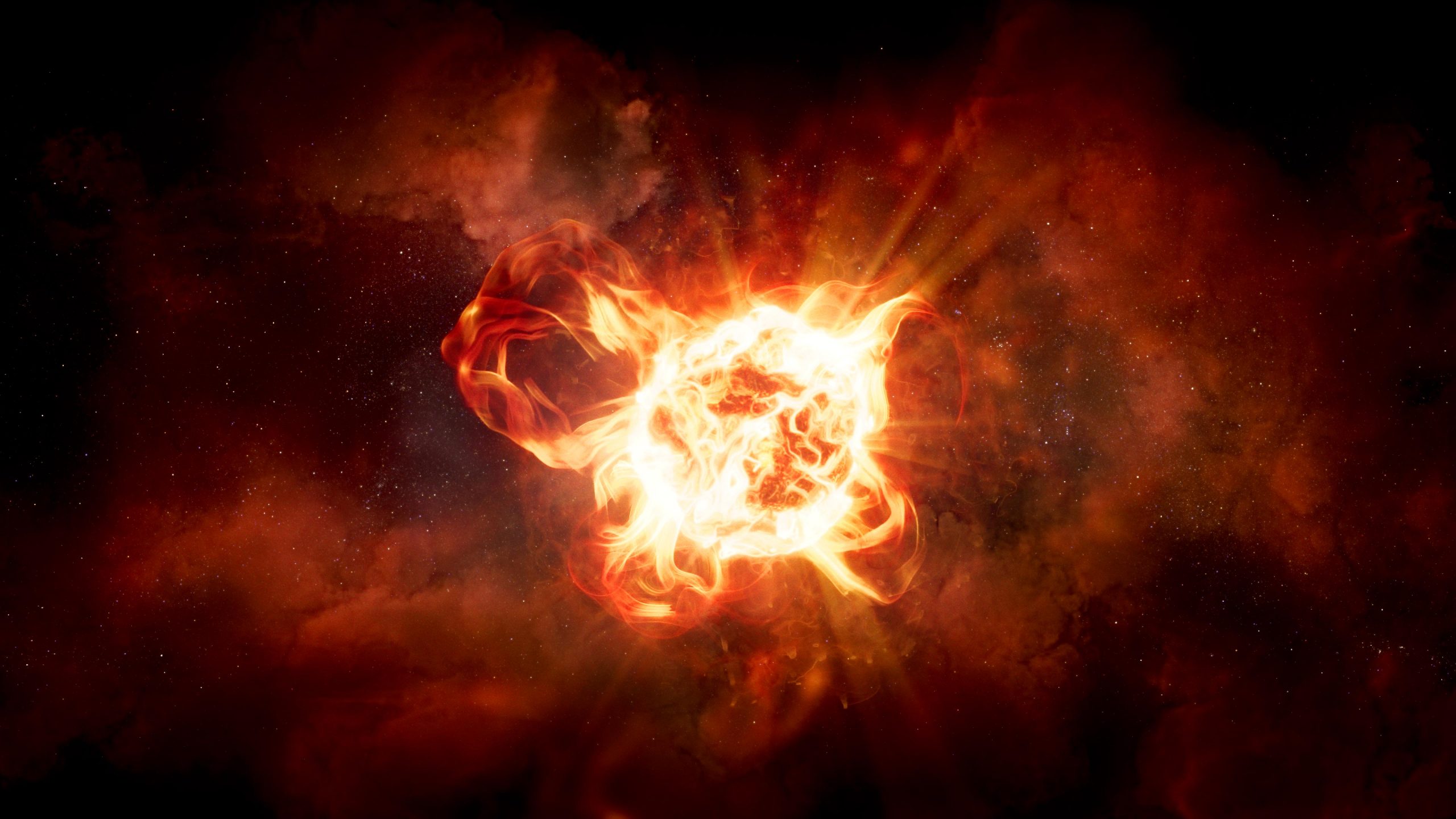
The enormous red hypergiant is 300,000 times brighter than our Sun. If it replaced the Sun in our own solar system, the bloated monster would extend out for hundreds of millions of miles, between the orbits of Jupiter and Saturn.
“This star is absolutely amazing. It’s one of the largest stars that we know of—a very evolved, red supergiant. It has had multiple, giant eruptions,” explained Humphreys.
Giant arcs of plasma surround the star at distances from it that are thousands of times farther away than the Earth is from the Sun. These arcs look like the solar prominences from our own Sun, only on a much grander scale. Also, they’re not physically connected to the star, but rather, appear to have been thrown out and are moving away. Some of the other structures close to the star are still relatively compact, looking like little knots and nebulous features.
Eruptions Through the Centuries
In previous Hubble work, Humphreys and her team were able to determine when these large structures were ejected from the star. They found dates ranging over the past several hundred years, some as recently as the past 100 to 200 years.
Now, in new work with Hubble, researchers resolved features much closer to the star that may be less than a century old. By using Hubble to determine the velocities and motions of the close-in knots of hot gas and other features, Humphreys and her team were able to date these eruptions more accurately. What they found was remarkable: many of these knots link to multiple episodes in the 19th and 20th centuries when VY Canis Majoris faded to one-sixth its usual brightness.
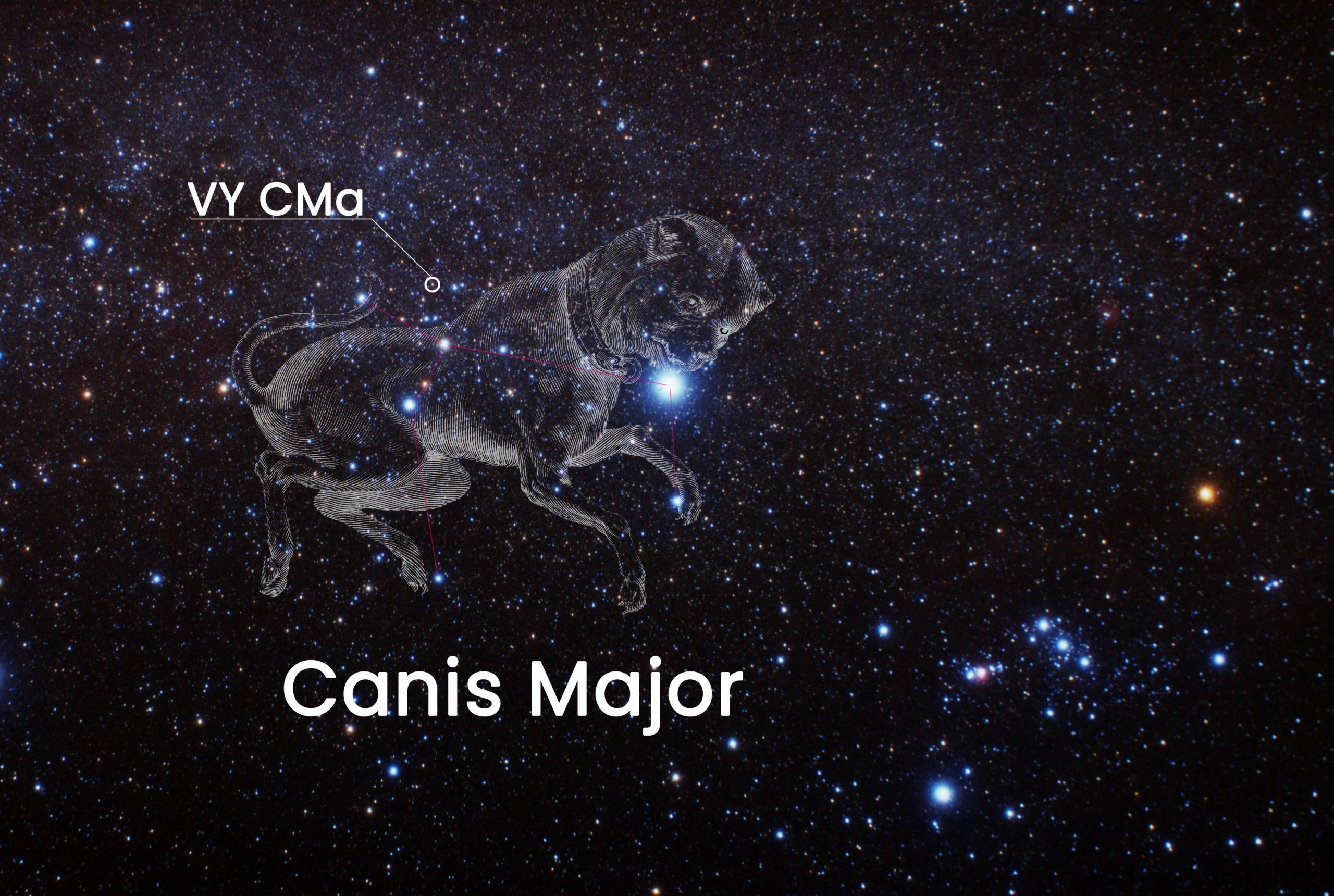
Unlike Betelgeuse, VY Canis Majoris is now too faint to be seen by the naked eye. The star was once visible but has dimmed so much that it can now only be seen with telescopes.
The hypergiant sheds 100 times as much mass as Betelgeuse. The mass in some of the knots is more than twice the mass of Jupiter. “It’s amazing the star can do it,” Humphreys said. “The origin of these high mass-loss episodes in both VY Canis Majoris and Betelgeuse is probably caused by large-scale surface activity, large convective cells like on the Sun. But on VY Canis Majoris, the cells may be as large as the whole Sun or larger.”
“This is probably more common in red supergiants than scientists thought and VY Canis Majoris is an extreme example,” Humphreys continued. “It may even be the main mechanism that’s driving the mass loss, which has always been a bit of a mystery for red supergiants.”
A Star in a Unique Evolutionary Phase
Though other red supergiants are comparably bright and eject a lot of dust, none of them is as complex as VY Canis Majoris. “So what’s special about it? VY Canis Majoris may be in a unique evolutionary state that separates it from the other stars. It’s probably this active over a very short period, maybe only a few thousand years. We’re not going to see many of those around,” said Humphreys.
The star began life as a super-hot, brilliant, blue supergiant star perhaps as much as 35 to 40 times our Sun’s mass. After a few million years, as the hydrogen fusion burning rate in its core changed, the star swelled up to a red supergiant. Humphreys suspects that the star may have briefly returned to a hotter state and then swelled back up to a red supergiant stage.
“Maybe what makes VY Canis Majoris so special, so extreme, with this very complex ejecta, might be that it’s a second-stage red supergiant,” explained Humphreys. VY Canis Majoris may have already shed half of its mass. Rather than exploding as a supernova, it might simply collapse directly to a black hole.
The team’s findings appear in the February 4, 2021 edition of The Astronomical Journal.
Reference: “The Mass-loss History of the Red Hypergiant VY CMa*” by Roberta M. Humphreys, Kris Davidson, A. M. S. Richards, L. M. Ziurys, Terry J. Jones and Kazunori Ishibashi, 4 February 2021, The Astronomical Journal.
DOI: 10.3847/1538-3881/abd316
The Hubble Space Telescope is a project of international cooperation between NASA and ESA (European Space Agency). NASA’s Goddard Space Flight Center in Greenbelt, Maryland, manages the telescope. The Space Telescope Science Institute (STScI) in Baltimore, Maryland, conducts Hubble science operations. STScI is operated for NASA by the Association of Universities for Research in Astronomy, in Washington, D.C.
Never miss a breakthrough: Join the SciTechDaily newsletter.
Follow us on Google and Google News.