
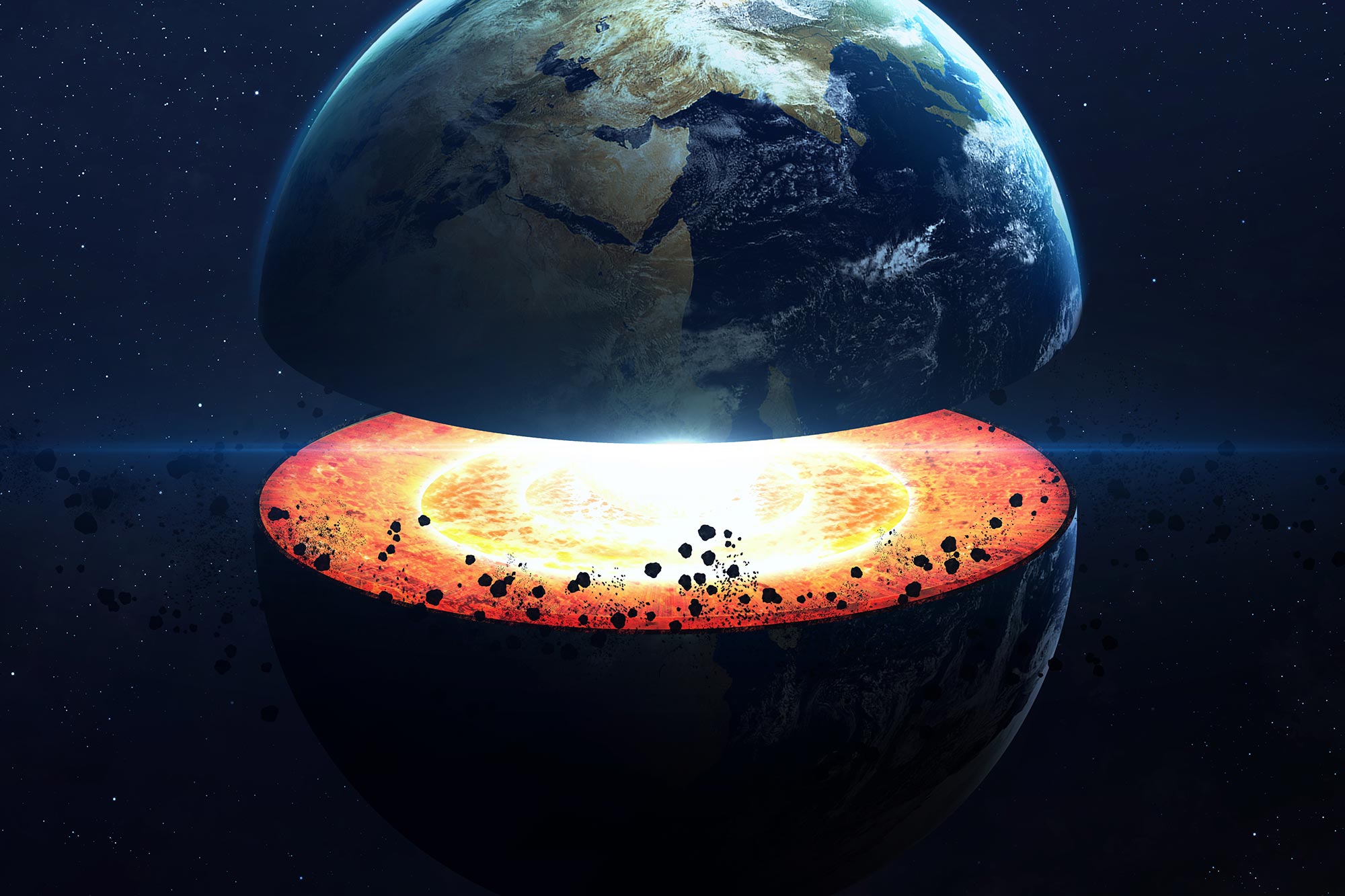
Mysterious seismic signals from massive North Atlantic storms are rippling through Earth’s core and surfacing in remote Australia.
Scientists from the Australian National University (ANU) have discovered that powerful winter storms in the North Atlantic Ocean send energy waves deep through the Earth’s core. This breakthrough could help researchers learn more about the inner workings of our planet and even other worlds in the solar system.
Using two specially designed spiral-shaped sensor arrays, each covering 50 by 50 kilometers in remote parts of Australia, ANU seismologists detected PKP waves. These are a rare type of seismic wave generated by intense cyclones in the North Atlantic. The waves travel all the way through the Earth and reappear in Australia during the southern hemisphere’s summer.
The team pinpointed two key storm zones in Greenland and Newfoundland as the main sources of these deep-traveling waves, which are created by the movement of ocean water against the sea floor.
ANU PhD student and study co-author Abhay Pandey explained that the method of detecting and studying these energetic signals, using technology that was carefully designed and installed in remote Australia, is crucial for detecting core waves and could prove useful in studying other planets.
“This method, particularly in the context of exploring other planets and icy moons, can be used to identify planets with a core, including those that don’t have plate tectonics or volcanoes, as well as planets that don’t experience quakes, providing valuable data for future exploration,” he said.
Seismic Arrays in Remote Australia
Study co-author and ANU seismologist, Professor Hrvoje Tkalčić, added: “If we can land a seismometer array on the surface of a small planet without quakes, the method might be handy for scanning their interiors by using the atmospheric and hidden ocean signals that resemble the ones from our study.
“We used a unique apparatus: two spiral-arm arrays of seismometers that we carefully designed and installed in remote areas of Queensland and Western Australia. We then analyzed those waveforms to detect these microseismic, long-wave-period signals.”
The research findings show how these stormy ocean waves in the North Atlantic transmit energy through the Earth’s core, providing useful data to help scientists better study Earth’s interior.
The so-called “microseismic noise” recorded, is a phenomenon in which seismic waves are generated from the interaction between the ocean and the Earth’s solid surface.
The ANU research team used state-of-the-art array-seismology techniques to identify the source region in the North Atlantic Ocean, focusing on the southernmost point of Greenland and the deeper part of the North Atlantic.
Why Australia Is Ideal for Observation
“We combined data from multiple days to identify the regions where the signals were strongest, providing insights into the source and transmission of the seismic waves,” Mr Pandey said.
“The signals are tiny in amplitude and often below the observational threshold of a single sensor, requiring specific instrument designs to record them. The signals are difficult to record, but the observational infrastructure in remote and “quiet” parts of the Australian continent and its unique geographic position makes it ideal for observing them.”
Many factors influence the transmission of microseismic waves: the activity or intensity of the cyclone in various parts of the year, the depth of the ocean, the shape of the ocean floor, the distance to the source region, the frequency band used for observation, and the types of sensors.
“Our study used a seismic period band of four to six seconds, which is crucial for detecting the signals of interest,” Mr Pandey said.
The North Atlantic Ocean is seismically active, but the types of quakes and their typically low magnitudes make it difficult to study the Earth’s deep structure using traditional earthquake data.
“Our research uses these microseismic phenomena as an alternative data source to study the Earth’s structure beneath Australia – the land girt by the sea,” Professor Tkalčić said.
“The signals are complex, varying based on the source and receiver path, and require efficient methods and modern observational infrastructure, including our national ocean bottom seismometers pool to detect and record them.”
Reference: “Detection of Seismic Core Phases from the Northern Atlantic Cyclones on the Australian Spiral‐Arm Arrays” by Abhay Pandey and Hrvoje Tkalčić, 2 May 2025, Seismological Research Letters.
DOI: 10.1785/0220240435
Never miss a breakthrough: Join the SciTechDaily newsletter.
Follow us on Google and Google News.
1 Comment
Hello sir namaste god bless all family members und company together work welt bitte achtu ihre gusendheit alle family… temperature werden mear heist alle welt.schone gruss Rajveer Singh sun of karnail singh batth village kotala bet po chhourian district Ludhiana Punjab India thanks for alls…