
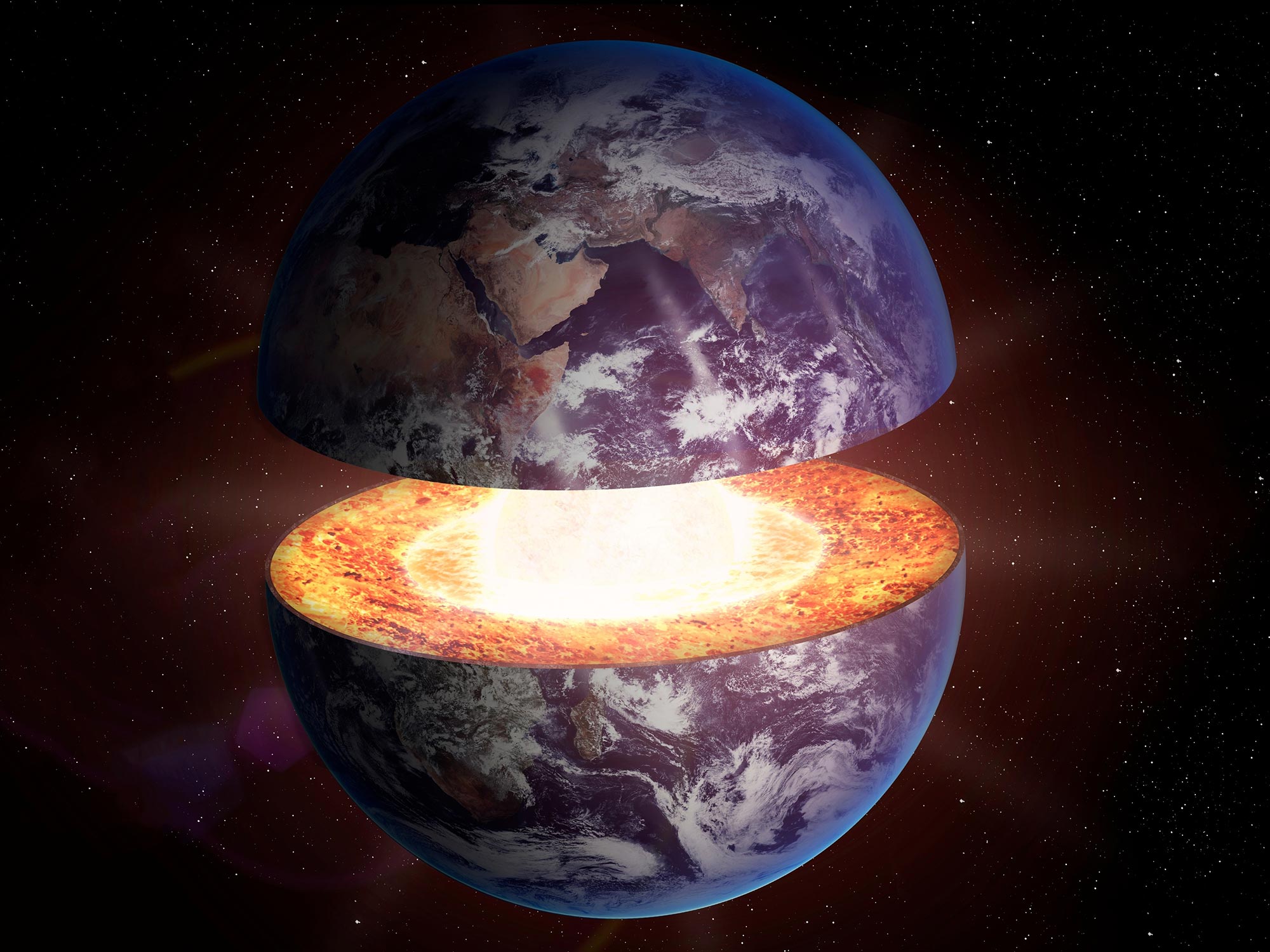
Scientists at ANU have discovered a doughnut-shaped area in Earth’s liquid outer core that could help explain mysteries about the planet’s magnetic field, highlighting the need for ongoing multidisciplinary research in this area.
Scientists from The Australian National University (ANU) have discovered a doughnut-shaped area within Earth’s liquid core, located thousands of kilometers beneath our feet. This finding offers new insights into the dynamics of our planet’s magnetic field.
The structure within Earth’s liquid core is found only at low latitudes and sits parallel to the equator. According to ANU seismologists, it has remained undetected until now.
The Earth has two core layers: the inner core, a solid layer, and the outer core, a liquid layer. Surrounding the Earth’s core is the mantle. The newly discovered doughnut-shaped region is at the top of Earth’s outer core, where the liquid core meets the mantle.
New Techniques Reveal Hidden Structures
Study co-author and ANU geophysicist, Professor Hrvoje Tkalčić, said the seismic waves detected are slower in the newly discovered region than in the rest of the liquid outer core.
“The region sits parallel to the equatorial plane, is confined to the low latitudes, and has a doughnut shape,” he said.
“We don’t know the exact thickness of the doughnut, but we inferred that it reaches a few hundred kilometers beneath the core-mantle boundary.”

Rather than using traditional seismic wave observation techniques and observing signals generated by earthquakes within the first hour, the ANU scientists analyzed the similarities between waveforms many hours after the earthquake origin times, leading them to make the unique discovery.
“By understanding the geometry of the paths of the waves and how they traverse the outer core’s volume, we reconstructed their travel times through the Earth, demonstrating that the newly discovered region has low seismic speeds,” Professor Tkalčić said.
“The peculiar structure remained hidden until now as previous studies collected data with less volumetric coverage of the outer core by observing waves that were typically confined within one hour after the origin times of large earthquakes.
“We were able to achieve much better volumetric coverage because we studied the reverberating waves for many hours after large earthquakes.”
Implications for Understanding Earth’s Magnetic Field
Study co-author, Dr Xiaolong Ma, said that the discovery uncovers some mysteries of the dynamics of Earth’s magnetic field.
“There are still mysteries about the Earth’s outer core that are yet to be solved, which requires multidisciplinary efforts from seismology, mineral physics, geomagnetism and geodynamics,” Dr Ma said.
The outer core is predominantly made of liquid iron and nickel, and the vigorous movement of the electrically conductive liquid creates Earth’s magnetic field, which shields around Earth and helps to sustain all life, protecting it from damaging solar winds and harmful radiation.
The scientists believe that knowing more about the Earth’s outer core’s composition, including light chemical elements, is fundamental to understanding the magnetic field and predicting when it could potentially cease or weaken.
“Our findings are interesting because this low velocity within the liquid core implies that we have a high concentration of light chemical elements in these regions that would cause the seismic waves to slow down. These light elements, alongside temperature differences, help stir liquid in the outer core,” Professor Tkalčić said.
“The magnetic field is a fundamental ingredient that we need for life to be sustained on the surface of our planet.
“The dynamics of Earth’s magnetic field is an area of strong interest in the scientific community, so our results could promote more research about the magnetic field on both Earth and other planets.”
Reference: “Seismic low-velocity equatorial torus in the Earth’s outer core: Evidence from the late–coda correlation wavefield” by Xiaolong Ma and Hrvoje Tkalčić, 30 August 2024, Science Advances.
DOI: 10.1126/sciadv.adn5562
The study was funded by the Australian Government.
Never miss a breakthrough: Join the SciTechDaily newsletter.
Follow us on Google and Google News.
1 Comment
Too bad it’s not an actual doughnut. We’d be set for life.