
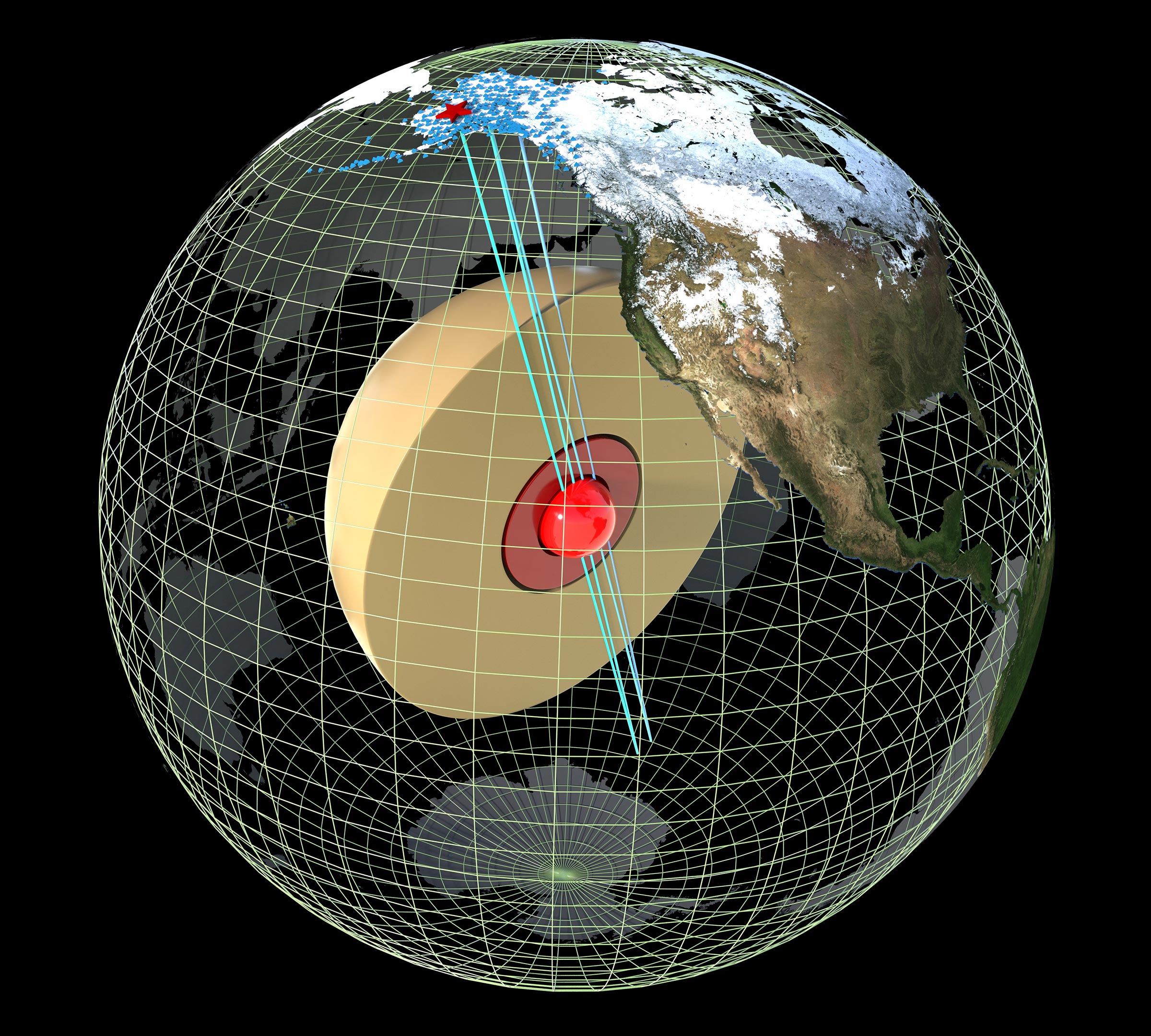
Earth’s innermost inner core, a newly identified metallic layer, may preserve clues about the planet’s evolutionary history through its distinct seismic properties.
Data captured from seismic waves caused by earthquakes has shed new light on the deepest parts of Earth’s inner core, according to seismologists from The Australian National University (ANU).
By measuring the different speeds at which these waves penetrate and pass through the Earth’s inner core, the researchers believe they’ve documented evidence of a distinct layer inside Earth known as the innermost inner core – a solid “metallic ball” that sits within the center of the inner core.
Not long ago it was thought Earth’s structure was comprised of four distinct layers: the crust, the mantle, the outer core, and the inner core. The findings, published in Nature Communications, confirm there is a fifth layer.
Insights into Earth’s Evolutionary History
“The existence of an internal metallic ball within the inner core, the innermost inner core, was hypothesized about 20 years ago. We now provide another line of evidence to prove the hypothesis,” Dr. Thanh-Son Phạm, from the ANU Research School of Earth Sciences, said.
Professor Hrvoje Tkalčić, also from ANU, said studying the deep interior of Earth’s inner core can tell us more about our planet’s past and evolution.
“This inner core is like a time capsule of Earth’s evolutionary history – it’s a fossilized record that serves as a gateway into the events of our planet’s past. Events that happened on Earth hundreds of millions to billions of years ago,” he said.
The researchers analyzed seismic waves that travel directly through the Earth’s center and “spit out” at the opposite side of the globe to where the earthquake was triggered, also known as the antipode. The waves then travel back to the source of the quake.
The ANU scientists describe this process as similar to a ping pong ball bouncing back and forth.
Bouncing Seismic Waves
“By developing a technique to boost the signals recorded by densely populated seismograph networks, we observed, for the first time, seismic waves that bounce back and forth up to five times along the Earth’s diameter. Previous studies have documented only a single antipodal bounce,” Dr. Phạm said.
“The findings are exciting because they provide a new way to probe the Earth’s inner core and its centermost region.”
One of the earthquakes the scientists studied originated in Alaska. The seismic waves triggered by this quake “bounced off” somewhere in the south Atlantic, before traveling back to Alaska.
The researchers studied the anisotropy of the iron-nickel alloy that comprises the inside of the Earth’s inner core. Anisotropy is used to describe how seismic waves speed up or slow down through the material of the Earth’s inner core depending on the direction in which they travel. It could be caused by different arrangement of iron atoms at high temperatures and pressures or the preferred alignment of growing crystals.
They found the bouncing seismic waves repeatedly probed spots near the Earth’s center from different angles. By analyzing the variation of travel times of seismic waves for different earthquakes, the scientists infer the crystallized structure within the inner core’s innermost region is likely different to the outer layer.
They say it might explain why the waves speed up or slow down depending on their angle of entry as they penetrate the innermost inner core.
Crystal Structure and Earth’s History
According to the ANU team, the findings suggest there could have been a major global event at some point during Earth’s evolutionary timeline that led to a “significant” change in the crystal structure or texture of the Earth’s inner core.
“There are still many unanswered questions about the Earth’s innermost inner core, which could hold the secrets to piecing together the mystery of our planet’s formation,” Professor Tkalčić said.
The researchers analyzed data from about 200 magnitude-6 and above earthquakes from the last decade.
Reference: “Up-to-fivefold reverberating waves through the Earth’s center and distinctly anisotropic innermost inner core” by Thanh-Son Phạm and Hrvoje Tkalčić, 21 February 2023, Nature Communications.
DOI: 10.1038/s41467-023-36074-2
Never miss a breakthrough: Join the SciTechDaily newsletter.
Follow us on Google and Google News.
1 Comment
Never knew this, thank you for letting me know.