
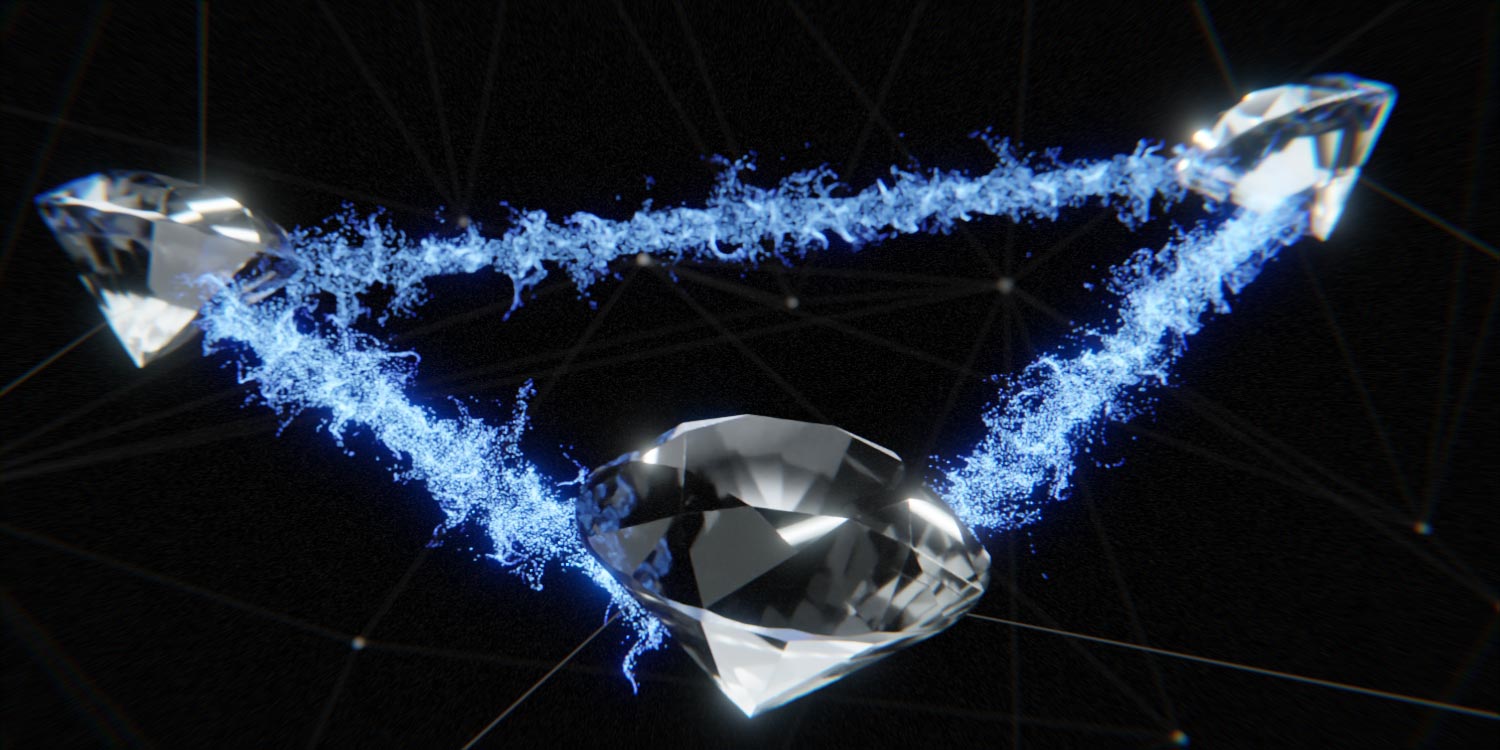
A team of researchers from QuTech in the Netherlands reports realization of the first multi-node quantum network, connecting three quantum processors. In addition, they achieved a proof-of-principle demonstration of key quantum network protocols. Their findings mark an important milestone towards the future quantum internet and have now been published in Science.
The Quantum Internet
The power of the Internet is that it allows any two computers on Earth to be connected with each other, enabling applications undreamt of at the time of its creation decades ago. Today, researchers in many labs around the world are working towards the first versions of a quantum internet — a network that can connect any two quantum devices, such as quantum computers or sensors, over large distances. Whereas today’s Internet distributes information in bits (that can be either 0 or 1), a future quantum internet will make use of quantum bits that can be 0 and 1 at the same time. “A quantum internet will open up a range of novel applications, from unhackable communication and cloud computing with complete user privacy to high-precision time-keeping,” says Matteo Pompili, PhD student and a member of the research team. “And like with the Internet 40 years ago, there are probably many applications we cannot foresee right now.”
Towards Ubiquitous Connectivity
The first steps towards a quantum internet were taken in the past decade by linking two quantum devices that shared a direct physical link. However, being able to pass on quantum information through intermediate nodes (analogous to routers in the classical internet) is essential for creating a scalable quantum network. In addition, many promising quantum internet applications rely on entangled quantum bits, to be distributed between multiple nodes. Entanglement is a phenomenon observed at the quantum scale, fundamentally connecting particles at small and even at large distances. It provides quantum computers their enormous computational power and it is the fundamental resource for sharing quantum information over the future quantum internet. By realizing their quantum network in the lab, a team of researchers at QuTech — a collaboration between Delft University of Technology and TNO — is the first to have connected two quantum processors through an intermediate node and to have established shared entanglement between multiple stand-alone quantum processors.
An animation explaining the world’s first rudimentary quantum network. Credit: Slimplot for QuTech
Operating the Quantum Network
The rudimentary quantum network consists of three quantum nodes, at some distance within the same building. To make these nodes operate as a true network, the researchers had to invent a novel architecture that enables scaling beyond a single link. The middle node (called Bob) has a physical connection to both outer nodes (called Alice and Charlie), allowing entanglement links with each of these nodes to be established. Bob is equipped with an additional quantum bit that can be used as memory, allowing a previously generated quantum link to be stored while a new link is being established. After establishing the quantum links Alice-Bob and Bob-Charlie, a set of quantum operations at Bob converts these links into a quantum link Alice-Charlie. Alternatively, by performing a different set of quantum operations at Bob, entanglement between all three nodes is established.

Ready for Subsequent Use
An important feature of the network is that it announces the successful completion of these (intrinsically probabilistic) protocols with a “flag” signal. Such heralding is crucial for scalability, as in a future quantum internet many of such protocols will need to be concatenated. “Once established, we were able to preserve the resulting entangled states, protecting them from noise,” says Sophie Hermans, another member of the team. “It means that, in principle, we can use these states for quantum key distribution, a quantum computation or any other subsequent quantum protocol.”
Quantum Internet Demonstrator
This first entanglement-based quantum network provides the researchers with a unique testbed for developing and testing quantum internet hardware, software, and protocols. “The future quantum internet will consist of countless quantum devices and intermediate nodes,” says Ronald Hanson, who led the research team. “Colleagues at QuTech are already looking into future compatibility with existing data infrastructures.” In due time, the current proof-of-principle approach will be tested outside the lab on existing telecom fiber — on QuTech’s Quantum Internet Demonstrator, of which the first metropolitan link is scheduled to be completed in 2022.
Higher-Level Layers
In the lab, the researchers will focus on adding more quantum bits to their three-node network and on adding higher level software and hardware layers. Pompili: “Once all the high-level control and interface layers for running the network have been developed, anybody will be able to write and run a network application without needing to understand how lasers and cryostats work. That is the end goal.”
Reference: “Realization of a multinode quantum network of remote solid-state qubits” by M. Pompili, S. L. N. Hermans, S. Baier, H. K. C. Beukers, P. C. Humphreys, R. N. Schouten, R. F. L. Vermeulen, M. J. Tiggelman, L. dos Santos Martins, B. Dirkse, S. Wehner and R. Hanson, 16 Apr 2021, Science.
DOI: 10.1126/science.abg1919
Never miss a breakthrough: Join the SciTechDaily newsletter.
Follow us on Google and Google News.
16 Comments
… shouldn’t this be impossible by some theory?
We need a priest, now!…
So.. is the whole ‘transmitting information FTL’ thing solved, or does the existing fiber network still carry that particular load? My brain need ambulance.
Well, this tells a whole lot of nothing…
As a multidisciplined, multi-degreed engineer, I’ve long been fascinated with the potential for entanglement to create FTL communication networks. Imagine being able to eleminate the communications delay between, say, Mars and Earth. It is very exciting.
Didn’t we just put up many quantum satellites in space forming “Starlink”. I think there are people that are way ahead of these students..just a hunch..anybody else feel that way?
No, star link is not quantum based. Just regular old radio wave. The satalights are just closer to earth than normally parked and a lot more of them.
The only method of communication that may be differnt is freaking Lazer beams attached to the heads of Sha.. satalights that will shoot info to eachother. (Higher bandwidth and driectional)
Next stop human teleportation! 😉
I’d like to believe this research will lead to a so-called ‘Quantum Internet’ but it breaks already established & proven laws of quantum physics around quantum information.
‘Quantum’ is like the new ‘Snake Oil’ of the 21st Century.
Known laws of physics don’t even work the same way outside of our solar system… So we shouldn’t assume there are limits until we have researched enough
Clarification needed: is this a means to make FTL communication via long distances? Like no lag on speaking to someone on mars?
Or dose it need a phsycal link to establish the quantum link? Could that be maintained after initiated and shiped off? Or could the physical link be initiated by traditional light speed communication?
This is so very exciting to hear more on.
That is not true about physical laws. Physical laws are invariant with time and space. That is why they are laws. Physics works the same whether within or outside of this solar system.
So. The security aspect is interesting. I can see a number of centralized coordinators similar to DNS existing – at least according to this model. The “coordinating” node will have the copy of the state, thus renegotiation and realignment after establishing connection and dropping the middle node is the next challenge.
Everyone thinking this allows FTL comms needs to stop now.
This is not instantaneous communication over any distance, this is a networking structure for quantum CPUs. This allows devices that think in both 0/1 at the same time to communicate with each other, rather than the much easier 0 or 1 devices. Not to say this isn’t cutting edge, but this is not the scifi stuff you’re dreaming it is.
Amazing. Can it run Crysis though? 🤣🤣🤣
What I learned from other readings is that particles become linked in the same lab machine and then must be separated to different locations in order to form a communication system. Separating them can be done by a fiber optic cable or possibly by storing them in a device and physically driving/flying/hand carrying them to a separate location. Preserving the entangled state is still very difficult and a certain percentage of entangled particles lose their entanglement in the transportation process. If a method of entangling particles that are already separated by some distance has been developed then I have not heard of it.
Entanglement theory says that communication between entangled particles is instantaneous at any distance. So, for now, it would seem that faster than light communication is possible at any distance. If literally true we could communicate with the far side of the entire universe in real time zoom meetings. For now the catch is getting the particles physically separated to the remote locations.
Bobby Hill: So, what is the speed of communication between entangled particles? I have not seen any info on it accept that is instantaneous at any distance.