
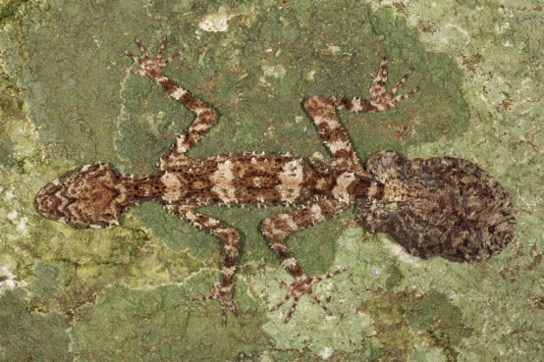
A James Cook University researcher has discovered three new vertebrate species in north-east Australia, a leaf-tail gecko, a golden-colored skink and a boulder-dwelling frog.
A James Cook University-National Geographic expedition to Cape York Peninsula in north-east Australia has found three vertebrate species new to science and isolated for millions of years—a bizarre-looking leaf-tail gecko, a golden-colored skink, and a boulder-dwelling frog.
Earlier this year Dr Conrad Hoskin from James Cook University and National Geographic photographer/Harvard University researcher Dr Tim Laman teamed up for an expedition to explore a remote mountain range on Cape York Peninsula in north-east Australia.
The rugged mountain range of Cape Melville is an amazing place—millions of black granite boulders the size of cars and houses piled hundreds of meters high. Surveys have previously been conducted in the boulder-fields around the base of Cape Melville but the plateau of boulder-strewn rainforest on top had remained largely unexplored, fortressed by massive boulder walls.
In March this year, with funding from the National Geographic Expedition Council, Hoskin, Laman, and a National Geographic film crew flew in by helicopter to explore the uplands. The results were incredible. Within several days they had discovered three highly distinct new vertebrate species (a leaf-tailed gecko, a golden-colored skink, and a boulder-dwelling frog) as well as a host of other interesting species that may also be new to science.
“Finding three new, obviously distinct vertebrates would be surprising enough in somewhere poorly explored like New Guinea, let alone in Australia, a country we think we’ve explored pretty well”, said Dr. Hoskin.
The upland of Cape Melville is a thoroughly isolated rainforest island in a ‘sea’ of hot, dry forest. The gecko, skink, frog and other rainforest-associated inhabitants have been completely isolated up there for millions of years.
“These species are restricted to the upland rainforest and boulder-fields of Cape Melville. They’ve been isolated there for millennia, evolving into distinct species in their unique rocky environment”, Dr Hoskin said.
The three new species have been named by Dr Hoskin, with the descriptions appearing in October issues of the international journal Zootaxa.
The highlight was the discovery of the leaf-tailed gecko. Leaf-tail geckos are large (20 cm), ‘primitive-looking’ geckos that are Gondwanan relics from a time when rainforest was more widespread in Australia. The Cape Melville Leaf-tailed Gecko is highly distinct from all relatives and has been named Saltuarius eximius. The species name translates as ‘exceptional’, ‘extraordinary’, or ‘exquisite’, in reference to its unusual form and how distinct it is.
“The second I saw the gecko I knew it was a new species. Everything about it was obviously distinct”, said Dr Hoskin.
This spectacular gecko is hidden in the boulders during the day and emerges at night to hunt on rocks and trees. Highly camouflaged, the geckos sit motionless, head-down waiting to ambush passing insects and spiders. Intriguing features of the gecko are its huge eyes and incredibly long and slender body and limbs – probably all adaptations to life in the dimly lit boulder-fields.
Patrick Couper, Curator of Reptiles and Frogs at the Queensland Museum, and collaborator on the gecko’s description, said “That this gecko was hidden away in a small patch of rainforest on top of Cape Melville is truly remarkable.”
“What makes it even more remarkable is that two other totally new vertebrates were found at the same time,” he said.
“The Cape Melville Leaf-tailed Gecko is the strangest new species to come across my desk in 26 years working as a professional herpetologist. I doubt that another new reptile of this size and distinctiveness will be found in a hurry, if ever again, in Australia.”
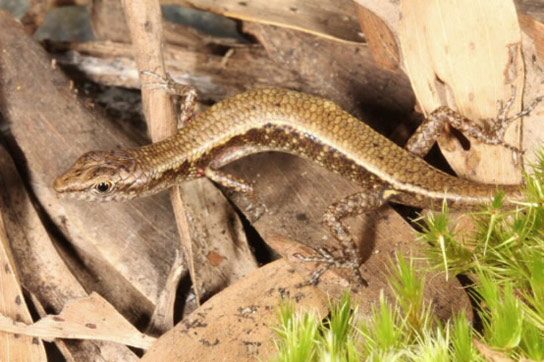
The Cape Melville Shade Skink (Saproscincus saltus) was also discovered and described. This beautiful golden-colored skink is also restricted to moist rocky rainforest on the plateau. It is also long-limbed, but unlike the gecko is active by day, running and jumping across the mossy boulders hunting insects. The species name ‘saltus’, means ‘leaping’. This species is highly distinct from its relatives, which are in rainforests to the south.
Also discovered was a fascinating boulder-dwelling frog, the Blotched Boulder-frog (Cophixalus petrophilus). This small frog is completely restricted to the boulder-fields at Cape Melville. Aptly, its species name means ‘rock-loving’. During the dry season, the frog lives deep down in the labyrinth of the boulder-field where conditions are cool and moist. In the summer wet season, the frog emerges on the surface rocks to feed and breed in the rain.
“You might wonder how a frog’s tadpoles can live in a ‘hollow’ boulder-field with no water sitting around.” Dr Hoskin said. “The answer is that the eggs are laid in moist rock cracks and the tadpoles develop within the eggs, guarded by the male, until fully-formed froglets hatch out. As for the gecko, its eyes are very large – once again an adaptation for life in the dimly lit boulder-piles.”
“This frog lives most of its life deep in the boulder-fields where it is dark, cool and moist, and only comes to the surface when it rains.” Dr. Hoskin said.

Given the discovery of three new vertebrate species, Cape Melville clearly holds many more secrets for future expeditions.
“The top of Cape Melville is a lost world. Finding these new species up there is the discovery of a life time – I’m still amazed and buzzing from it,” said Dr Hoskin.
References:
“A new skink (Scincidae: Saproscincus) from rocky rainforest habitat on Cape Melville, north-east Australia” by Conrad J. Hoskin, 23 October 2013, Zootaxa.
DOI: 10.11646/zootaxa.3722.3.7
PDF
“A spectacular new leaf-tailed gecko (Carphodactylidae: Saltuarius) from the Melville Range, north-east Australia” by Conrad J. Hoskin & Patrick Couper, 1 October 2013, Zootaxa.
DOI: 10.11646/zootaxa.3717.4.6
PDF
“A new frog species (Microhylidae: Cophixalus) from boulder-pile habitat of Cape Melville, north-east Australia” by Conrad J. Hoskin, 21 October 2013, Zootaxa.
DOI: 10.11646/zootaxa.3722.1.5
PDF
Never miss a breakthrough: Join the SciTechDaily newsletter.
Follow us on Google and Google News.