
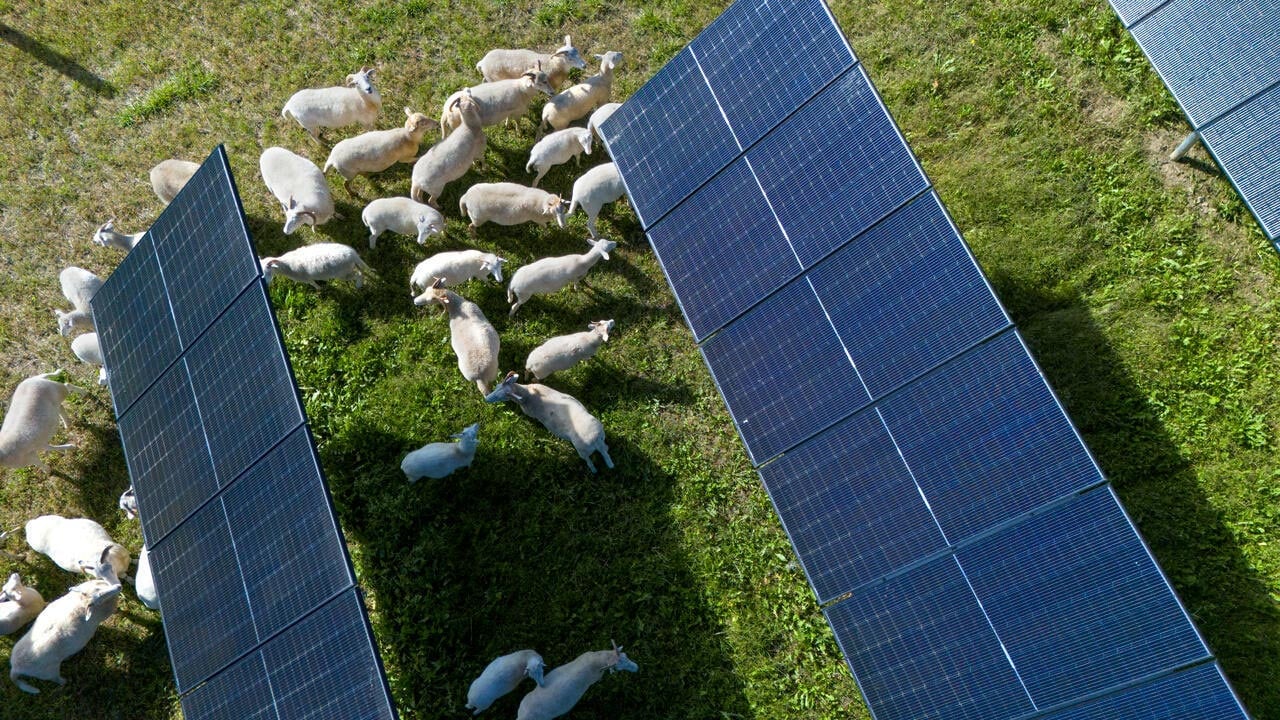
Solar grazing is helping sheep farmers expand their businesses, opening opportunities for rural jobs, new investment, and stronger agricultural supply chains.
Sheep can feed on the vegetation growing around solar panels while farmers get paid to keep it under control. Too few sheep may leave farmers with grass they still need to mow, while heavier grazing can reduce honeybee numbers.
Two new Cornell University studies examine the ecological and financial choices behind this growing practice, known as solar grazing. One tested how the number of sheep on the land affects beneficial insects. The other developed a tool to help farmers plan flock size, purchases, and sales.
More sheep, fewer honey bees
At two sheep per hectare, or roughly one per 1.2 acres, the combined abundance of wild bees, honey bees, and lady beetles was 38% higher than in a mowed control plot. Honey bee numbers were 83% higher, accounting for most of the overall increase.
Doubling the density to four sheep per hectare improved vegetation control, but beneficial insect abundance was similar to that in the mowed control. Eight sheep per hectare delivered the strongest vegetation control, and flock health remained high. At that density, however, honey bee abundance fell by 45%.
“We zeroed in on stocking rates because that’s a concrete number that sheep farmers understand and work with every day, and we want this research to be useful,” said Steve Grodsky, the study’s senior author and an assistant professor of natural resources in Cornell’s Ashley School of Global Development and the Environment. “With solar grazing, people, energy, agricultural animals, plants, and insects are all part of this ecosystem. We’re trying to understand the connections between those pieces so that when solar developers, municipalities looking at solar development, or farmers are faced with a decision, they can have scientific information about potential trade-offs and synergies.”
The researchers spent three years testing those stocking rates, the number of sheep grazing a given area, at the university-owned Cascadilla Community Solar Farm in Dryden, New York. Using Cornell’s teaching flock, the team brought together entomologists, ecologists, and animal and plant scientists from the College of Agriculture and Life Sciences (CALS). Their paper was published in Environmental Research Letters.
“Sheep grazing and beneficial insect habitat are two prominent conversation topics around solar development right now,” said Leana Zoller, the paper’s first author and a postdoctoral associate in natural resources in the Ashley School. “But what’s been missing is research that treats them as parts of the same system. When we talk about sustainable solar development, integrating these discussions into a single framework is really helpful to farmers and community decision makers.”
Grodsky also serves as assistant unit leader of the U.S. Geological Survey New York Cooperative Fish and Wildlife Research Unit. Sarah Carson, director of Cornell’s Campus Sustainability Office, helped coordinate the researchers’ access to the site with the solar company responsible for managing it.
The study’s other CALS co-authors included sheep farmer and solar grazing consultant Nikola Kochendoerfer, Ph.D. ’20, Antonio DiTommaso, a professor in the School of Integrative Plant Science, and John Losey, a professor of entomology. Also contributing were Scott McArt, Ph.D. ’12, an associate professor of entomology, Paige Muñiz, formerly a technician in McArt’s lab, and Todd Ugine, Ph.D. ’04, a research associate in Losey’s lab.
Planning flock growth around grass and costs
For farmers deciding how many sheep to buy or sell, the second study offers a way to weigh the financial and practical demands together. Researchers led from the Cornell SC Johnson College of Business developed a spreadsheet-based model that uses target flock size, costs, anticipated revenue, and expected vegetation at individual solar sites to help optimize those decisions. They presented the tool in a separate study published in Manufacturing & Service Operations Management.
Solar developers can also use the model to understand what farmers need from a grazing agreement and design contracts that are more profitable and sustainable for everyone involved over the long term. United Agrivoltaics has already made the tool part of its onboarding process.
The project grew out of a chance meeting between the paper’s first author, Vincent Slaugh, an assistant professor at the Cornell Peter and Stephanie Nolan School of Hotel Administration, and Caleb Scott, an Ithaca-based sheep farmer who founded United Agrivoltaics. Afterward, Slaugh began working through the economics and logistics of grazing sheep at solar installations. He recruited Linwei Xin, an associate professor of operations research and information engineering, and Shane Henderson, the Charles W. Lake, Jr. Professor in Productivity, both in the Cornell Duffield College of Engineering.
Solar contracts help sheep farms expand
Kochendoerfer’s solar grazing operation includes 700 ewes at installations in New York and Vermont.
“I work with a lot of farms that are now scaling up because of solar,” Kochendoerfer said. “There is a new wave of sheep farmers who are capitalizing on this access to good land. With solar grazing, you get paid to graze as opposed to having to pay to graze. That leads to sustainable, meaningful economic income that these farmers can use to expand, build a barn, buy equipment or hire someone. It’s enabling a lot of folks to build sound, viable agricultural businesses.”
Slaugh sees the steady income and animal feed available through solar contracts as an opportunity for American shepherds to increase production. U.S. sheep production falls well short of domestic demand for meat and wool. About half of the lamb and mutton consumed in the United States is imported, mainly from New Zealand and Australia.
“If we grow the sheep industry, will the American diet eventually include more lamb? Could that be a side effect of the solar energy revolution? I think the answer is very likely yes,” Slaugh said. “And then when that happens, we’d expect processors and supporting industries to come back, for banks to be willing to give more loans, and for supply chains to follow. All of that grows the economy, and rural economies in particular.”
References: “Low solar grazing densities support beneficial insects in agrivoltaic systems” by Leana Zoller, Nikola Kochendoerfer, Antonio DiTommaso, John Losey, Scott H McArt, Paige A Muñiz, Todd Ugine and Steven M Grodsky, 16 October 2026, Environmental Research Letters.
DOI: 10.1088/1748-9326/aeb145
“Flock Management for Solar Grazing” by Vincent Slaugh, Linwei Xin and Shane Henderson, 28 September 2026, Manufacturing & Service Operations Management.
DOI: 10.1287/msom.2025.0305
Never miss a breakthrough: Join the SciTechDaily newsletter.
Follow us on Google and Google News.