
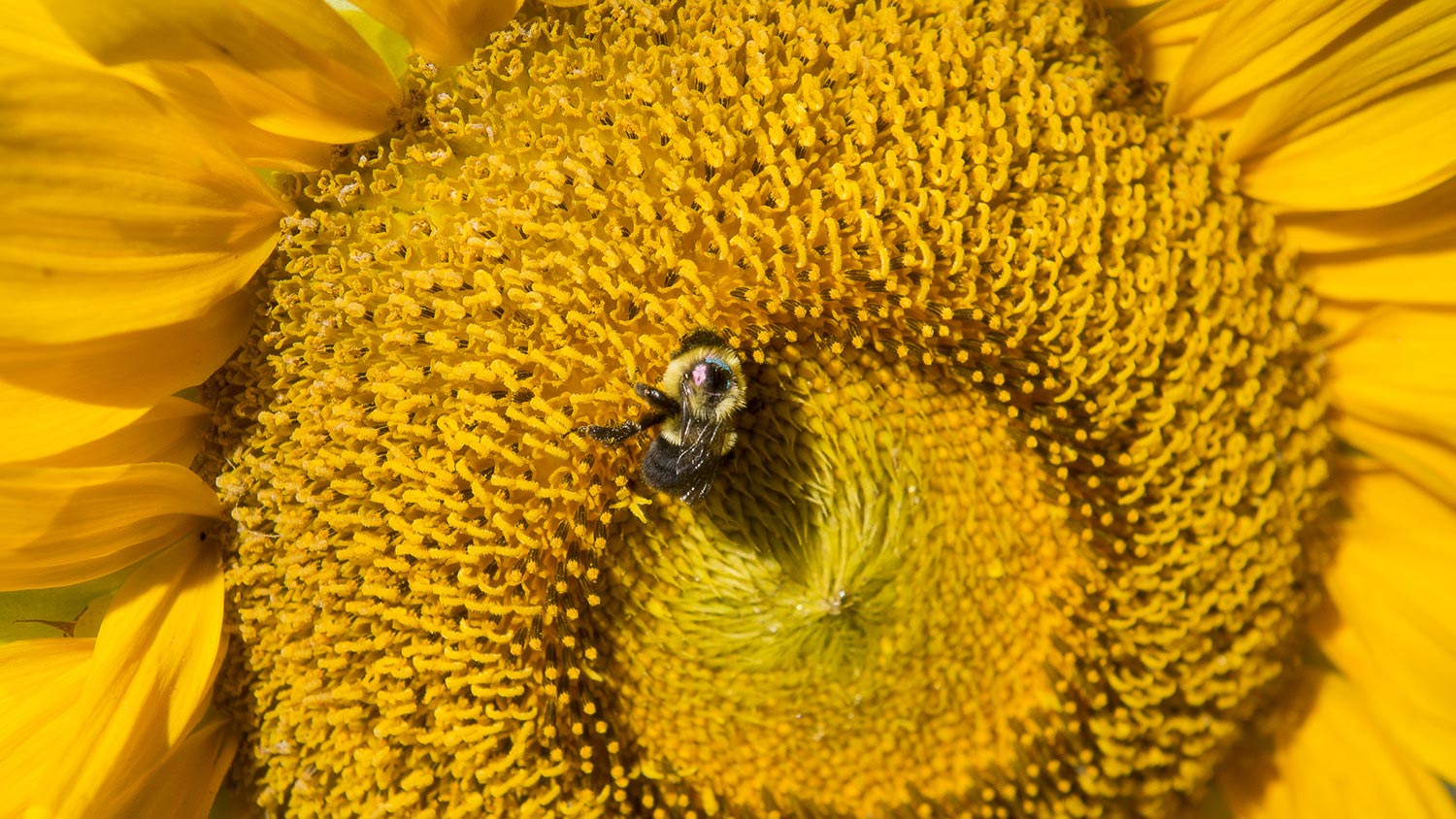
Flowering strips – pollinator-friendly rows of plants that increase foraging habitat for bees – can help offset pollinator decline but may also bring risks of higher pathogen infection rates for pollinators foraging in those strips.
Researchers from North Carolina State University and the University of Massachusetts Amherst show that flowering strip plants generally benefitted bee colony reproduction by adding floral resources for common eastern bumble bees (Bombus impatiens). The results came with a tradeoff, however, as bumble bees exposed to certain plants showed higher rates of infection by a bee pathogen acquired on flowers – Crithidia bombi, which is associated with reduced bee-foraging abilities as well as mortality in food-compromised bees.
The study showed that certain “high-infection” plants doubled C. bombi infection intensity when compared with “low-infection” plant species. Bees feeding mostly on canola plants – a major bee foraging plant and important U.S. crop – showed infection levels between high- and low-infection plants.
Nonetheless, all bee colonies that foraged on flowering strips – both low-infection and high-infection types – showed increases in reproduction relative to bees that only had access to canola.
“We wanted to know the effects of flowering strip plant species on the health and reproduction of bumble bees,” said Rebecca E. Irwin, professor of applied ecology at NC State and a co-author of a paper describing the research, published in Proceedings of the National Academy of Sciences. “Flowering strips are becoming more common as people look for ways to mitigate pollinator declines.”
The researchers used information gleaned from a previous study to split flowering strips into low- and high-infection portions. Low-infection plants included sunflower and thyme, while high-infection plants included swamp milkweed and purple loosestrife.
“In a prior study, we evaluated 15 plant species by putting the same amount of C. bombi on each, letting a bee forage, and then seeing whether and how bad of an infection it developed,” said Lynn S. Adler, professor of biology at UMass Amherst and the corresponding author of the paper. “We used that to designate plant species as ‘high/low infection’ for this study.”
Researchers placed bees in tents with the crop plants and either high-infection flowering strips, low-infection flowering strips or no flowering strips.
“The bees were all infected with the same amount of pathogen and then allowed to forage, so the plants could increase or decrease infection,” Adler said.
Adler said the flowering-strip tradeoff – more bee reproduction but higher pathogen infection rates – may be acceptable.
“It depends on how critical food versus the pathogen is for pollinators,” she said. “Crithidia is somewhat benign, but if these patterns hold for other pathogens like Nosema, a common honey bee disease, it may be more of a concern. Right now I would not recommend stopping our investment in flowering strips.”
The researchers hope to continue examining the effects of flowering strips on bee populations and health by including other bee species and pathogen types.
“I think we need a much more comprehensive program to evaluate how pollinator habitat characteristics affect pathogen spread to make informed choices,” Adler said. “In the meantime, providing flowering resources in pollinator habitat is still the best path forward.”
Paper co-authors include Nicholas A. Barber from San Diego State University and Olivia M. Biller from Thomas Jefferson University.
The study was funded by the U.S. Department of Agriculture’s Agriculture and Food Research Initiative grant 2013-441 02536; the National Institutes of Health under grant 1 R01 GM122062-01; the National Science Foundation under grant DEB-1258096; and U.S. Department of Agriculture’s Cooperative State Research Education and Extension Service under grant MAS000411.
Reference: “Flowering plant composition shapes pathogen infection intensity and reproduction in bumble bee colonies” by Lynn S. Adler, Nicholas A. Barber, Olivia M. Biller and Rebecca E. Irwin, 11 May 2020, Proceedings of the National Academy of Sciences.
DOI: 10.1073/pnas.2000074117
Never miss a breakthrough: Join the SciTechDaily newsletter.
Follow us on Google and Google News.
1 Comment
GREAT ARTICLE ON BEEs VERY TIMELY For ME THANKS AGAIN