
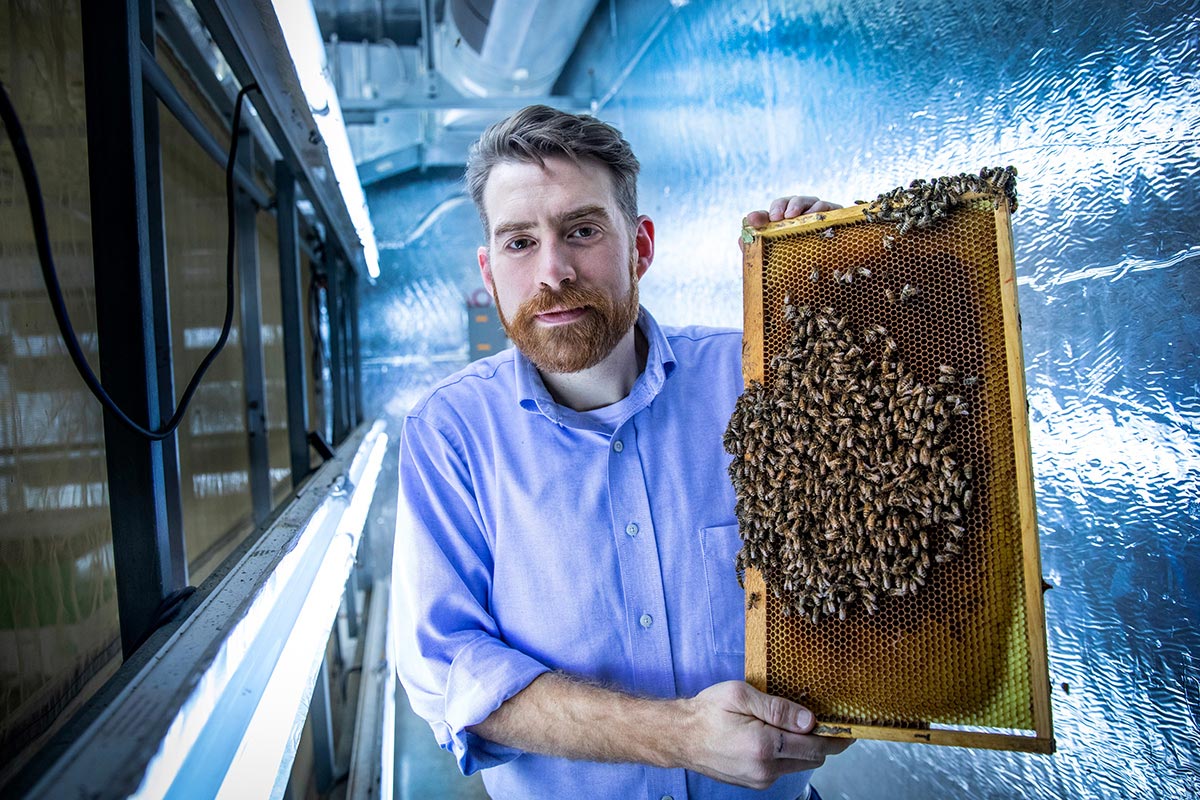
Honey bees that guard hive entrances are twice as likely to allow in trespassers from other hives if the intruders are infected with the Israeli acute paralysis virus, a deadly pathogen of bees, researchers report.
Their new study, reported in the Proceedings of the National Academy of Sciences, strongly suggests that IAPV infection alters honey bees’ behavior and physiology in ways that boost the virus’s ability to spread, the researchers say.
“The most important finding of our study is that IAPV infection increases the likelihood that infected bees are accepted by foreign colonies,” said Adam Dolezal, a professor of entomology at the University of Illinois at Urbana-Champaign who led the new research. “Somehow, the infected bees are able to circumvent the guards of foreign colonies, which they shouldn’t be able to do.”

Previous studies have shown that IAPV-infected honey bees are more likely than healthy bees to lose their way when returning home from foraging trips. In commercial beekeeping operations where hives are stacked much closer together than in the wild, the virus is even more likely to spread from one infected colony to nearby healthy ones.
To capture the behavior of individual bees, researchers tagged each one with the equivalent of a QR code and continuously monitored their interactions. The scientists were able to simultaneously track the behaviors of as many as 900 bees.
In previous work, study co-author U. of I. entomologist Gene Robinson and his colleagues developed this automated system to study bees engaged in trophallaxis, a process by which honey bees exchange regurgitated food and other liquids. They used this system to study how IAPV infection might affect the bees’ trophallaxis social network.
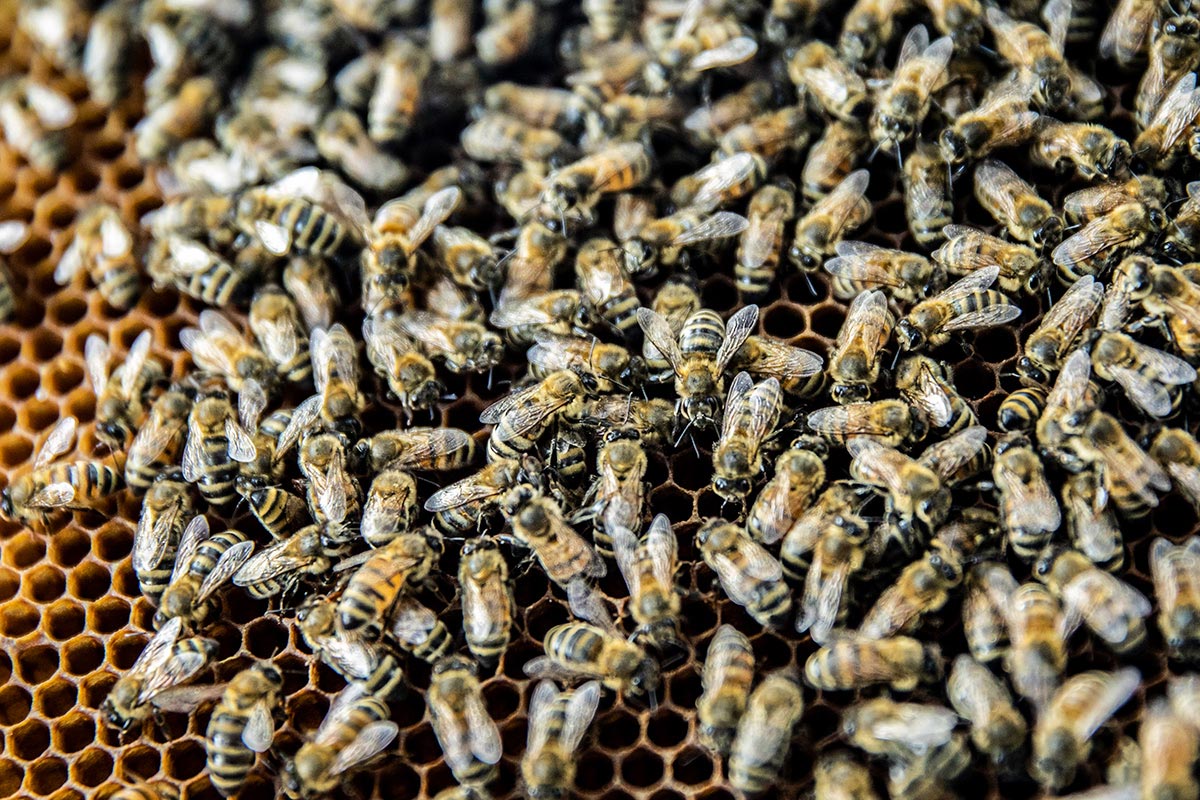
“Honey bees use trophallaxis to share food with each other as well as hormones and other signaling molecules that can affect their physiology and behavior. They do it in pairs by touching their mouthparts and antennae, and each bee does this with hundreds of partners a day,” said Robinson, who directs the Carl R. Woese Institute for Genomic Biology at Illinois. “Trophallaxis is essential to the spread of information and nutrition throughout the hive, but unfortunately, a behavior performed with such close social contact also allows viral infections to be transmitted through a hive.”
In the new study, the scientists saw that honey bees altered their behavior in response to infection in their own hives. IAPV-infected bees – and bees that had had their immune systems stimulated to mimic infection – engaged in less trophallaxis than their healthy counterparts did.
The infected bees were just as mobile as the other bees, so their lower rates of trophallaxis were not the result of sluggishness from being sick, Dolezal said. The researchers believe this change in behavior is a general response to a health threat and not specific to IAPV infection, which is in line with previous research.
When the scientists placed honey bee workers at the entrance of a foreign hive, however, the infected bees engaged in more trophallaxis with the guards, the researchers found. The guards were more likely to admit them than to let in healthy bees or bees whose immune systems had been stimulated. This response was specific to IAPV infection.
“Something about them must be different,” Dolezal said.
To test whether the IAPV-infected bees were giving off a different chemical odor than their healthy nest mates, the researchers analyzed the chemistry of the hydrocarbons that coat the bees’ exoskeletons. They discovered distinct hydrocarbon profiles for healthy bees, IAPV-infected bees, and immunostimulated bees.
“It seems that the virus is changing how the bees smell, and perhaps the infected bees also are behaving in a way that is meant to appease the guards by engaging more in trophallaxus,” Dolezal said.
The new findings suggest that IAPV is evolving in ways that enhance its ability to infect as many hosts as possible, Dolezal said.
“If you’re a virus, it’s much more valuable to get transmitted to a new family group, like traveling from one city to a new city,” he said. “And so how do you get there? You increase the chances that the sick bees leaving colony A are more likely to get into colony B.”
Reference: “Honey bee virus causes context-dependent changes in host social behavior” by Amy C. Geffre, Tim Gernat, Gyan P. Harwood, Beryl M. Jones, Deisy Morselli Gysi, Adam R. Hamilton, Bryony C. Bonning, Amy L. Toth, Gene E. Robinson and Adam G. Dolezal, 27 April 2020, Proceedings of the National Academy of Sciences.
DOI: 10.1073/pnas.2002268117
The Christopher Family Foundation, National Academies Keck Futures Initiative, American Pollinator Protection Campaign and U.S. Department of Agriculture’s National Institute of Food and Agriculture supported this research.
Never miss a breakthrough: Join the SciTechDaily newsletter.
Follow us on Google and Google News.
2 Comments
Bee hives will now have to practice “Social Distancing” against their pandemic.
Sounds way too much like human behavior for it to be a coincidence; it may not be the same virus; but it must be something similar as we also seem to be devoted to our own social collapse; more like than not, our leaders know that they are infected; they may even have had themselves infected intentionally; just based upon their own behaviors