

Scientists from The University of Texas at Austin report in the journal Science that they have developed a new strategy to protect honey bees from a deadly trend known as colony collapse: genetically engineered strains of bacteria.
An increasing number of honey bee colonies in the U.S. have seen the dwindling of their adult bees. According to a national survey, beekeepers lost nearly 40% of their honey bee colonies last winter, the highest rate reported since the survey began 13 years ago.
The engineered bacteria live in the guts of honey bees and act as biological factories, pumping out medicines protecting the bees against two major causes of colony collapse: Varroa mites and deformed wing virus. The researchers believe their method could one day scale up for agricultural use because the engineered bacteria are easy to grow, inoculating the bees is straightforward and the engineered bacteria are unlikely to spread beyond bees.
“It has direct implications for bee health,” said Nancy Moran, a professor of integrative biology and the primary investigator on the study.
“This is the first time anyone has improved the health of bees by genetically engineering their microbiome,” added Sean Leonard, a graduate student and first author of the study.
Varroa mites and deformed wing virus often come together; as the mites feed on bees, they can spread the virus, while also weakening the bees and making them more vulnerable to pathogens in the environment.
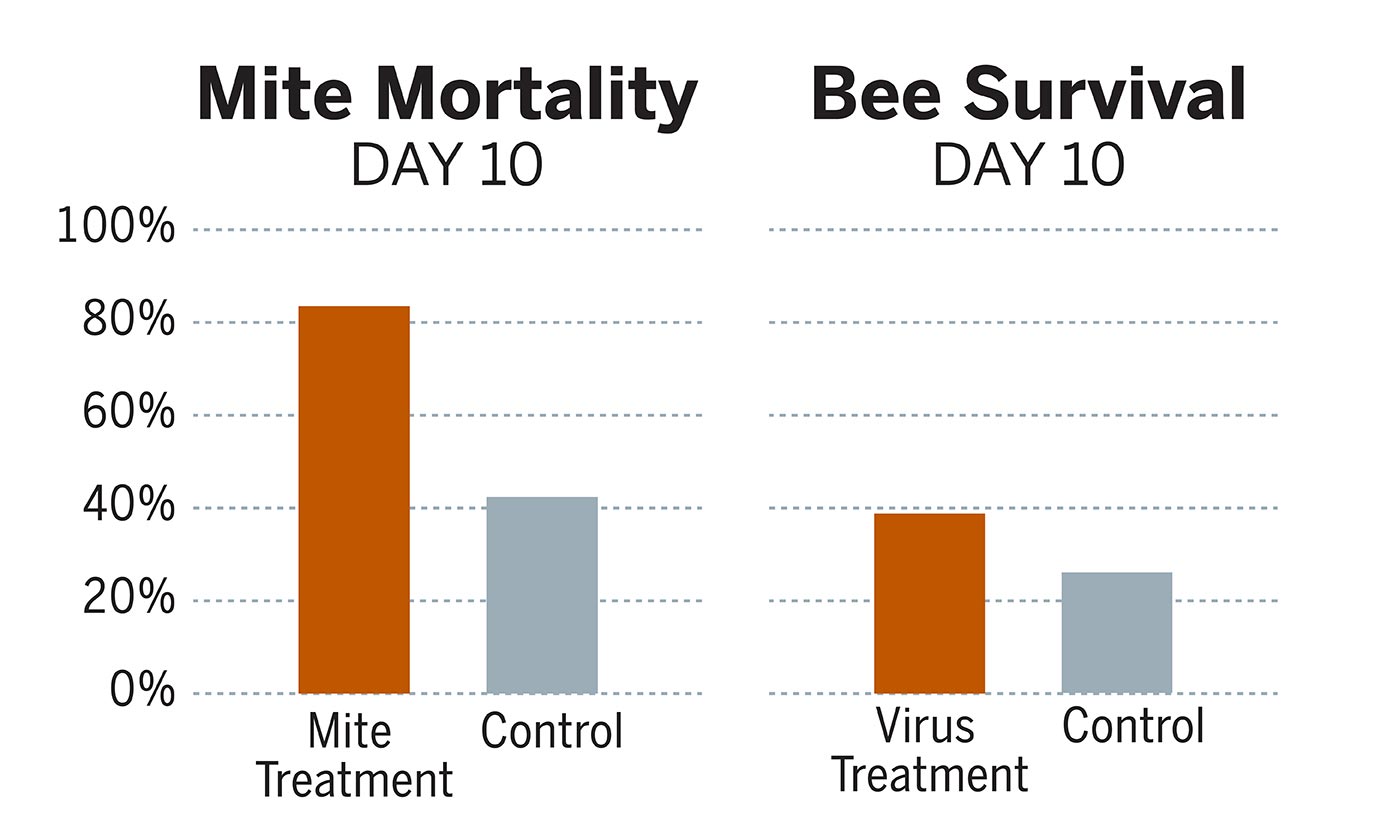
To address each problem, the team engineered one strain of bacteria to target the virus and another for the mites. Compared with control bees, the bees treated with the strain of bacteria targeting the virus were 36.5% more likely to survive to day 10. Meanwhile, Varroa mites feeding on another set of bees treated with the mite-targeting strain of bacteria were about 70% more likely to die by day 10 than mites feeding on control bees.
According to the American Beekeeping Federation, honey bees contribute nearly $20 billion each year to the value of U.S. crop production, and they play an enormous role in global food production. Without honey bees, dozens of crops, from almonds to berries to broccoli, would either vanish or produce significantly less food.
Like humans, honey bees have an ecosystem of bacteria in their guts called a microbiome and also an antiviral defense mechanism called RNA interference (RNAi) that helps the body fight off certain viruses, called RNA viruses. When an RNA virus is introduced, it produces molecules called double-stranded RNAs that a healthy cell detects, triggering an RNAi immune response.
“You usually only get signs of these molecules when an RNA virus is replicating,” Moran said. “It’s a signal that this might be an evil thing and you should attack it.”
To promote a helpful RNAi response to viruses in bees — and trigger a lethal RNAi response in the mites — the team introduced modified bacteria to hundreds of bees in a laboratory setting. Sprayed with a sugar water solution containing the bacteria, the bees groomed one another and ingested the solution. The team found inoculating young worker bees with the engineered bacteria led the bees’ immune systems to be primed to protect them against deformed wing virus, which is an RNA virus, and caused the mites’ own immune systems to fight against and ultimately kill them.
While the experiments occurred under strict biocontainment protocols used with genetic engineering, Moran said, even absent such protocols, the risk of the engineered bacteria escaping into the wild and infecting other insects — and thereby conferring some anti-pest or anti-pathogen superpowers — is very low. The type of bacteria used are highly specialized to live in the bee gut, can’t survive for long outside of it and are protective for a virus that strikes only bees. Still, further research will be needed to determine the effectiveness and safety of the treatments in agricultural settings.
Another benefit of the approach is for researchers to use it as a tool in studying bee genetics. The engineered bacteria can knock down specific bee genes, enabling insights into the workings of the bee genome, and possibly enabling new breeding strategies to produce more robust bee colonies.
Reference: “Engineered symbionts activate honey bee immunity and limit pathogens” by Sean P. Leonard, J. Elijah Powell, Jiri Perutka, Peng Geng, Luke C. Heckmann, Richard D. Horak, Bryan W. Davies, Andrew D. Ellington, Jeffrey E. Barrick and Nancy A. Moran, 31 January 2020, Science.
DOI: 10.1126/science.aax9039
The other senior author is associate professor Jeffrey Barrick. Other co-authors are professor Andy Ellington, associate professor Bryan Davies, research associate Eli Powell, former postdoctoral researcher Jiri Perutka, postdoctoral fellow Peng Geng, undergraduate Luke Heckmann and research scientist assistant Richard D. Horak.
Moran, whose remarkable career was recently profiled in Science magazine, holds the Warren J. and Viola Mae Raymer Chair. Funding for this research was provided by the National Institutes of Health and the Defense Advanced Research Projects Agency.
Never miss a breakthrough: Join the SciTechDaily newsletter.
Follow us on Google and Google News.
2 Comments
My son rented out his been on the Big Island. His hives started dying. He loved his bees and actually started crying when he called me. He sent out bees to be tested and they came back that it was a virus.
Then he sent the comb out and it came back infected with pesticides.
Which is worse pesticides, bacteria, or virus?
This is completely asinine and mentally r*****ed thought process. An easier, more logical conclusion is to ban the use of pesticides that we know to cause bees to die because of the persistence of the manmade chemicals in the rhizosphere and the inability of certain manmade chemical pesticides to be broken down in the environment for months to over a year!