
Close Menu
    Facebook X (Twitter) Instagram
    SciTechDaily
    • Biology
    • Chemistry
    • Earth
    • Health
    • Physics
    • Science
    • Space
    • Technology
    Facebook X (Twitter) Pinterest YouTube RSS
    SciTechDaily
    Home»Biology»A Question for Almond Growers: To Bee, or Not to Bee?
    Biology

    A Question for Almond Growers: To Bee, or Not to Bee?

    By University of Hawaii at ManoaMarch 18, 2020No Comments3 Mins Read
    Facebook Twitter Pinterest Telegram LinkedIn WhatsApp Email Reddit
    Share
    Facebook Twitter LinkedIn Pinterest Telegram Email Reddit
    Bees Visit Pollinator-Independent Almond Blossoms
    Bees visit pollinator-independent almond blossoms. Credit: Drs. Saez and Negri

    Pollination by bees is vital even when crops are assumed to be pollinator independent. That’s according to a study co-authored by Ethel Villalobos, a researcher in the University of Hawaiʻi at Mānoa’s College of Tropical Agriculture and Human Resources Department of Plant and Environmental Protection Sciences and lead of the UH Honeybee Project.

    In a paper published in the February issue of Nature Scientific Reports, Villalobos collaborated with a team comprised mainly of Argentinian researchers and led by Agustin Sáez and Pedro Negri, co-founders of a start-up company called BeeFlow. Their series of field experiments examined the true “independence” of a new self-fertilizing almond variety called ‘Independence.’

    A multi-million dollar business

    Eighty percent of the world’s almonds are produced in California. The crop requires the pollination services of two million colonies of honey bees during the flowering season, which growers rent from beekeepers. Pollinating almonds requires the equivalent of moving half of all managed bees in the U.S. to California for a few weeks.
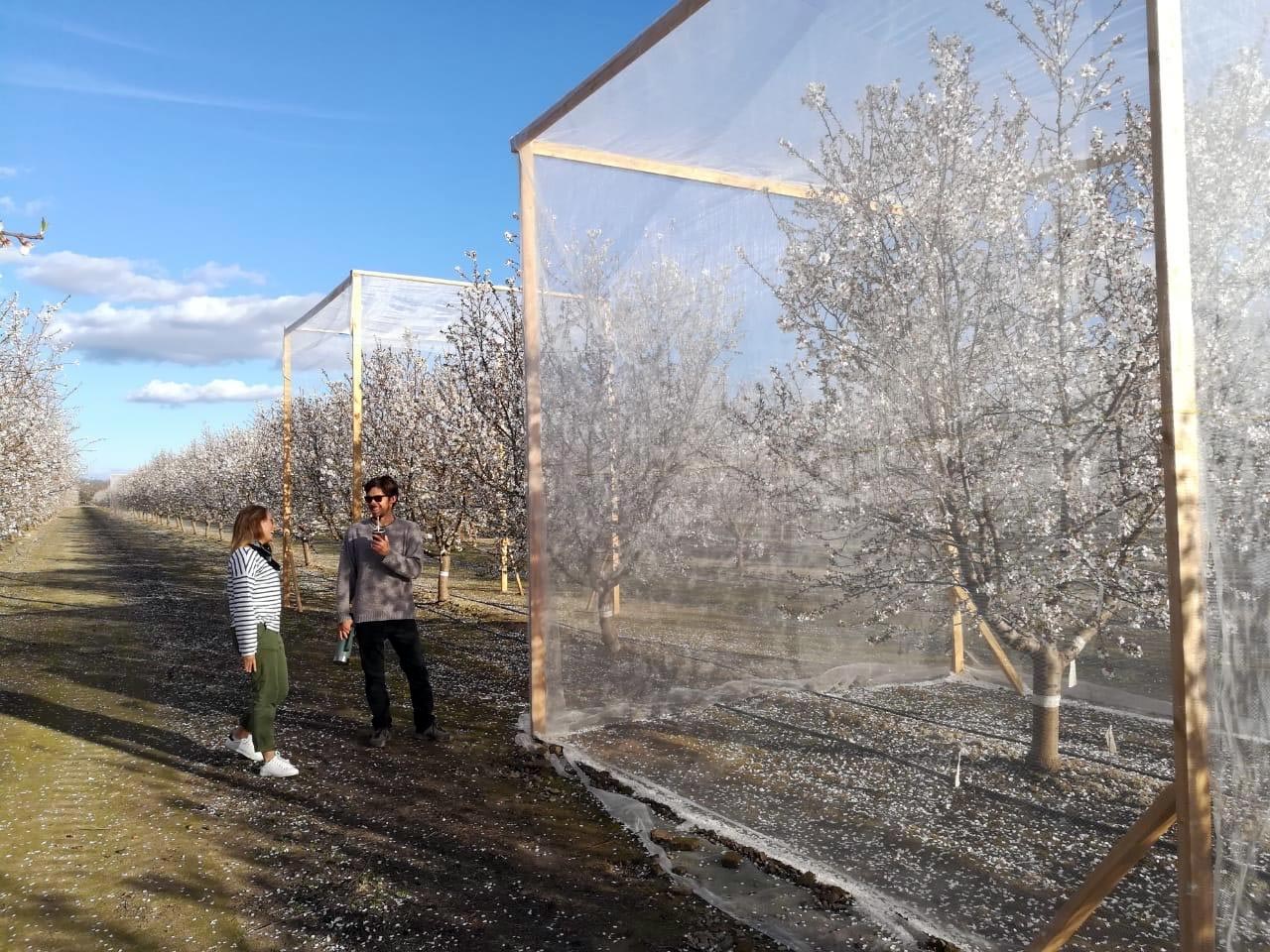
    Isolated Almond Trees
    Researchers isolated trees to assess effects of bee activity. Credit: Drs. Saez and Negri

    Besides the cost and effort, the pesticides used on almonds may be dangerous to bees. Thus there is intensive research going into breeding pollinator-independent almonds, which could cut the bees out of the equation entirely. However, this study shows the solution is not that simple.

    Pollinators are still crucial

    ‘Independence’ almonds still performed better when bees were assisting in pollination. They had a 60 percent increase in fruit set and a 20 percent increase in kernel yield when pollinated by bees. Even with the cost of renting colonies, farmers would still realize 10 percent more profit when the almonds were fertilized by bees.

    Almond Orchard
    Drone photo of almond orchard. Credit: BeeFlow CEO Matias Viel

    “This article highlights the danger of misinformation—the variety is marketed as ‘self-fertilizing,’ but growers don’t know they will get less yield without bees,” Villalobos explained. “This could also generate conflicts between almond growers. If one grower’s self-fertile almonds are planted near another’s bee-dependent varieties, the bees will visit both, and growers who rent bees will be paying for services benefiting others and getting less for their own crops.”

    Another potential problem is if allegedly pollinator-independent varieties continue replacing pollinator-dependent varieties, many beekeepers may lose one of their key annual incomes, threatening their financial well-being. This could lead to the loss of one of the most important incentives for maintaining a beekeeping industry in the U.S. and the narrowing of a work source for beekeepers.

    Bees in the ecosystem

    Most important, Villalobos concluded, is that bees have played an important role in keeping agricultural pesticide use in check, and attempting to eliminate them removes this check.

    “Since they are recognized and appreciated by most people, honey bees have helped raise awareness of how farm health is related to our own health,” she said. “We tend to lose sight of the benefits of protecting our natural world. Bees have helped us face that there are choices to be made.”

    Reference: “Bees increase crop yield in an alleged pollinator-independent almond variety” by Agustin Sáez, Marcelo A. Aizen, Sandra Medici, Matias Viel, Ethel Villalobos and Pedro Negri, 21 February 2020, Scientific Reports.
    DOI: 10.1038/s41598-020-59995-0

    Never miss a breakthrough: Join the SciTechDaily newsletter.
    Follow us on Google and Google News.

    Agriculture Bees Food Science University of Hawaii at Manoa
    Share. Facebook Twitter Pinterest LinkedIn Email Reddit

    Related Articles

    Group Genomics Drive Aggression in Africanized Honey Bees

    Tomato’s Hidden DNA Mutations Revealed in Genetic Study of 100 Varieties

    ‘Bee’ Thankful for the Evolution of Pollen – Discovery Made With Highly Detailed Electron Scanning Microscope

    Bumble Bee Disease & Reproduction Is Shaped by Flowering Strip Plants

    Surprisingly, Plants Are Better Pollinated in Cities Than in the Countryside

    These Rat-Eating Monkeys Are Helping Protect Palm Oil Harvests

    Contagious Cancer in Shellfish Spreading Across the Atlantic Ocean and Into the Pacific

    Low Oxygen Levels Trigger the Formation of Plant Sex Cells

    Airborne Insecticide Emission From Pneumatic Drilling Machines Linked to Honeybee Death

    Leave A Reply Cancel Reply

    • Facebook
    • Twitter
    • Pinterest
    • YouTube

    Don't Miss a Discovery

    Subscribe for the Latest in Science & Tech!

    Trending News

    AI Could Detect Early Signs of Alzheimer’s in Under a Minute – Far Before Traditional Tests

    What if Dark Matter Has Two Forms? Bold New Hypothesis Could Explain a Cosmic Mystery

    This Metal Melts in Your Hand – and Scientists Just Discovered Something Strange

    Beef vs. Chicken: Surprising Results From New Prediabetes Study

    Alzheimer’s Breakthrough: Scientists Discover Key Protein May Prevent Toxic Protein Clumps in the Brain

    Quantum Reality Gets Stranger: Physicists Put a Lump of Metal in Two Places at Once

    Scientists May Have Found the Key to Jupiter and Saturn’s Moon Mystery

    Scientists Uncover Brain Changes That Link Pain to Depression

    Follow SciTechDaily
    • Facebook
    • Twitter
    • YouTube
    • Pinterest
    • Newsletter
    • RSS
    SciTech News
    • Biology News
    • Chemistry News
    • Earth News
    • Health News
    • Physics News
    • Science News
    • Space News
    • Technology News
    Recent Posts
    • Why Promising Cancer Drugs Failed: Scientists Uncover the Missing Piece
    • Popular Sweetener Linked to DNA Damage – “It’s Something You Should Not Be Eating”
    • Ancient “Rock” Microbes May Reveal How Complex Life Began
    • Hidden “Trade Winds” Inside Cells Could Explain Cancer Spread
    • Humans Owe Their Eyes to a Tiny One-Eyed “Cyclops”
    Copyright © 1998 - 2026 SciTechDaily. All Rights Reserved.
    • Science News
    • About
    • Contact
    • Editorial Board
    • Privacy Policy
    • Terms of Use

    Type above and press Enter to search. Press Esc to cancel.