
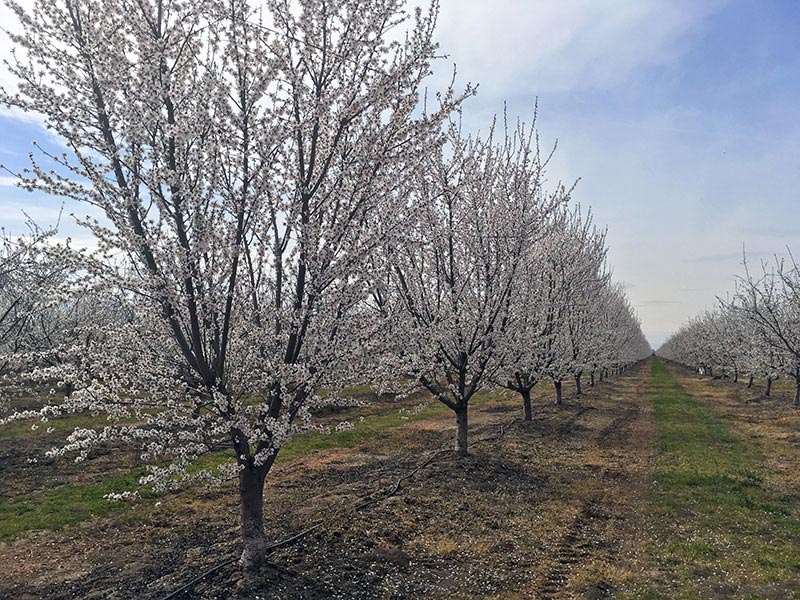
A favorite healthy snack, almonds are a staple on grocery store shelves worldwide. More than 80% of these almonds are grown in California. As permanent crops, almond trees have unique needs and challenges for farmers.
Sat Darshan Khalsa, a member of the Soil Science Society of America, studies how almond trees use the key nutrient nitrogen. He recently presented his research at the virtual 2020 ASA-CSSA-SSSA Annual Meeting.
How does farming almonds, considered a deciduous permanent crop, differ from a traditional crop?
“These crops are an intersection between agricultural and forest ecosystems,” Khalsa explains. “Similar to annual cropping systems, deciduous permanent crops like almonds are intensively farmed. They receive high inputs of fertilizer and water with high nutrient outputs.”
At the same time, crops like almonds are managed under no-till conditions where soil is minimally disturbed. Tilling or digging of any kind would disturb the trees’ roots. In addition, almond trees shed leaves, grow woody tissue, and undergo other processes similar to trees in a real forest. These all have effects on carbon, nitrogen, and other nutrient cycles.
These characteristics can often mean that nutrients flow off of the field. They can get into areas like groundwater aquifers, where they can impact drinking water supplies for rural communities. Khalsa’s work has tried to minimize this issue.
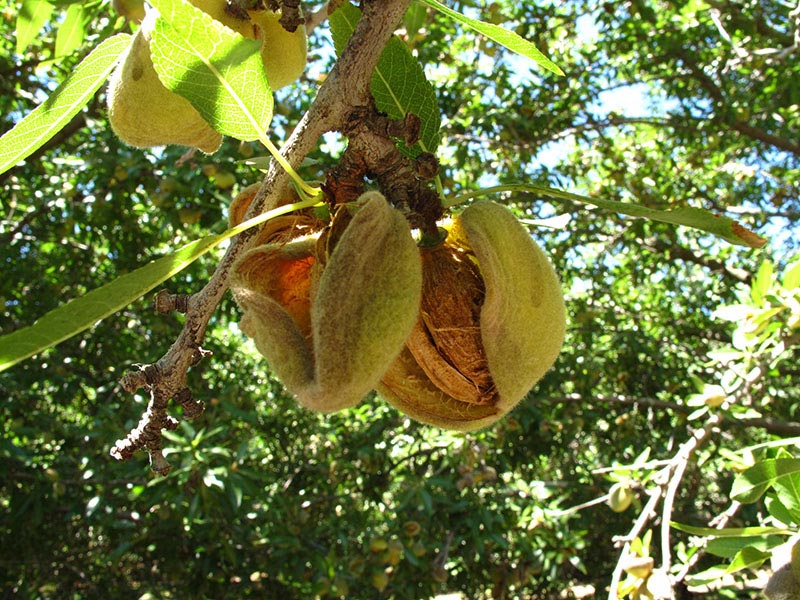
“Nitrogen is the primary nutrient tied to productivity,” he says. “At the same time, it’s an important pollutant that impacts air and water quality. Through our work, we can show that many almond growers in California are in a good position to continue to be highly productive. At the same time, they can protect, or even improve, environmental quality.”
Khalsa and his colleagues specifically studied a concept called nitrogen use efficiency. It helps farmers balance putting enough nitrogen on a field with protecting environmental quality. In their research, they show it is possible to have a high level of nitrogen use efficiency by using various conservation practices.
One of the conservation techniques is called nutrient budgeting. It’s a technique where inputs and outputs from a field are precisely measured to try to make them as balanced as possible. They also monitor the nutrients in leaves and soil.
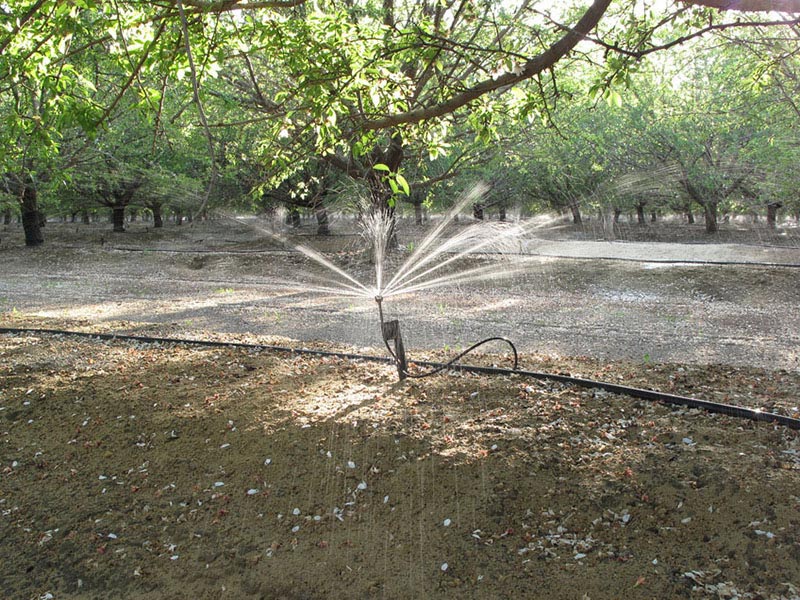
Another technique is called fertigation, where fertilizer is applied through the irrigation system in a very targeted way. This allows it to be precisely measured and timed to meet the plants’ needs. The work of Khalsa’s team can also be applied to other specialty crops around the world to help farmers have a higher income while producing nutritious food.
“Matching supply and demand is the foundation of the 4R framework with the goal of improving the efficiency of nutrient management,” Khalsa says. “The 4R framework is: the right fertilizer source at the right rate, at the right time, in the right place. That’s what will help us be more efficient.”
Challenges remain in understanding how crops like almonds cycle nitrogen year to year and how farmers apply nitrogen fertilizer. Khalsa also says his research highlights the importance of integrating their research with information networks, including Certified Crop Advisers and Cooperative Extension.
Efforts to address these agricultural issues must focus on the desires and needs of the farmers, growers, and industry organizations. That kind of work helps promote adoption and create new research opportunities such as assessing soil health practices in orchards.
Khalsa encourages researchers to maintain curiosity throughout each step of the food value chain. This allows them to better understand how their research interests align with other scientists, policy makers, and individuals like consumers within food and farming industries.
“After decades of working with plants, soil, and water, I personally think that through understanding people, we will be able to solve the biggest problems,” he says. “Agriculture plays an essential role in communities worldwide. I find no better way to connect with anyone, anywhere than through the food we share.”
Sat Darshan Khalsa is a scientist at the University of California, Davis. This research was funded by the United States Department of Agriculture California Specialty Crop Block Grants, the Foundation for Food and Agricultural Research, the California Department of Food and Agriculture Fertilizer Research and Education Program, and the Almond Board of California.
Meeting: 2020 ASA-CSSA-SSSA Annual Meeting.
Funding: United States Department of Agriculture California Specialty Crop Block Grants, the Foundation for Food and Agricultural Research, the California Department of Food and Agriculture Fertilizer Research and Education Program, Almond Board of California.
Never miss a breakthrough: Join the SciTechDaily newsletter.
Follow us on Google and Google News.
2 Comments
The billions of gallons of water to grow almonds during 12 months is sent all over the word as, almonds. The billions of gallons of water to grow alfalfa is sent to asia. California has a water problem, water hungry crops, and wealthy politically powerful agri-corporations.
Another View to the above Comment is the Following’
1. Most Civilizations live and prosper Close to Water Bodies or Watter Sources since time immemomrial.
2. Water Scaricity Globally Is a Real Threat to Humanity’s survival in the Medium to NEAR Future. Water Tables for Ground Water in Agricultural Heartland Like IOWA and Kansas etc. has Dropped alrmingly. These states are not Close to the Ocean and Replinishing the Water Tables is Not Going to be Easy. California as well as many large Cities are lucky enough tobe very close to the Ocean and 70 Percent of the Planets Water Resources reside in the Oceans.
3. Inventing Technologies which enable us to convert Water in the Oceans to Potable drinking watera and water usable for Agricultural —- using the Suns Solar energy Rays and appropriate technology is not Only Feasible but very much possible , though it may seem to be expensive in economic terms, currently.
(4) If we can build pipelines to transport Oil why not for Water ,or use the same Pipelines after sanitizing it once we have moved from the Fuel Economy Culture to a Non-Fuel economy Culture, to ensure Water Tables are Restored. The Climate Change and the impact of El Nino has ensured that the reliable monsoons provided by nature is no longer so reliable.
5. Given the above let us understand facts beyond Almonds and Alfaalfa.
6. Without Water , and using it optimally , it is not possible to Grow Crops efficiently and cost effectively. Israel has created a Oasis in the Desert and is and Will be a Blessing for all the Middle Eastern Economies who are dependent on the OIL and Fuel Economy Driven economics. Their Opitimal Use of Water in the Desert to create a booming economy is a boon to all farmers. Unless the Middle Eastern Economy’s diversify away from OIL and Fuel Based Economy they face a bleak future. The Impact OF CLIMATE Change will ensure that the Water Cycle of Mother Nature which provides water from the Skies for Parched Landscapes to farmers Globally is not going to go away and will remain unreliable and disrupted. The Best Friend for the Arab Economies in the Middle East is going to be Israel in the Future. They are blinded by ancient enimity and cannot see that their future is inextricably liked to REAL FRIENDS and not False Ideologies. The JUDEO-Christian- ISLAMIC Faith originates from the same Source. The Jewish People Trace their Origin to ABRAHAM , Who the PEOPLE OF Islamic Faith Call IBRAHIM! JESUS CHRIST WAS a JEW – for Gods sake — before he passed on his wisdom to Humanity ! Lord ony knows what they are sqabbling about!
7. I will end this lecture/rant about farming and Geopolitics with the following additional Thoughts For the Comment of Stephen Scaffer above.
(a) We Produce Huge amounts of Grain, Feed it to Cattle, Slaughter it and eat its flesh! Please tell me how much Water is used for such farming and consumption!
(b) There are Water Intensive Crops Like Rice which is the staple foodfor about 3 Billion Humans livingin India and China . Imagine what happens after they get rich and move to a Meat Based Diet!This is increasingly visible in both these nations ……
Humans better find a way to get off this Planet and Find another One to Inhabit Quickly and Destroy that one too!.
Finally this NUT likes Other NUTS like Mcadamia Nuts from Malawi in Africa (Delicious), Almonds and also Peanuts (the Poor mans staple Nut in India — Thank God I am not allergic to the Poor mans Nut!) .
We should Rename Sant Darshan Khalsa as SAINT Darshan Khalsa for sharing his environment Friendly Agricultural Practces . This California Based American would be welcomed in India to share his Knowledge and teach the Farmers of Our Poor Nation these great Practices with Farmers in ALL PARTS OF India.
Political Parties mislead Poor Farmers for their own political Purposes. Unless agricultural practises are modernised , as well as food habits change the survival of 10 Billion Population on the Planet is bleak , unless we put all Fallow and Barren Land to use and make it fertile and learn too Grow Crops without Soil and using Sea Water. This Research too is also receiving serious attention and efforts are underway.