

Astronomers have, for the first time, confirmed a colossal coronal mass ejection from a distant star, a blast so powerful it could strip the atmosphere from any nearby planet.
Astronomers using the European Space Agency’s XMM-Newton space observatory together with the LOFAR radio telescope have made a groundbreaking observation: they have clearly detected an explosive burst of stellar material ejected into space by another star. The eruption was so powerful that it could strip away the atmosphere of any planet caught in its path.
This event was identified as a coronal mass ejection (CME), a type of eruption often seen on our own Sun. During such an outburst, enormous amounts of plasma and magnetic energy are hurled into surrounding space, influencing what scientists call space weather. On Earth, these solar outbursts create dazzling auroras but can also erode planetary atmospheres over time.
Although CMEs are common for the Sun, astronomers had never obtained conclusive proof of one occurring on another star—until now.
“Astronomers have wanted to spot a CME on another star for decades,” says Joe Callingham of the Netherlands Institute for Radio Astronomy (ASTRON), author of the new research published in Nature. “Previous findings have inferred that they exist, or hinted at their presence, but haven’t actually confirmed that material has definitively escaped out into space. We’ve now managed to do this for the first time.”
As the CME surged outward through the star’s outer layers and into interstellar space, it generated a shock wave and an accompanying burst of radio waves. Joe and his team detected this brief but intense radio signal, tracing it back to a star roughly 40 light-years away (just under 15 times the width of our Solar System, a relatively short distance on the cosmic scale).
“This kind of radio signal just wouldn’t exist unless material had completely left the star’s bubble of powerful magnetism,” adds Joe. “In other words: it’s caused by a CME.”
A danger to any planets
The matter-flinging star is a red dwarf – a type of star far fainter, cooler, and smaller than the Sun. It is nothing like our own star: it has roughly half the mass, it rotates 20 times faster, and has a magnetic field 300 times more powerful. Most of the planets known to exist in the Milky Way orbit this kind of star.
The radio signal was spotted using the Low Frequency Array (LOFAR) radio telescope thanks to new data processing methods developed by co-authors Cyril Tasse and Philippe Zarka at the Observatoire de Paris-PSL. The team then used ESA’s XMM-Newton to determine the star’s temperature, rotation, and brightness in X-ray light. This was essential to interpret the radio signal and figure out what was actually going on.
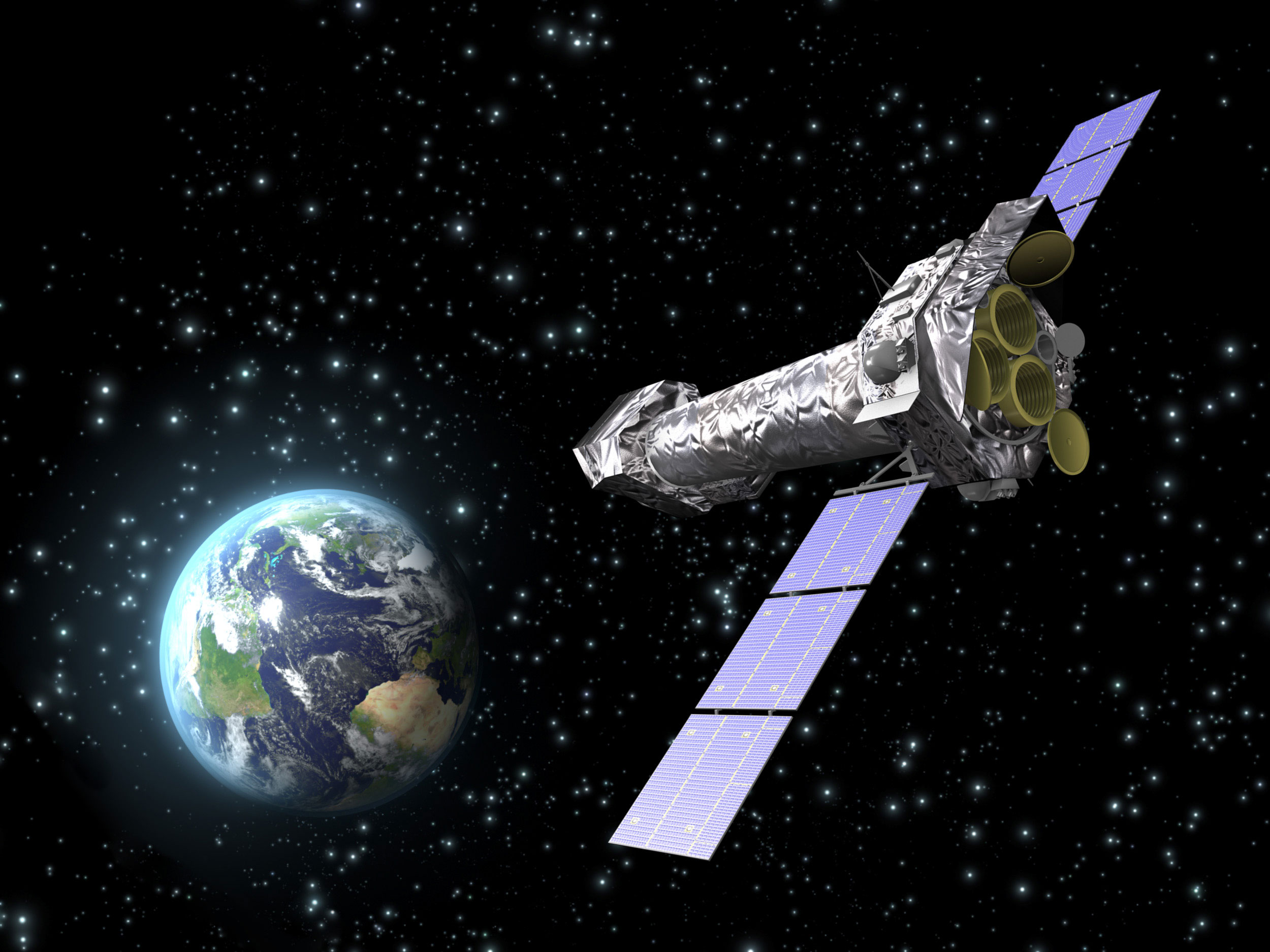
“We needed the sensitivity and frequency of LOFAR to detect the radio waves,” says co-author David Konijn, a PhD student working with Joe at ASTRON. “And without XMM-Newton, we wouldn’t have been able to determine the CME’s motion or put it in a solar context, both crucial for proving what we’d found. Neither telescope alone would have been enough – we needed both.”
The researchers determined the CME to be moving at a super-fast 2400 km per second, a speed only seen in 1 of every 20 CMEs taking place on the Sun. The ejection was both fast and dense enough to completely strip away the atmospheres of any planets closely orbiting the star.
In search of life
The atmosphere-stripping ability of the CME is an exciting discovery for our hunt for life around other stars. A planet’s habitability for life as we know it is defined by its distance from its parent star – whether or not it sits within the star’s ‘habitable zone’, a region where liquid water can exist on the surface of planets with suitable atmospheres. This is a Goldilocks scenario: too close to the star is too hot, too far is too cold, and in between is just right.
But what if that star is especially active, regularly throwing out dangerous eruptions of material and triggering violent storms? A planet regularly bombarded by powerful coronal mass ejections may lose its atmosphere entirely, leaving a barren rock behind – an uninhabitable world, despite its orbit being ‘just right’.
“This work opens up a new observational frontier for studying and understanding eruptions and space weather around other stars,” adds Henrik Eklund, an ESA research fellow based at the European Space Research and Technology Centre (ESTEC) in Noordwijk, The Netherlands.
“We’re no longer limited to extrapolating our understanding of the Sun’s CMEs to other stars. It seems that intense space weather may be even more extreme around smaller stars – the primary hosts of potentially habitable exoplanets. This has important implications for how these planets keep hold of their atmospheres and possibly remain habitable over time.”
The finding also informs our understanding of space weather, something that’s long been a focus for ESA missions and is currently being explored by SOHO, the Proba missions, Swarm, and Solar Orbiter.
XMM-Newton, meanwhile, is a leading explorer of the hot and extreme Universe. Launched in 1999, the space telescope has gazed into the cores of galaxies, studied stars to understand how they evolve, investigated the environs of black holes, and spotted intense bursts of energetic radiation from distant stars and galaxies.
“XMM-Newton is now helping us discover how CMEs vary by star, something that’s not only interesting in our study of stars and our Sun, but also our hunt for habitable worlds around other stars,” says ESA XMM-Newton Project Scientist Erik Kuulkers. “It also demonstrates the immense power of collaboration, which underpins all successful science. The discovery was a true team effort, and resolves the decades-long search for CMEs beyond the Sun.”
Reference: “Radio burst from a stellar coronal mass ejection” by J. R. Callingham, C. Tasse, R. Keers, R. D. Kavanagh, H. K. Vedantham, P. Zarka, S. Bellotti, P. I. Cristofari, S. Bloot, D. C. Konijn, M. J. Hardcastle, L. Lamy, E. K. Pass, B. J. S. Pope, H. Reid, H. J. A. Röttgering, T. W. Shimwell and P. Zucca, 12 November 2025, Nature.
DOI: 10.1038/s41586-025-09715-3
Never miss a breakthrough: Join the SciTechDaily newsletter.
Follow us on Google and Google News.
2 Comments
Oh, that Lister and his vindaloos.
Wow I really love this Space stuff