
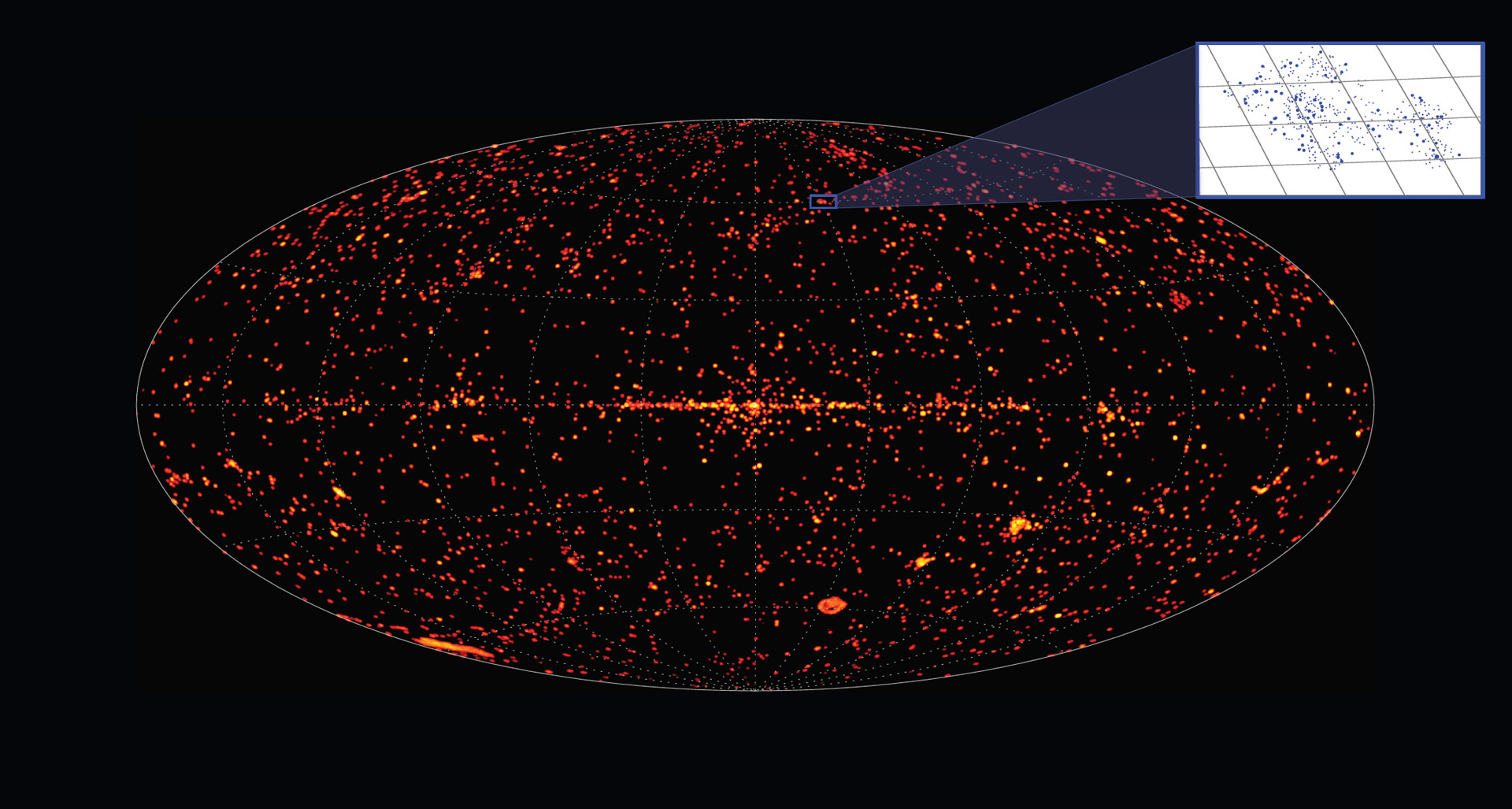
Scientists have set a new record for cosmic X-ray sources ever sighted, creating an unprecedented cosmic X-ray catalog with 531,261 detections of X-ray emitting objects and 372,728 unique X-ray sources identified.
The release of a new catalog from the XMM-Newton space telescope provides an unprecedented cosmic X-ray library for the exploration of the extreme Universe. The third XMM-Newton Serendipitous Source Catalog (3XMM-DR4) contains more than half a million sources, all of which are provided to a better quality than ever before. Improved data processing means that source identification is more reliable, and fainter objects are detected.
The catalog provides an exceptional dataset for generating large, well-defined samples of objects such as active galaxies (which dominate the detections in this catalog), clusters of galaxies, interacting compact binaries, and active stellar coronae. This vast inventory is also home to some of the rarest and most extreme phenomena in the Universe, such as tidal disruption events – when a black hole swallows another star, producing prodigious outbursts of X-ray emission.
“The catalog provides plenty of scope for new discoveries as well as in-depth studies of large samples,” says Professor Mike Watson of the University of Leicester, who leads the XMM-Newton Survey Science Center (SSC).
“XMM-Newton is pre-eminent amongst current X-ray missions in its ability to perform ‘survey’ science, with a chance to find previously undetected objects and then explore their properties.”
The sources in the 3XMM catalog are identified and isolated from serendipitous data recorded by XMM-Newton’s EPIC X-ray cameras. In each of the 600-700 observations made each year, around 70 extra sources are captured in addition to the target object which usually only takes up a small fraction of the field of view. Covering observations between February 2000 and December 2012, the catalog contains some 531,261 X-ray source detections relating to 372,728 unique X-ray sources.
“The third XMM-Newton Serendipitous Source Catalog shows how much added value can be gained from the observations,” notes Watson. “I’d like to pay tribute to the efforts of the whole team which were crucial to completing this major undertaking.”
Natalie Webb of the Institut de Recherche en Astrophysique et Planétologie, Toulouse is taking over from Leicester’s Simon Rosen as the SSC Manager for the next phase of the project. She comments: “Previous versions of the catalog have yielded unexpected and exciting results, and with around 50 percent more data now available, there should be plenty more to come. I look forward to the SSC continuing to play its leading role in this area.”
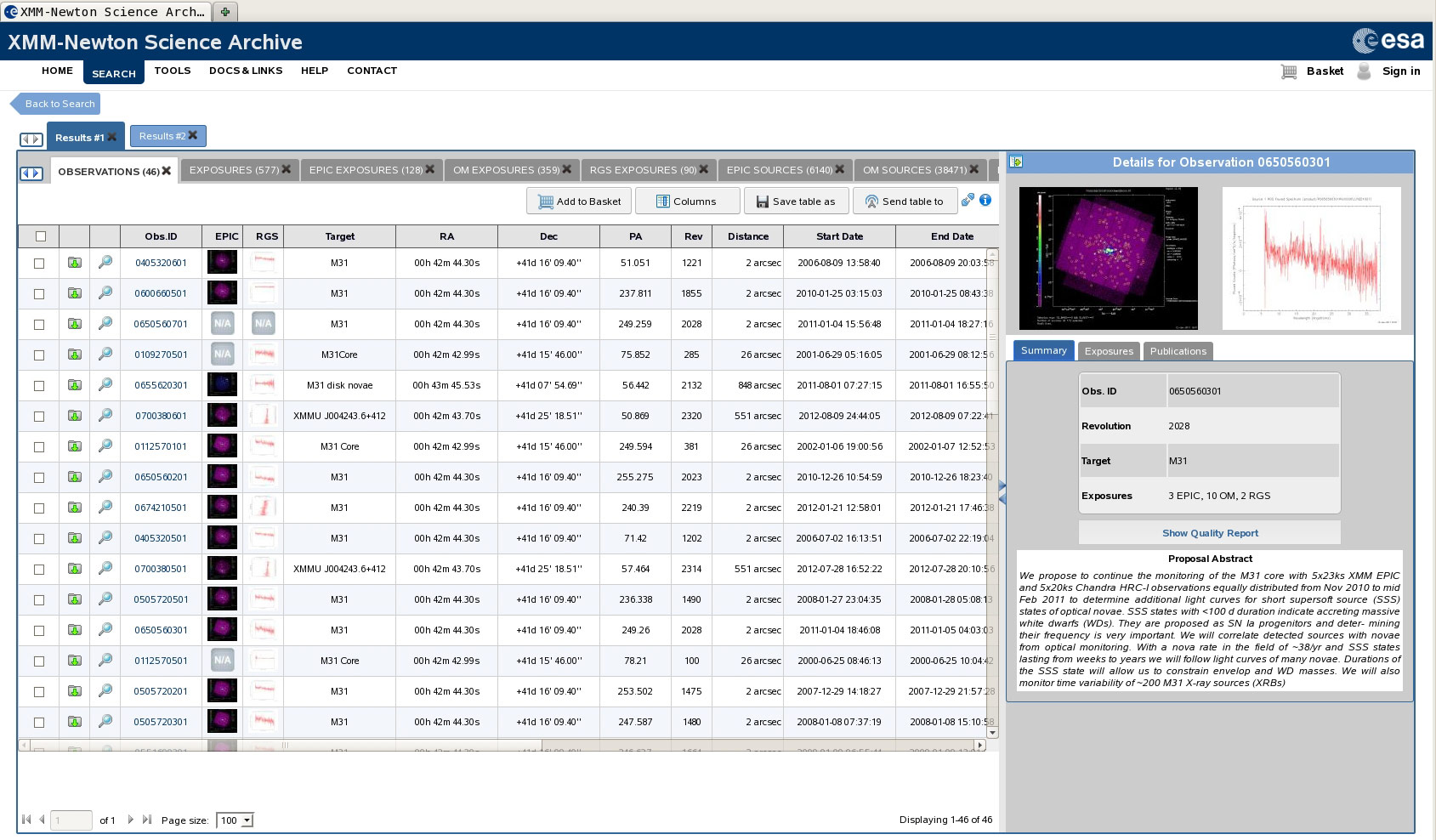
Coinciding with the publication of the 3XMM catalog, a new version of the XMM-Newton Science Archive (XSA) is released, providing convenient access to the catalog. The most visible change in XSA is the new web-based interface, but behind the scenes many changes have been introduced to make it easier and quicker to find and use the data.
XMM-Newton Archive Scientist Nora Loiseau took detailed feedback from the XMM-Newton community to define the capabilities needed for the new system to allow scientists to carry out research using data from the archive. The new archive is significantly faster, mainly because it uses different algorithms for indexing and searching. Searches are typically more than twenty times faster than before, and the new archive also facilitates some complex searches which had not been possible on the old system.
The XMM-Newton Survey Science Center, led by Professor Mike Watson at the University of Leicester, is a consortium of the following institutions:
University of Leicester, United Kingdom
Mullard Space Science Laboratory, University College London, United Kingdom
Institute of Astronomy, Cambridge, United Kingdom
Max-Planck Institut für extraterrestrische Physik, Garching, Germany
Astrophysikalisches Institut, Potsdam, Germany
Service d’Astrophysique, CEA/DSM/Dapnia, Saclay, France
Institut de Recherche en Astrophysique et Planétologie, Toulouse, France
Observatoire Astronomique de Strasbourg, France
Instituto de Fisica de Cantabria, Santander, Spain
Osservatorio Astronomico di Brera, Milan, Italy
The new catalog is the outcome of three years of work by the XMM-Newton Survey Science Center (SSC) team, led by the University of Leicester, which is responsible for its compilation. The main aim of these efforts has been to improve the processing of the XMM-Newton data, directed at producing a catalog with the highest quality and integrity as a resource for the astronomical community. One of the key improvements was the use of an improved description of the performance of XMM’s telescopes. This allowed the advanced software that automatically searches the X-ray images to disentangle complex groupings of objects more reliably. Amongst the host of other enhancements, a more sophisticated approach to treating the background signal was implemented, allowing more, fainter objects to be detected.
More about XMM-Newton Serendipitous Source Catalog: 3XMM-DR4: http://xmmssc-www.star.le.ac.uk/Catalogue/xcat_public_3XMM-DR4.html
Never miss a breakthrough: Join the SciTechDaily newsletter.
Follow us on Google and Google News.