
Close Menu
    Facebook X (Twitter) Instagram
    SciTechDaily
    • Biology
    • Chemistry
    • Earth
    • Health
    • Physics
    • Science
    • Space
    • Technology
    Facebook X (Twitter) Pinterest YouTube RSS
    SciTechDaily
    Home»Biology»Worms Reveal How Melatonin Works in the Brain to Promote Sleep
    Biology

    Worms Reveal How Melatonin Works in the Brain to Promote Sleep

    By University of ConnecticutFebruary 23, 2021No Comments3 Mins Read
    Facebook Twitter Pinterest Telegram LinkedIn WhatsApp Email Reddit
    Share
    Facebook Twitter LinkedIn Pinterest Telegram Email Reddit
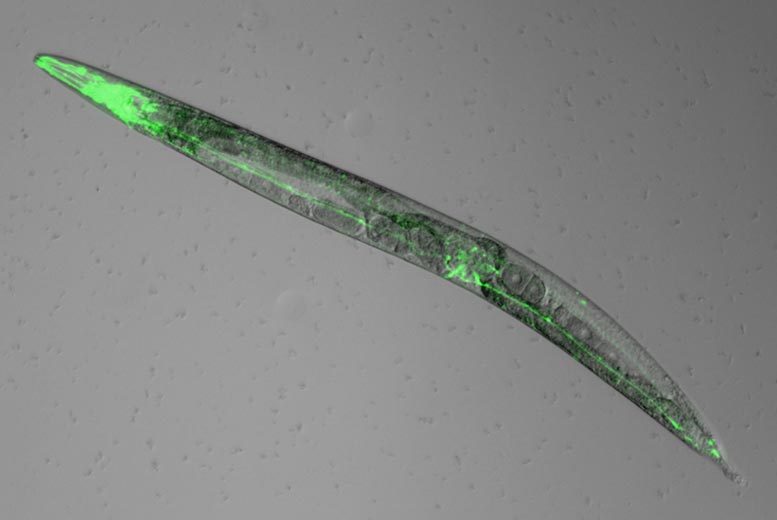
    Caennorhabditis elegans Worm
    The Caennorhabditis elegans worm’s neurons expressing the receptor for melatonin glow green. Credit: Bojun Chen/UConn Health

    Research in C. elegans shows how melatonin activates the BK channel in the brain.

    Melatonin is used as a dietary supplement to promote sleep and get over jet lag, but nobody really understands how it works in the brain. Now, researchers at UConn Health show that melatonin helps worms sleep, too, and they suspect they’ve identified what it does in us.

    Our bodies produce melatonin in darkness. It’s technically a hormone, but you can readily buy melatonin as a supplement in pharmacies, nutrition stores, and other retail shops. It’s widely used by adults and often in children as well.

    Melatonin binds to melatonin receptors in the brain to produce its sleep-promoting effects. Think of a receptor as a keyhole, and melatonin as the key. The two keyholes for melatonin are called MT1 and MT2 in human brain cells. But scientists didn’t really know what happens when the keyhole is unlocked. Now UConn Health School of Medicine neuroscientists Zhao-Wen Wang and Bojun Chen and their colleagues have identified that process through their work with C. elegans worms, as reported in Proceedings of the National Academy of Sciences. When melatonin fits into the MT1 receptor in the worm’s brain, it opens a potassium channel known as the BK channel.

    A major function of the BK channel in neurons is to limit the release of neurotransmitters, which are chemical substances used by neurons to talk to each other. In their search for factors related to the BK channel, the Wang and Chen labs found that a melatonin receptor is needed for the BK channel to limit neurotransmitter release. They subsequently found that melatonin promotes sleep in worms by activating the BK channel through the melatonin receptor. Worms that lack either melatonin secretion, the melatonin receptor, or the BK channel spend less time in sleep.

    But Wait — Worms Sleep?

    Indeed they do, says Chen. There’s actually been quite a lot of research on worm sleep, and researchers found that sleep is similar between worms and mammals like humans and mice.

    Wang and Chen next plan to see if the melatonin-MT1-BK relationship holds in mice. The BK channel is involved in all kinds of bodily happenings, from epilepsy to high blood pressure. By learning more about the relationships between the BK channel, sleep, and behavioral changes, the researchers hope both to understand melatonin better and also help people who suffer from other diseases related to the BK channel.

    Reference: “Melatonin promotes sleep by activating the BK channel in C. elegans” by Longgang Niu, Yan Li, Pengyu Zong, Ping Liu, Yuan Shui, Bojun Chen and Zhao-Wen Wang, 21 September 2020, Proceedings of the National Academy of Sciences.
    DOI: 10.1073/pnas.2010928117

    Never miss a breakthrough: Join the SciTechDaily newsletter.
    Follow us on Google and Google News.

    Biochemistry Cell Biology Neuroscience Pharmacology Physiology University of Connecticut
    Share. Facebook Twitter Pinterest LinkedIn Email Reddit

    Related Articles

    NIH Study Provides an Atlas to Pinpoint Neurons Involved in Neurodegenerative Diseases

    “Eat Me!” – The Cell Signal of Death

    Scientists Discover How Humans Develop Much Larger Brains Than Other Apes

    Cause of Alzheimer’s Disease Traced to Genetic Mutation in Common Enzyme

    Scientists Deconstruct the “Biological Clock” That Regulates Precise Timing of Complex Birdsong

    Scientists Find Neurochemicals – Dopamine and Serotonin – Have Unexpectedly Profound Roles in the Human Brain

    Neuroscientists Show How Interactions Between Neuronal Migration and Outgrowth Shape Network Architecture

    Laminin Alpha 5 is Crucial to Adolescent Brain Maturation

    Researchers Use Stem Cells from Teeth to Grow Brain-Like Cells

    Leave A Reply Cancel Reply

    • Facebook
    • Twitter
    • Pinterest
    • YouTube

    Don't Miss a Discovery

    Subscribe for the Latest in Science & Tech!

    Trending News

    Scientists Discover How Coffee Impacts Memory, Mood, and Gut Health

    Why Did the Neanderthals Disappear? Scientists Reveal Humans Had a Hidden Advantage

    Physicists Propose Strange Experiment Where Time Goes Quantum

    Magnesium Magic: New Drug Melts Fat Even on a High-Fat, High-Sugar Diet

    Weight-Loss Drugs Like Ozempic May Come With an Unexpected Cost

    Mezcal “Worm” in a Bottle Mystery: DNA Testing Reveals a Surprise

    New Research Reveals That Your Morning Coffee Activates an Ancient Longevity Switch

    This Is What Makes You Irresistible to Mosquitoes

    Follow SciTechDaily
    • Facebook
    • Twitter
    • YouTube
    • Pinterest
    • Newsletter
    • RSS
    SciTech News
    • Biology News
    • Chemistry News
    • Earth News
    • Health News
    • Physics News
    • Science News
    • Space News
    • Technology News
    Recent Posts
    • Harvard Scientists Reveal Secret Structure Behind How You Smell
    • Scientists Just Discovered the Hidden Trick That Keeps Your Cells Alive
    • This Simple Movement Could Be Secretly Cleaning Your Brain
    • Male Birth Control Breakthrough: Scientists Find Way To Turn Sperm Production Off and Back On
    • A Common Vitamin Could Hold the Key to Treating Fatty Liver Disease
    Copyright © 1998 - 2026 SciTechDaily. All Rights Reserved.
    • Science News
    • About
    • Contact
    • Editorial Board
    • Privacy Policy
    • Terms of Use

    Type above and press Enter to search. Press Esc to cancel.