
Close Menu
    Facebook X (Twitter) Instagram
    SciTechDaily
    • Biology
    • Chemistry
    • Earth
    • Health
    • Physics
    • Science
    • Space
    • Technology
    Facebook X (Twitter) Pinterest YouTube RSS
    SciTechDaily
    Home»Health»Desktop Air Curtain System Developed That Prevents Spread of COVID-19
    Health

    Desktop Air Curtain System Developed That Prevents Spread of COVID-19

    By American Institute of PhysicsMay 17, 2022No Comments3 Mins Read
    Facebook Twitter Pinterest Telegram LinkedIn WhatsApp Email Reddit
    Share
    Facebook Twitter LinkedIn Pinterest Telegram Email Reddit
    Desktop Air Curtain System COVID
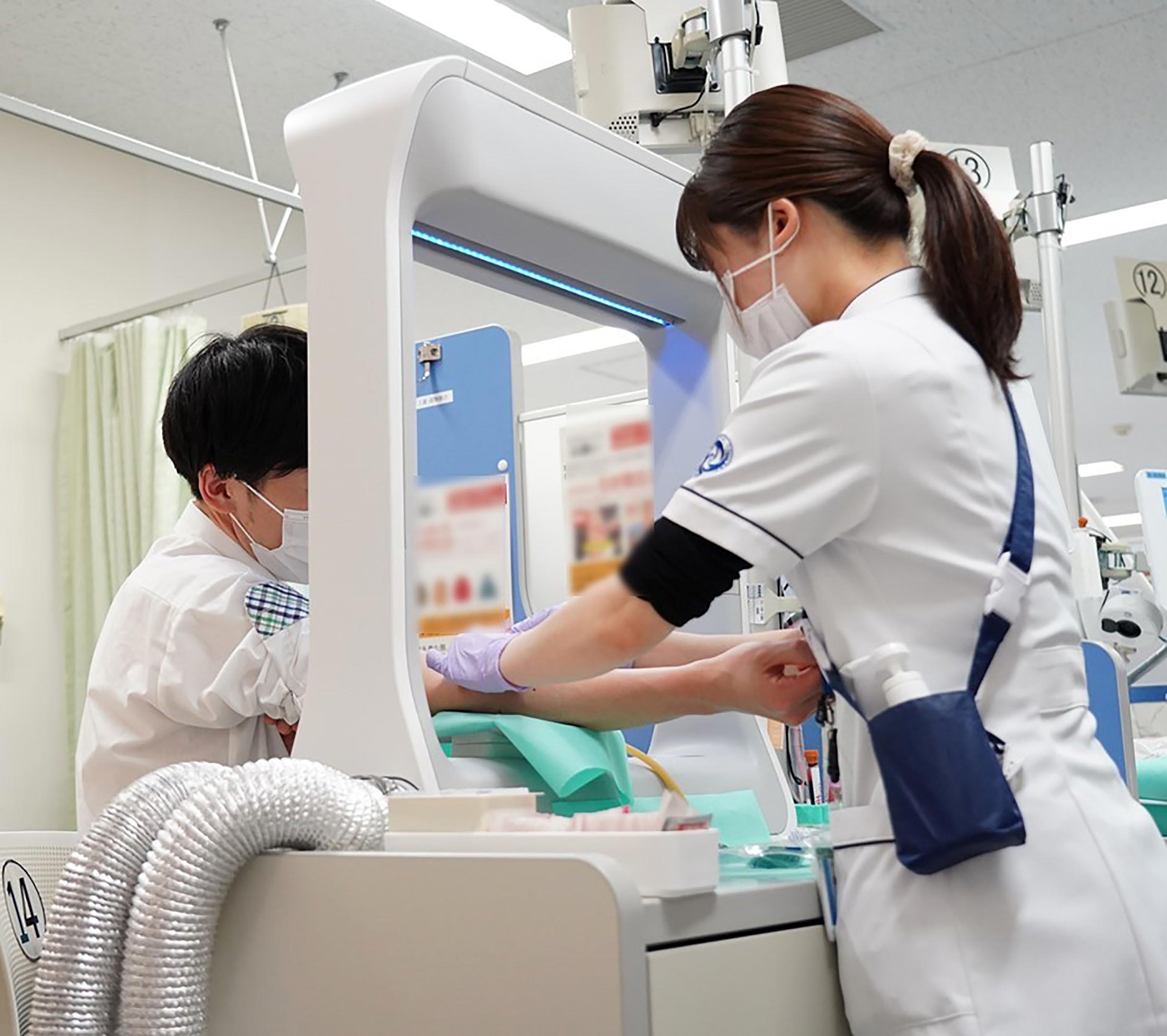
    DACS tested on patient at Nagoya University Hospital. Credit: Junki Mikami (FUIGO)

    Device Suitable for Use in Hospital Wards, Blood Labs, and Reception Counters

    In efforts to prevent the spread of COVID-19, miniaturizing air curtains for hospital wards, labs, and other health care settings is gaining popularity as a practical solution to inadequate face masks or when social distancing is not a realistic option.

    Researchers in Japan developed a desktop air curtain system (DACS) that blocks all incoming aerosol particles, as described in a new article in AIP Advances, published by AIP Publishing.

    “We envisage this system will be effective as an indirect barrier for use in blood-testing labs, hospital wards, and other situations where sufficient physical distance cannot be maintained, such as at a reception counter,” co-author Kotaro Takamure said.

    An air curtain, sometimes known as an air door, is a fan-powered ventilation system that creates an air seal over an entryway. They are used in hospitals to prevent ambulance fumes and other contaminants from reaching the inside of an emergency room.

    One challenge in developing smaller air curtains is fully blocking emitted aerosol particles over time because it is difficult to maintain the air wall over a long distance. As a result, the devices gradually lose air-discharge intensity, creating a turbulent flow that allows infected aerosol particles to escape into the surrounding environment.

    Airflow Design and Aerosol Blocking Mechanism

    The DACS contains a discharge and suction port to help address this problem. A generator at the top of the DACS produces the airflow, which is guided to the suction port at the bottom of the device. This prevents airflow dispersion, thus leading to the collection of all the aerosol particles at the suction port. A high-efficiency particulate air (HEPA) filter can be installed inside the suction port for air purification.

    The researchers are developing an accompanying virus inactivation system equipped with ultraviolet light that connects to the suction port. After the air is sanitized with the UV light, it is recirculated to maintain airflow of the air curtain and air pressure in the room.

    The researchers tested their device by using an air compressor connected to a mannequin to simulate breathing. Dioctyl sebacate, a widely used solvent that spreads easily, was added to the airflow to create aerosol particles. Particle image velocimetry and high-speed cameras were used to determine the DACS’s blocking effect.

    The aerosol particles approaching the DACS abruptly bent toward the suction port, signifying that air curtain flow fully blocked all incoming aerosol particles.

    When the researchers placed the mannequin’s arm through the DACS to imitate a blood-collection scenario, they found the airflow above the arm was disrupted. However, the aerosol blocking performance remained unaffected.

    The DACS was tested on patients during blood collection at Nagoya University Hospital. The researchers are looking at lowering the suction port, so the arm can be placed below the heart for proper blood collection.

    Reference: “Blocking effect of desktop air curtain on aerosols in exhaled breath” by Kotaro Takamure, Yasuaki Sakamoto, Tetsuya Yagi, Yasumasa Iwatani, Hiroshi Amano and Tomomi Uchiyama, 17 May 2022, AIP Advances.
    DOI: 10.1063/5.0086659

    Never miss a breakthrough: Join the SciTechDaily newsletter.
    Follow us on Google and Google News.

    American Institute of Physics COVID-19 Infectious Diseases
    Share. Facebook Twitter Pinterest LinkedIn Email Reddit

    Related Articles

    Hand-Held Particle Detector Measures Aerosols for Coronavirus Risk Assessment

    Some Masks Can Be Worse Than Not Wearing One at All: Physics of How Masks Affect Airflow and COVID-19 Protection

    There Many Different COVID-19 Tests – Which One to Choose?

    Time to Rethink COVID Predictions? Pandemic Infection Rates Are Deterministic but Cannot Be Modeled

    Contagion Transmission Model: Estimating Risk of Airborne COVID-19 With Mask Usage, Social Distancing

    Aerosol Microdroplets Not Very Effective at Spreading the COVID-19 Virus

    The Latest Science on How to Keep COVID-19 Out of School Classrooms

    Scientists Compare How COVID-19 Cough Clouds Travel With and Without Face Masks

    Evaporation Critical to Coronavirus Transmission As Weather Changes: Effects of Humidity, Temperature, and Wind on COVID-19

    Leave A Reply Cancel Reply

    • Facebook
    • Twitter
    • Pinterest
    • YouTube

    Don't Miss a Discovery

    Subscribe for the Latest in Science & Tech!

    Trending News

    5 Simple Ways To Remember More and Forget Less

    The Atomic Gap That Could Cost the Semiconductor Industry Billions

    Researchers Finally Solve 50-Year-Old Blood Group Mystery

    Scientists Discover “Molecular Switch” That Fuels Alzheimer’s Brain Inflammation

    Trees Emit Tiny Lightning Flashes During Storms and Scientists Finally Prove It

    Pomegranate Compound Could Help Protect Against Heart Disease

    Your Blood Test Might Already Show Alzheimer’s Risk

    Scientists Were Wrong About This Strange “Rule-Breaking” Particle

    Follow SciTechDaily
    • Facebook
    • Twitter
    • YouTube
    • Pinterest
    • Newsletter
    • RSS
    SciTech News
    • Biology News
    • Chemistry News
    • Earth News
    • Health News
    • Physics News
    • Science News
    • Space News
    • Technology News
    Recent Posts
    • Scientists Complete Largest 3D Map of the Universe to Probe Dark Energy
    • Hidden Parasite Found in Popular Portuguese Lake Raises Health Concerns
    • This Simple Trick Can Boost Your Workout Endurance by 20%
    • This Popular Supplement May Interfere With Cancer Treatment, Scientists Warn
    • Scientists Propose Radical New Way To Detect Alien Life – Without Traditional Biosignatures
    Copyright © 1998 - 2026 SciTechDaily. All Rights Reserved.
    • Science News
    • About
    • Contact
    • Editorial Board
    • Privacy Policy
    • Terms of Use

    Type above and press Enter to search. Press Esc to cancel.