
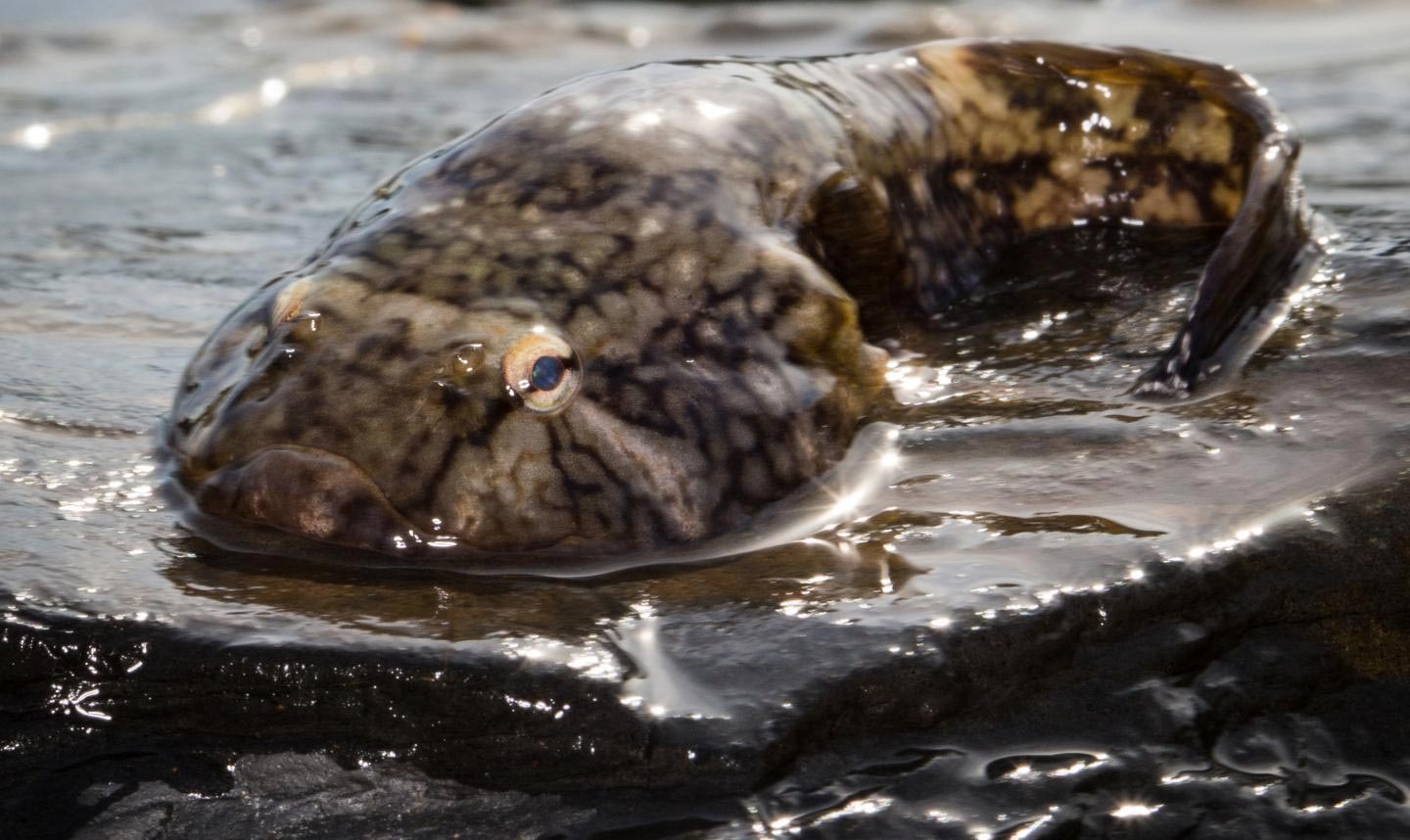
The finger-sized Northern clingfish employs one of the best suction cups in the world. A small disk on its belly can attach to wet, slimy, even rough surfaces and hold up to 230 times its own body weight.
A University of Washington team inspired by the clingfish’s suction power set out to develop an artificial suction cup that borrows from nature’s design. Their prototype, described in a paper published on September 9, 2019, in the journal Philosophical Transactions of the Royal Society B, actually performed better than the clingfish.
“I like to say, nature is always best,” said lead author Petra Ditsche, who started this work as a postdoctoral researcher at UW Friday Harbor Laboratories on San Juan Island. “In this case, when considering their attachment force, our suction cups are better.”

The suction cups could be useful across a number of industries that require a strong but reversible sticking force on rough or textured surfaces. These could include tagging whales and other marine animals, attaching sensors to fouled aquatic surfaces, or operating underwater vehicles to clean ship hulls. Applications in shower caddy design or industrial processing are other interesting fields of application for the bioinspired suction cups, the researchers said.
Key to their suction cup breakthrough was understanding how the clingfish’s natural suction works so effectively — especially on rough surfaces that normally cause a manufactured suction cup to fail.
Clingfish have a disc on their bellies that allows them to hold on with great tenacity. The rim of the disc is covered with layers of micro-sized, hairlike structures, in many different sizes. This layered effect creates more friction along the rim and helps the fish stick to rough surfaces. The entire disk is flexible and elastic, allowing it to adapt and hold on to coarse, uneven surfaces.

“These fish are so evocative in what they can do. They can stick to irregular rocks covered in algae, and you cannot buy something that will reversibly stick to those rocks,” said co-author Adam Summers, a professor of biology and of aquatic and fishery sciences based at Friday Harbor Labs. “An awful lot of experimentation and skepticism finally led us to understand how it worked.”
There are about 110 known species in the clingfish family found all over the world. The population around the San Juan Islands is robust and healthy. They often cling to rocks near the shore, and at low tide, they can be seen in tide pools and under rocks.
Many marine animals can stick strongly to underwater surfaces — sea stars, mussels, and anemones, to name a few — but few can release as fast as the clingfish, particularly after generating so much sticking power.
After more than five years spent deciphering how the clingfish suction cups work, the researchers began building their own prototype, borrowing from the innovations of nature.
The team discovered after years of lab tests that combining different materials helped give the artificial suction cups a rigid structure that was strong enough to hold tension, while also soft and flexible enough to conform and stick to rough surfaces. They also found a way to increase the friction on the rim of the cup.
“This combination of all these different aspects finally gave us good results and enabled us really to build a suction cup that is able to attach strongly to rough surfaces,” Ditsche said.
The researchers tested several iterations of their suction cup design by sticking them to a spectrum of rough and smooth surfaces, then pulling until each cup failed using a testing machine. They did the same tests using the natural clingfish suction disk. Each time, the most advanced artificial cup outperformed the clingfish suction across all surfaces.
The prototype is ready to be taken to the next step, ideally in collaboration with engineers who could develop the concept further with specific products and applications in mind, Ditsche said. Depending on how the cups are used, factors like temperature and sun exposure might require fine-tuning of the design.
“There’s an understanding of how something works. And then there’s understanding how it works so well that you can actually make one. Biology doesn’t always give you that opportunity,” Summers said. “This is a really unusual situation, where when we looked closely over time, we realized we could mimic what we saw.”
This research was funded by the National Science Foundation and the Seaver Institute.
Reference: “Learning from Northern clingfish (Gobiesox maeandricus): bioinspired suction cups attach to rough surfaces” by Petra Ditsche and Adam Summers, 9 September 2019, Philosophical Transactions of the Royal Society B.
DOI: 10.1098/rstb.2019.0204
Never miss a breakthrough: Join the SciTechDaily newsletter.
Follow us on Google and Google News.