

A new study uses computer simulations to track airflows inside a car’s passenger cabin, providing potential strategies — some of them counterintuitive — for reducing the risk of transmitting airborne diseases.
A new study of airflow patterns inside a car’s passenger cabin offers some suggestions for potentially reducing the risk of COVID-19 transmission while sharing rides with others.
The study, by a team of Brown University researchers, used computer models to simulate the airflow inside a compact car with various combinations of windows open or closed. The simulations showed that opening windows — the more windows the better — created airflow patterns that dramatically reduced the concentration of airborne particles exchanged between a driver and a single passenger. Blasting the car’s ventilation system didn’t circulate air nearly as well as a few open windows, the researchers found.
“Driving around with the windows up and the air conditioning or heat on is definitely the worst scenario, according to our computer simulations,” said Asimanshu Das, a graduate student in Brown’s School of Engineering and co-lead author of the research. “The best scenario we found was having all four windows open, but even having one or two open was far better than having them all closed.”
Das co-led the research with Varghese Mathai, a former postdoctoral researcher at Brown who is now an assistant professor of physics at the University of Massachusetts, Amherst. The study is published in the journal Science Advances.
The researchers stress that there’s no way to eliminate risk completely — and, of course, current guidance from the U.S. Centers for Disease Control (CDC) notes that postponing travel and staying home is the best way to protect personal and community health. The goal of the study was simply to study how changes in airflow inside a car may worsen or reduce the risk of pathogen transmission.
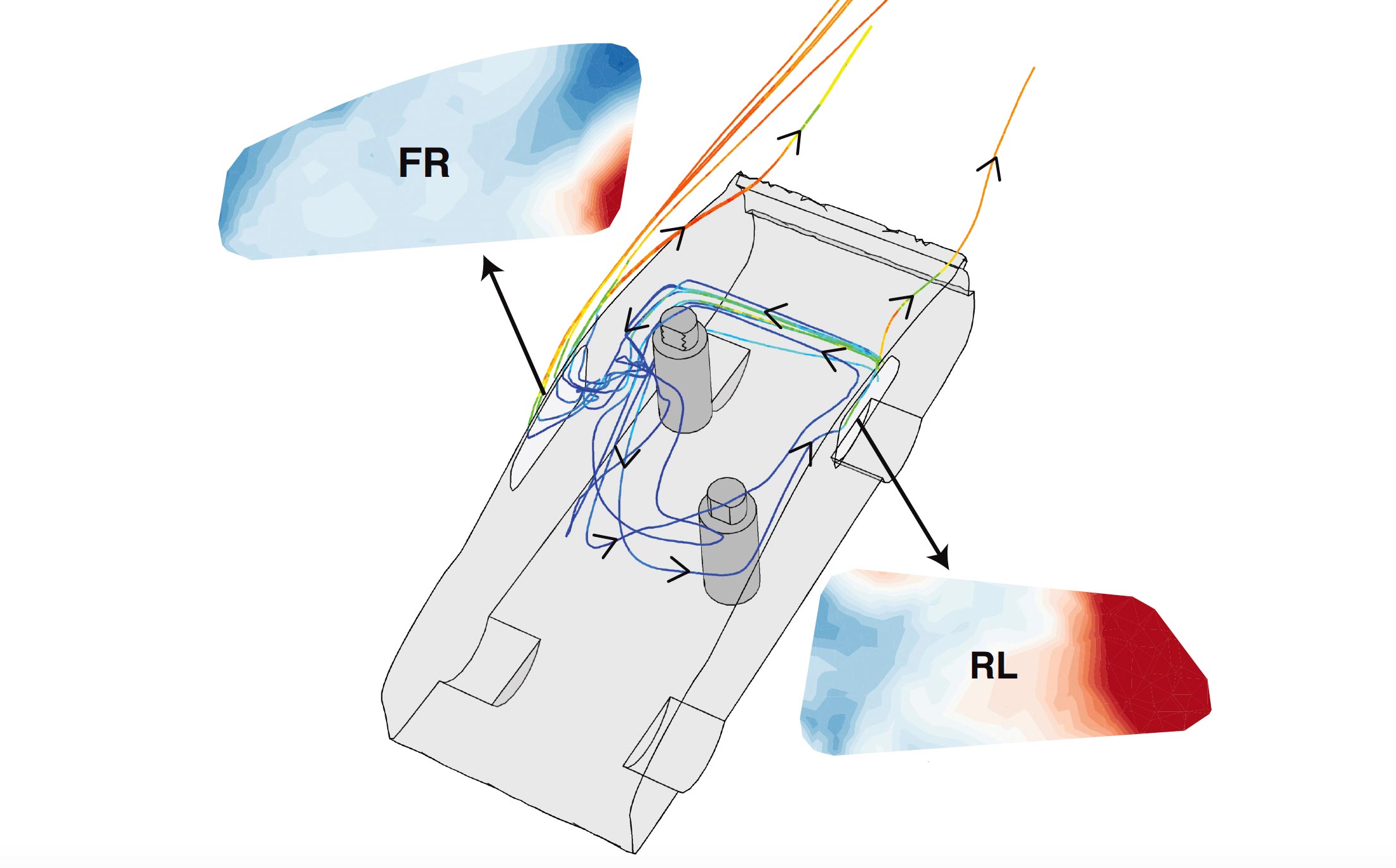
The computer models used in the study simulated a car, loosely based on a Toyota Prius, with two people inside — a driver and a passenger sitting in the back seat on the opposite side from the driver. The researchers chose that seating arrangement because it maximizes the physical distance between the two people (though still less than the 6 feet recommended by the CDC). The models simulated airflow around and inside a car moving at 50 miles per hour, as well as the movement and concentration of aerosols coming from both driver and passenger. Aerosols are tiny particles that can linger in the air for extended periods of time. They are thought to be one way in which the SARS-CoV-2 virus is transmitted, particularly in enclosed spaces.
Part of the reason that opening windows is better in terms of aerosol transmission is because it increases the number of air changes per hour (ACH) inside the car, which helps to reduce the overall concentration of aerosols. But ACH was only part of the story, the researchers say. The study showed that different combinations of open windows created different air currents inside the car that could either increase or decrease exposure to remaining aerosols.
Because of the way air flows across the outside of the car, air pressure near the rear windows tends to be higher than pressure at the front windows. As a result, air tends to enter the car through the back windows and exit through the front windows. With all the windows open, this tendency creates two more-or-less independent flows on either side of the cabin. Since the occupants in the simulations were sitting on opposite sides of the cabin, very few particles ended up being transferred between the two. The driver in this scenario is at slightly higher risk than the passenger because the average airflow in the car goes from back to front, but both occupants experience a dramatically lower transfer of particles compared to any other scenario.
The simulations for scenarios in which some but not all windows are down yielded some possibly counterintuitive results. For example, one might expect that opening windows directly beside each occupant might be the simplest way to reduce exposure. The simulations found that while this configuration is better than no windows down at all, it carries a higher exposure risk compared to putting down the window opposite each occupant.
“When the windows opposite the occupants are open, you get a flow that enters the car behind the driver, sweeps across the cabin behind the passenger, and then goes out the passenger-side front window,” said Kenny Breuer, a professor of engineering at Brown and a senior author of the research. “That pattern helps to reduce cross-contamination between the driver and passenger.”
It’s important to note, the researchers say, that airflow adjustments are no substitute for mask-wearing by both occupants when inside a car. And the findings are limited to potential exposure to lingering aerosols that may contain pathogens. The study did not model larger respiratory droplets or the risk of actually becoming infected by the virus.
Still, the researchers say the study provides valuable new insights into air circulation patterns inside a car’s passenger compartment — something that had received little attention before now.
“This is the first study we’re aware of that really looked at the microclimate inside a car,” Breuer said. “There had been some studies that looked at how much external pollution gets into a car, or how long cigarette smoke lingers in a car. But this is the first time anyone has looked at airflow patterns in detail.”
The research grew out of a COVID-19 research task force established at Brown to gather expertise from across the University to address widely varying aspects of the pandemic. Jeffrey Bailey, an associate professor of pathology and laboratory medicine and a coauthor of the airflow study, leads the group. Bailey was impressed with how quickly the research came together, with Mathai suggesting the use of computer simulations that could be done while laboratory research at Brown was paused for the pandemic.
“This is really a great example of how different disciplines can come together quickly and produce valuable findings,” Bailey said. “I talked to Kenny briefly about this idea, and within three or four days his team was already doing some preliminary testing. That’s one of the great things about being at a place like Brown, where people are eager to collaborate and work across disciplines.”
Reference: “Airflows inside passenger cars and implications for airborne disease transmission” by Varghese Mathai, Asimanshu Das, Jeffrey A. Bailey and Kenneth Breuer, 4 December 2020, Science Advances.
DOI: 10.1126/sciadv.abe0166
Never miss a breakthrough: Join the SciTechDaily newsletter.
Follow us on Google and Google News.
40 Comments
The author is really digging for a story here. The CoV-19 flow in a port-a-potty would be the next logical step. Millions of construction workers would read that one for sure. lol
As a rideshare driver and passenger, i find this article highly relevant. You must not get out much.
What about train,bus,airplanes?
Don’t open the window in the airplane.
I am really glad I read this would not have known this I live in the North so if you see me driving with the top down you’ll know it’s me
Very helpful for ride share and cab drivers to know. People still need to get around, as as essential workers, they need to know how to do their jobs as safely as possible.
What about the potential for transmissions from other cars around you with windows down? I know when someone in front of me is smoking cigs vaping or weed. That air was just in their lungs.
EXACTLY !!! I’m been telling this to all my friends and family and just get blank stares back. Some things are simply too scary for some folks to contemplate I suppose.
This only applies to strangers, or Uber or other forms of carrying unrelated persons in vehicles. I will not wear a mask while driving. It is a waste of disposable masks.
Do women in burkas wear masks under their burkas ❓
Do women in burkas wear masks 😷 under their burkas❓
Did they account for the HEPA filtration used in all cars to recirculate the air? Mmm nope.
How about a study that does NOT include 100% common sense? This is already known, how about ANY kind of study that includes someone WITH the disease in a room with people without the disease? I have not had COVID-19 and would be willing to take my chances in helping with something like this, as long as whatever happens be publicly presented. No theories, no personal opinions and no editing let the numbers be shown and let people make their own judgement on the matter. Some people may need interpreters for this but they will find someone they trust to interpret.
Good one unfortunately I think it would be a long wait for that test.
Do cars need to drive six feet apart?
What a colossal waste of time and money.
It’s very informative for rideshare drivers.
NBC,as in the nightmare of nuclear, BIOLOGICAL WAR, special filters modified to kill viruses. On A/C heater ect. and full chemical suits modified gas mask to also kill viruses. or don’t care until it’s too late. Prevention worth more, an once/pound – Pounds/Ton do the math.
Cars or trucks have a cabin filter. And you can choose to circulate the cabin air and not the outside air. So was this study done?? Doubt it cause that would be common sense. Keep your windows up and use cabin air only. 🤦♂️
Leaving windows up with cars circulation on was the worst. It was addressed in the study.
Blasting the car’s ventilation system didn’t circulate air nearly as well as a few open windows, the researchers found.
“Driving around with the windows up and the air conditioning or heat on is definitely the worst scenario, according to our computer simulations,”
Yes, open windows ventilate better then the vehicles HVAC system. Everyone knows this. What’s the first thing desperately reached for when someone lets one rip? It isn’t the fan speed switch.
What does 99.7 survival say to me?
Uhhh. Common sense here, people! This is nothing new!!! ANY illness is going to be more infectious in confined spaces. Are people actually this stupid? Or does the author simply lack the intellectual capacity to write something meaningful?
Good Lord, help us all!!!
Get a Horse!
Just don’t leave your basement. Solves the problem.
Why during a pandemic would anyone be car pooling right now? And if your car is equipped with HEPA/cabin air filters-great-there installed for better air quality from pollen, dust and logical driving environments…not a freakin pandemic virus! If we all stayed in our own states, our own homes and actually limited all the moving about just to make a buck we might actually get through this…but as long as we are still ordering packages from overseas, sharing gas pump handles and going out for scratch tickets…you may as well put a HEPA on your face.
Yeah what I’m seeing is anyone driving in dead winter for a living without all the windows down is probably going to catch covid mask or no mask.
In all the centuries we’ve lived with viruses no one came up with this insane ideology. What were they thinking. Especially a virus with a nearly a 99% survival rate. But you keep reaching…utilize your time better.
You won’t be satisfied until you’ve unecessarily scared the poo out of every living creature. Will you do just anything for money or to get your names in lights?
Someone actually paid to have this study done? Windows up, no airflow, recycled breath air. Guess what happens when you open a window? YOU LET IN FRESH AIR! And if you press the gas peddle and move…. AIRFLOW!
This a good one for the caribbean to know about.
Hope the taxpayers didn’t have to pay too much for this “study”.
Haha. Well i read the article. Currently here in my state its 30 degrees(f) with a low of 22. It will only get colder as we creep into january and February. Cant say i or anyone else really wants to roll their windows down and keep the heat (ventilation) system off. That is, once the snow starts flying and it seems like a artic tundra outside if your windows are not already frozen in the up position.
Before anybody dismisses this article, we need to understand the science of CFD. Taking an informed look at the streamlines and pressure profiles near the window, we can see that opening the left rear window, and the right front windows a little sets up a circulation flow that protects both driver and passenger the most. I don’t think most people knew that before the study.
Really. You had to do a study to find out windows open is the best option. Lol. How much did that study cost? Anyone with half a brain already knows this. Real breaking news here.
Cross-ventilation.
This is the death of science
Is there any commen sense in the world ?
very good
I agree that the better the air circulation is in the car, the stronger protection from viruses and microbes is. But you cannot negate the role or a good cleaning after all. So you can read this post about proper vehicle cleaning and how you can clean your car with a pressurized washer without any damage.
thanks a lot!