
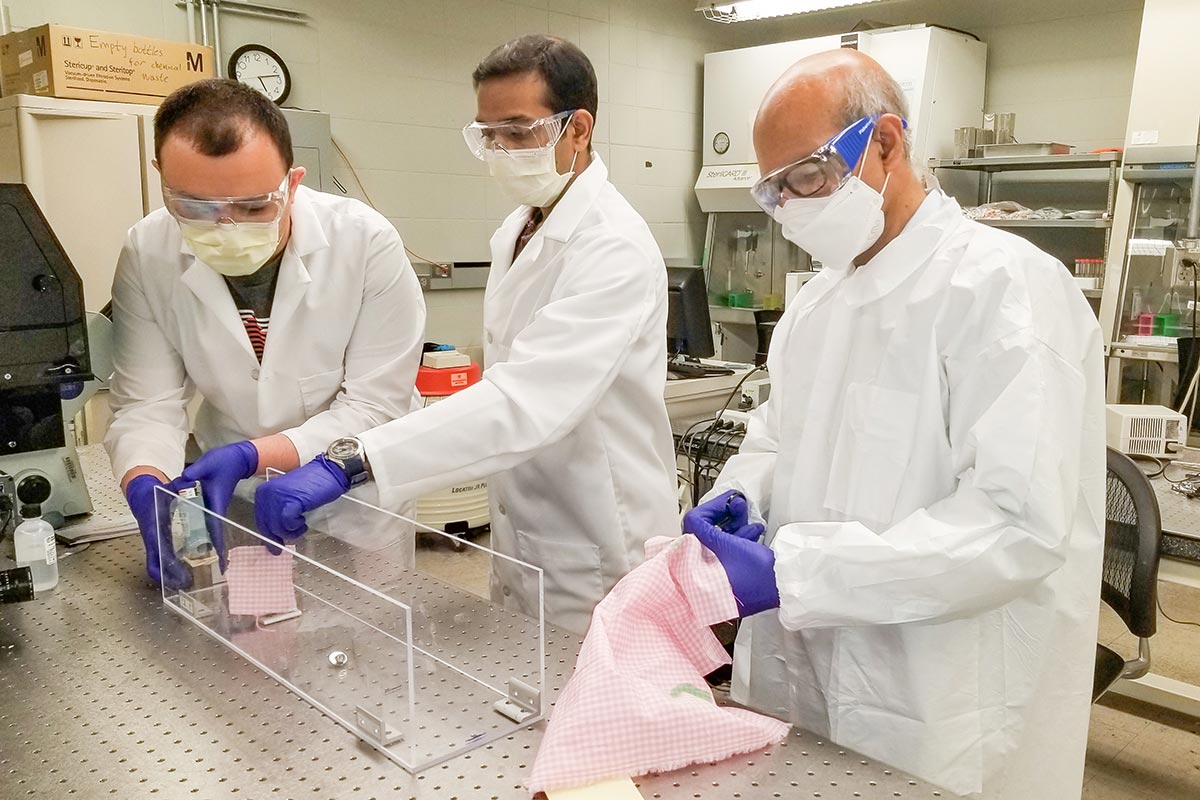
UIUC Editor’s note: Health authorities believe COVID-19 spreads by the transmission of respiratory droplets, and the Centers for Disease Control and Prevention recommends homemade cloth face coverings for use in public spaces. Starting today, Illinois joins many other states in requiring people to wear masks while out. However, initial uncertainty regarding the masks’ effectiveness in reducing exhaled droplets leaves some people unsure or skeptical of their usefulness during the current COVID-19 pandemic. Mechanical science and engineering professor Taher Saif spoke with News Bureau physical sciences editor Lois Yoksoulian about a study that he and his graduate students, Onur Aydin and Bashar Emon, performed on the effectiveness of common household fabrics for use in homemade masks.
Physically speaking, are the respiratory droplets produced by talking and breathing the same as those that come from a cough or a sneeze?
The droplets released during sneezing and coughing are larger than those released while speaking and breathing, and any of these droplets may carry many virus particles. The larger droplets tend to fall nearby due to gravity, but the smaller ones can go far, with the majority of them remaining within six feet of the infected individual. Unfortunately, because symptomatic, presymptomatic and asymptomatic carriers can shed the coronavirus, we cannot tell without testing which individuals are the sources of infection. Hence, a physical barrier, such as a mask, can prevent the spreading.
How does droplet type influence the fabric choice and the number of layers used to make a mask?
The droplets released during coughing and sneezing come in various sizes and velocities. The fabric for any mask should be breathable and impermeable to high- and low-velocity droplets. It is important to realize that a highly impermeable fabric is likely to be less breathable. Low breathability will force airflow through the sides and will defeat the purpose of the mask. In that case, the mask simply gives a false sense of safety. The choice of fabric and the number of layers is a matter of compromise between breathability and droplet resistance. We need to maximize both.
What fabric properties did you test?
We tested the breathability and droplet blocking ability of common household fabrics. To quantify breathability, we simply measure the airflow velocity through the material. Measuring droplet blocking is a more complicated process that uses an inhaler to generate high-velocity droplets.
We fill the nozzle of an inhaler with distilled water mixed with 100-nanometer fluorescent particles, which mimic the coronavirus in size. When puffed, the inhaler forces the water through the nozzle and generates high-momentum droplets that we collect on a plastic dish placed vertically in front of the inhaler. We then repeat the process with the fabric we are testing over the collection dish. We measure how much water landed on the dish in both cases by counting the nanoparticles using a microscope. We can then use the ratio of the volume collected with and without the fabric to give us a measure of droplet-blocking efficiency.
What types of fabric did you examine?
We considered a set of 10 common household fabrics and compared their properties with those of a medical/dental-quality mask as a benchmark. The fabrics had different combinations of cotton, polyester and silk. We also measured the breathability and resistance for two- and three-layered T-shirt fabric. Our work produced two key findings.
First, most common household fabrics, such as T-shirt material, have 40% or higher droplet blocking when used as a single layer. In two layers, to our surprise, T-shirt fabric had a 98% droplet blocking efficiency – exceeding that of the medical mask, while maintaining better breathability.
Second, most common fabrics are hydrophilic, meaning they up soak water, whereas medical masks are hydrophobic, meaning they repel water. This tells us that common household fabrics use an alternative mechanism to hold droplets by retaining them.
Reference: “Performance of fabrics for home-made masks against spread of respiratory infection through droplets: a quantitative mechanistic study” by Onur Aydin, Md Abul Bashar Emon and M Taher A Saif, 24 April 2020, medRxiv.
DOI: 10.1101/2020.04.19.20071779
Never miss a breakthrough: Join the SciTechDaily newsletter.
Follow us on Google and Google News.