
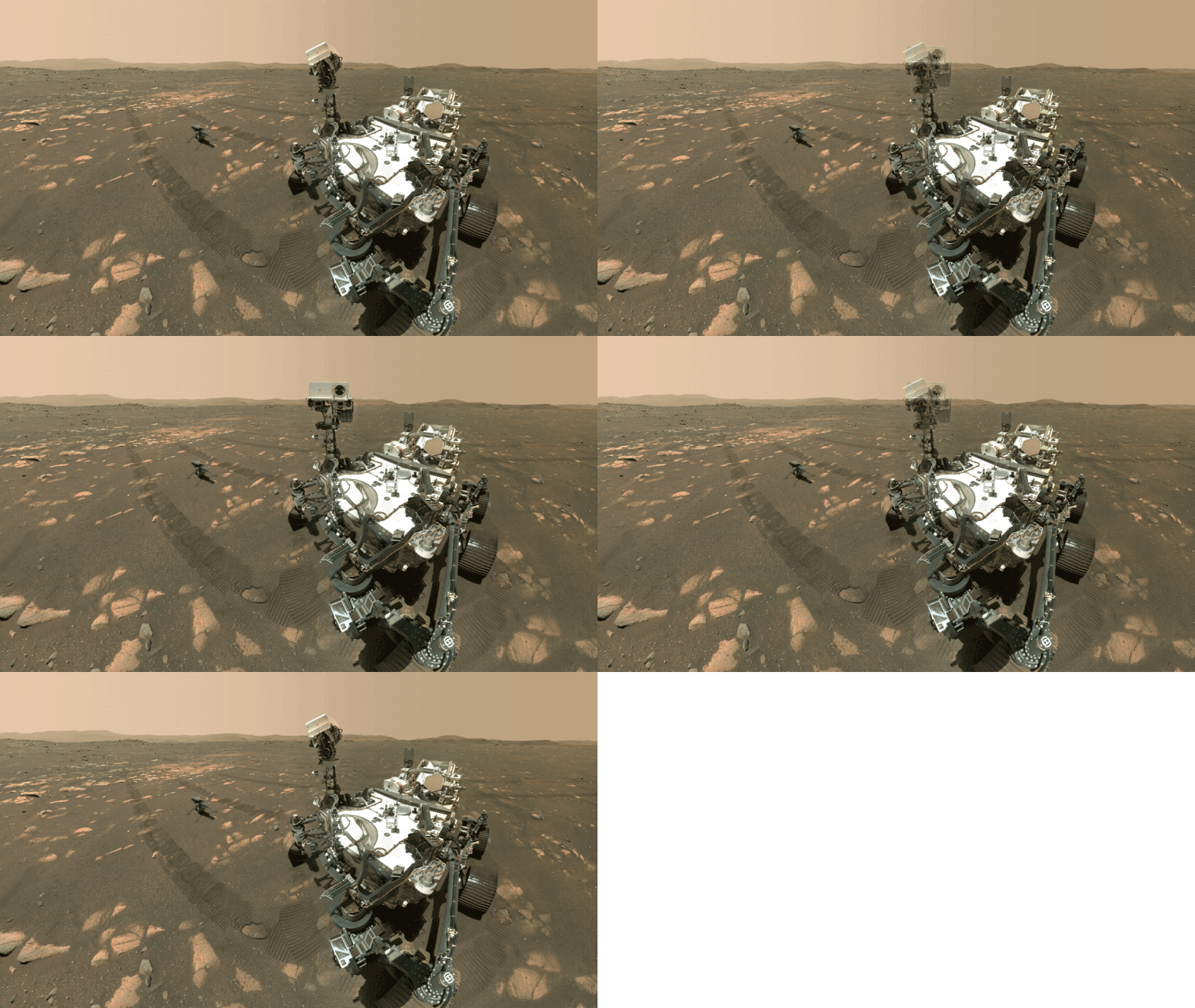
The historic image of the rover beside the Mars Helicopter proved to be one of the most complex rover selfies ever taken. Video, with bonus audio, sheds light on the process.
Ever wondered how Mars rovers take a selfie? Color video from NASA’s Perseverance shows how the rover captured the historic April 6, 2021, image of itself beside the Ingenuity Mars Helicopter. As a bonus, the rover’s entry, descent, and landing microphone captured the sound of the arm’s motors whirring during the process.
Selfies allow engineers to check wear and tear on the rover. But they also inspire a new generation of space enthusiasts: Many rover team members can cite a favorite image that sparked their interest in NASA.
“I got into this because I saw a picture from Sojourner, NASA’s first Mars rover,” said Vandi Verma, Perseverance’s chief engineer for robotic operations at NASA’s Jet Propulsion Laboratory in Southern California. Verma worked as a driver for the agency’s Opportunity and Curiosity rovers, and she helped to create Curiosity’s first selfie, snapped on October 31, 2012. “When we took that first selfie, we didn’t realize these would become so iconic and routine,” she said
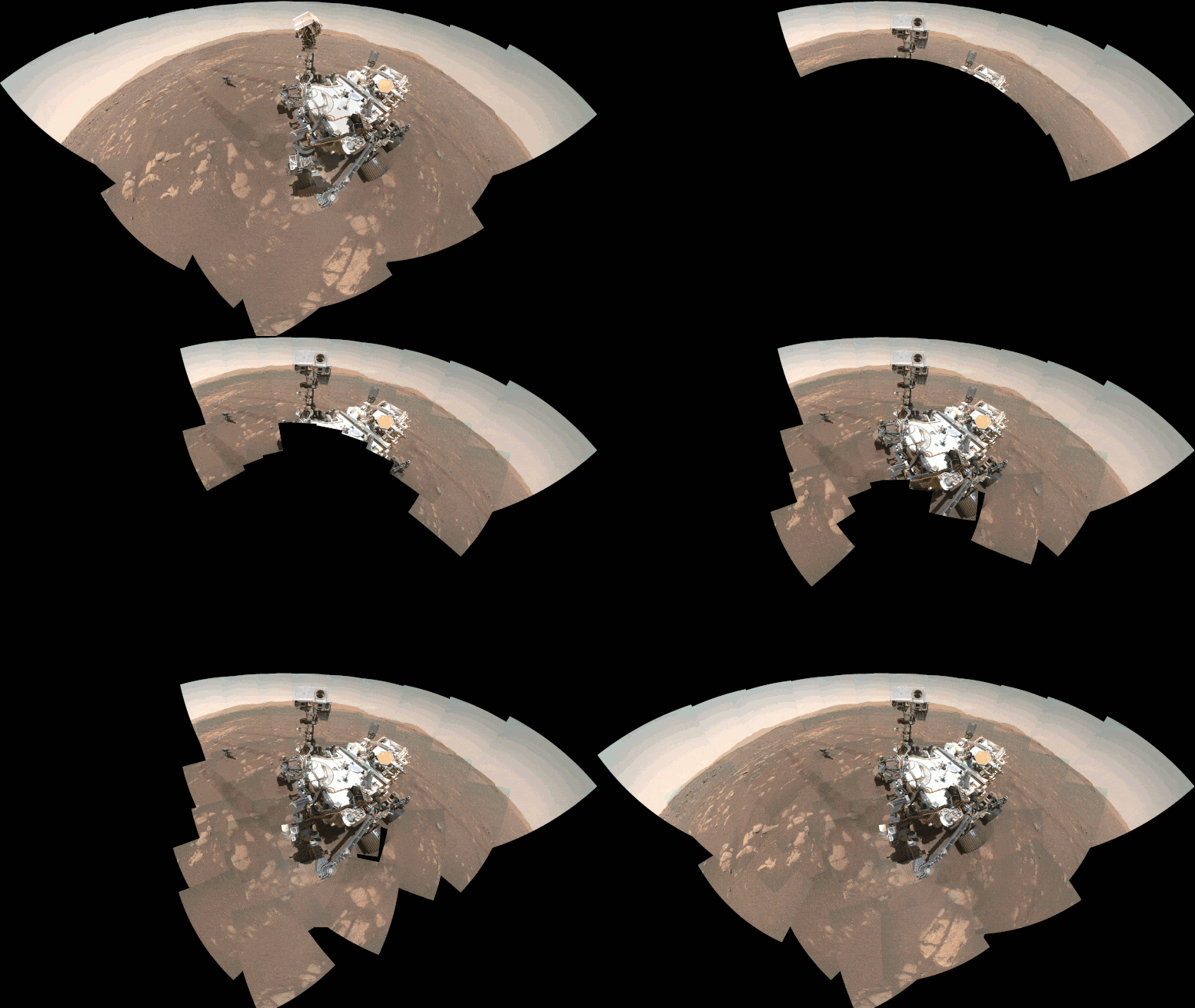
Video from one of Perseverance’s navigation cameras shows the rover’s robotic arm twisting and maneuvering to take the 62 images that compose the image. What it doesn’t capture is how much work went into making this first selfie happen. Here’s a closer look.
NASA’s Perseverance rover captured a historic group selfie with the Ingenuity Mars Helicopter on April 6, 2021. But how was the selfie taken? Vandi Verma, Perseverance’s chief engineer for robotic operations at NASA’s Jet Propulsion Laboratory in Southern California breaks down the process in this video. Credit: NASA/JPL-Caltech/MSSS
Teamwork
Perseverance’s selfie came together with the help of a core group of about a dozen people, including rover drivers, engineers who ran tests at JPL, and camera operations engineers who developed the camera sequence, processed the images, and stitched them together. It took about a week to plot out all the individual commands required.
Everyone was working on “Mars time” (a day on the Red Planet is 37 minutes longer than on Earth), which often means being awake in the middle of the night and catching up on sleep during the day. These team members sometimes passed up that sleep just to get the selfie done.
JPL worked with Malin Space Science Systems (MSSS) in San Diego, which built and operates the camera responsible for the selfie. Called WATSON (Wide Angle Topographic Sensor for Operations and eNgineering), the camera is designed primarily for getting close-up detail shots of rock textures, not wide-angle images. Because each WATSON image covers only a small portion of a scene, engineers had to command the rover to take dozens of individual images to produce the selfie.
“The thing that took the most attention was getting Ingenuity into the right place in the selfie,” said Mike Ravine, Advanced Projects Manager at MSSS. “Given how small it is, I thought we did a pretty good job.”
This computer simulation shows NASA’s Perseverance Mars rover taking its first selfie, on April 6, 2021. The point of view of the rover’s WATSON camera is included to show how each of the 62 images were taken before being sent to Earth and stitched together into the selfie. Credit: NASA/JPL-Caltech
When images come down from Mars, the MSSS image processing engineers began their work. They start by cleaning up any blemishes caused by dust that settled on the camera’s light detector. Then, they assemble the individual image frames into a mosaic and smooth out their seams using software. Finally, an engineer warps and crops the mosaic so that it looks more like a normal camera photo that the public is used to seeing.
Computer Simulations
Like the Curiosity rover (this black-and-white video from March 2020 shows how it takes a selfie), Perseverance has a rotating turret at the end of its robotic arm. Along with other science instruments, the turret includes the WATSON camera, which stays focused on the rover during selfies while being angled to capture a part of the scene. The arm acts like a selfie stick, remaining just out of frame in the final product.
Commanding Perseverance to film its selfie stick in action is much more challenging than with Curiosity. Where Curiosity’s turret measures 22 inches (55 centimeters) across, Perseverance’s turret is much bigger, measuring 30 inches (75 centimeters) across. That’s like waving something the diameter of a road bike wheel just centimeters in front of Perseverance’s mast, the “head” of the rover.
JPL created software to ensure the arm doesn’t collide with the rover. Each time a collision is detected in simulations on Earth, the engineering team adjusts the arm trajectory; the process repeats dozens of times to confirm the arm motion is safe. The final command sequence gets the robotic arm “as close as we could get to the rover’s body without touching it,” Verma said.
They run other simulations to ensure that, say, the Ingenuity helicopter is positioned appropriately in the final selfie or the microphone can capture sound from the robotic arm’s motors.
The Sound of Selfies
Along with its entry, descent, and landing microphone, Perseverance carries a microphone in its SuperCam instrument. The mics mark a first for NASA’s Mars spacecraft, and audio promises to be an important new tool for rover engineers in the years ahead. Among other uses, it can provide important details about whether something is working right. In the past, engineers would have to settle for listening to a test rover on Earth.
“It’s like your car: Even if you’re not a mechanic, sometimes you hear a problem before you realize something’s wrong,” Verma said.
While they haven’t heard anything concerning to date, the whirring motors do sound surprisingly musical when reverberating through the rover’s chassis.
More About the Mission
A key objective for Perseverance’s mission on Mars is astrobiology, including the search for signs of ancient microbial life. The rover will characterize the planet’s geology and past climate, pave the way for human exploration of the Red Planet, and be the first mission to collect and cache Martian rock and regolith (broken rock and dust).
Subsequent NASA missions, in cooperation with ESA (European Space Agency), would send spacecraft to Mars to collect these sealed samples from the surface and return them to Earth for in-depth analysis.
The Mars 2020 Perseverance mission is part of NASA’s Moon to Mars exploration approach, which includes Artemis missions to the Moon that will help prepare for human exploration of the Red Planet.
JPL, which is managed for NASA by Caltech in Pasadena, California, built and manages operations of the Perseverance rover.
Never miss a breakthrough: Join the SciTechDaily newsletter.
Follow us on Google and Google News.
2 Comments
EPIC!!!
How many robots does it take NASA to screw in a lightbulb? The Chinese seem to have taken a much more practical route, that of dropping a camera to take the selfie. One and done.
If we’re just trying to technologically show off, the ultimate demonstration would be to concede that human space exploration is pointless. Not only is it an order of magnitude or two more expensive, it is crippled by the difficult constraint of not killing astronauts. And the goal? Is it “bases” or “communities” off-earth? Really? That’s never going to work out, for way too many reasons to get into here. And going to other planetary systems, requiring travel at a significant fraction of the speed of light is also not going to happen; colossally wasting money on human spaceflight today won’t help fund the research needed to completely upend physics to make that possible, if it is at all . . .