

NASA’s Curiosity has uncovered a vast lattice of mineral “boxwork” ridges on Mount Sharp, evidence that groundwater lingered beneath the Martian surface even after its rivers and lakes vanished.
Hardened by minerals and exposed by relentless winds, the ridges exist only in one mysterious layer, where surprising veins of calcium sulfate have re-emerged.
Curiosity’s Close-Up Revelation
New images from NASA’s Curiosity rover are offering the first close-up look at a part of Mars that scientists had only observed from orbit—until now. These detailed views are already raising new questions about how the Martian surface changed over billions of years. Mars once had flowing rivers, lakes, and possibly even an ocean. But for reasons still unclear, that water eventually disappeared, transforming the planet into the cold, dry desert we see today.
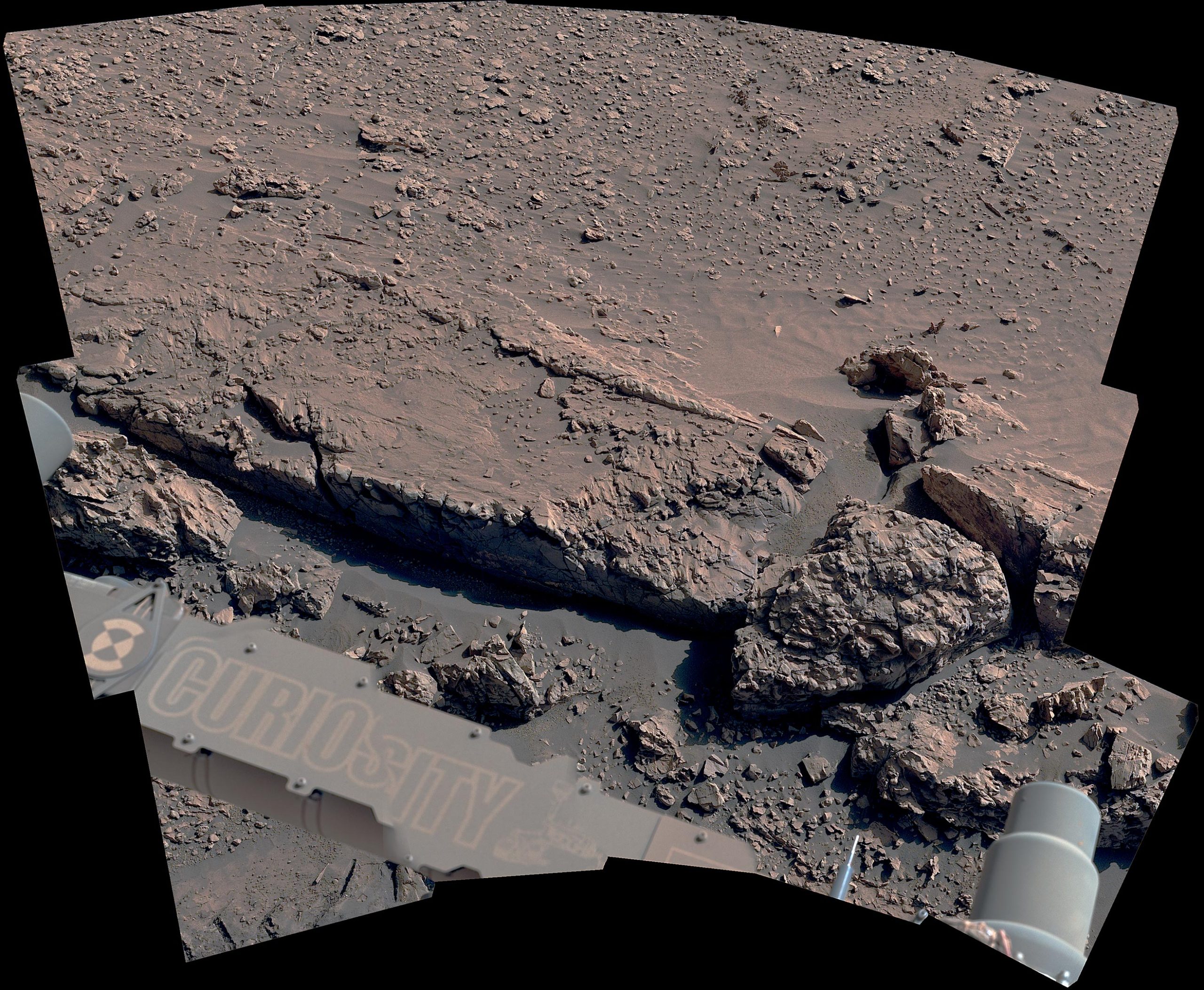
By the time the layer Curiosity is now exploring was formed, the long-lived lakes in Gale Crater—its landing site—had already vanished. But groundwater was still present beneath the surface. Curiosity found dramatic evidence of this underground water in the form of low ridges, just a few inches tall, that crisscross the terrain in a pattern geologists call “boxwork.” These boxy structures likely formed when mineral-rich groundwater seeped through cracks in the bedrock, depositing materials that hardened over time. While the softer surrounding rock eroded from wind and dust over eons, the hardened mineral ridges remained, revealing a hidden framework etched into the landscape.
The ridges themselves resemble a crumbling curb and stretch for miles across a specific layer of Mount Sharp, a 3-mile-high mountain whose foothills Curiosity has been climbing since 2014. Interestingly, boxwork patterns like these haven’t been seen anywhere else on the mountain, not by Curiosity or by orbiting spacecraft.
Drag your mouse or move your phone to pan around within this 360-degree view to explore the boxwork patterns on Mars that NASA’s Curiosity is investigating for the first time. The rover captured the 291 images that make up this mosaic between May 15 and May 18. Credit: NASA/JPL-Caltech/MSSS
Boxwork Mysteries & Martian Layers
“A big mystery is why the ridges were hardened into these big patterns and why only here,” said Curiosity’s project scientist, Ashwin Vasavada of NASA’s Jet Propulsion Laboratory in Southern California. “As we drive on, we’ll be studying the ridges and mineral cements to make sure our idea of how they formed is on target.”
Important to the boxwork patterns’ history is the part of the mountain where they’re found. Mount Sharp consists of multiple layers, each of which formed during different eras of ancient Martian climate. Curiosity essentially “time travels” as it ascends from the oldest to youngest layers, searching for signs of water and environments that could have supported ancient microbial life.
The rover is currently exploring a layer with an abundance of salty minerals called magnesium sulfates, which form as water dries up. Their presence here suggests this layer emerged as the climate became drier. Remarkably, the boxwork patterns show that even in the midst of this drying, water was still present underground, creating changes seen today.
Surprise Veins and New Terrain
Scientists hope to gain more insight into why the boxwork patterns formed here, and Mars recently provided some unexpected clues. The bedrock between the boxwork ridges has a different composition than other layers of Mount Sharp. It also has lots of tiny fractures filled with white veins of calcium sulfate, another salty mineral left behind as groundwater trickles through rock cracks. Similar veins were plentiful on lower layers of the mountain, including one enriched with clays, but had not been spotted in the sulfate layer until now.
“That’s really surprising,” said Curiosity’s deputy project scientist, Abigail Fraeman of JPL. “These calcium sulfate veins used to be everywhere, but they more or less disappeared as we climbed higher up Mount Sharp. The team is excited to figure out why they’ve returned now.”

Drilling Deep for Clues
On June 8, Curiosity set out to learn about the unique composition of the bedrock in this area, using the drill on the end of its robotic arm to snag a sample of a rock nicknamed “Altadena.” The rover then dropped the pulverized sample into instruments within its body for more detailed analysis.
Drilling additional samples from more distant boxwork patterns, where the mineral ridges are much larger, will help the mission make sense of what they find. The team will also search for organic molecules and other evidence of an ancient habitable environment preserved in the cemented ridges.

Earthly Names on Alien Soil
As Curiosity continues to explore, it will be leaving a new assortment of nicknames behind, as well. To keep track of features on the planet, the mission applies nicknames to each spot the rover studies, from hills it views with its cameras to specific calcium sulfate veins it zaps with its laser. (Official names, such as Aeolis Mons — otherwise known as Mount Sharp — are approved by the International Astronomical Union.)
The previous names were selected from local sites in Southern California, where JPL is based. The Altadena sample, for instance, bears the name of a community near JPL that was severely burned during January’s Eaton Canyon fire. Now on a new part of their Martian map, the team is selecting names from around Bolivia’s Salar de Uyuni, Earth’s largest salt flat. This exceptionally dry terrain crosses into Chile’s Atacama Desert, and astrobiologists study both the salt flat and the surrounding desert because of their similarity to Mars’ extreme dryness.
More About Curiosity
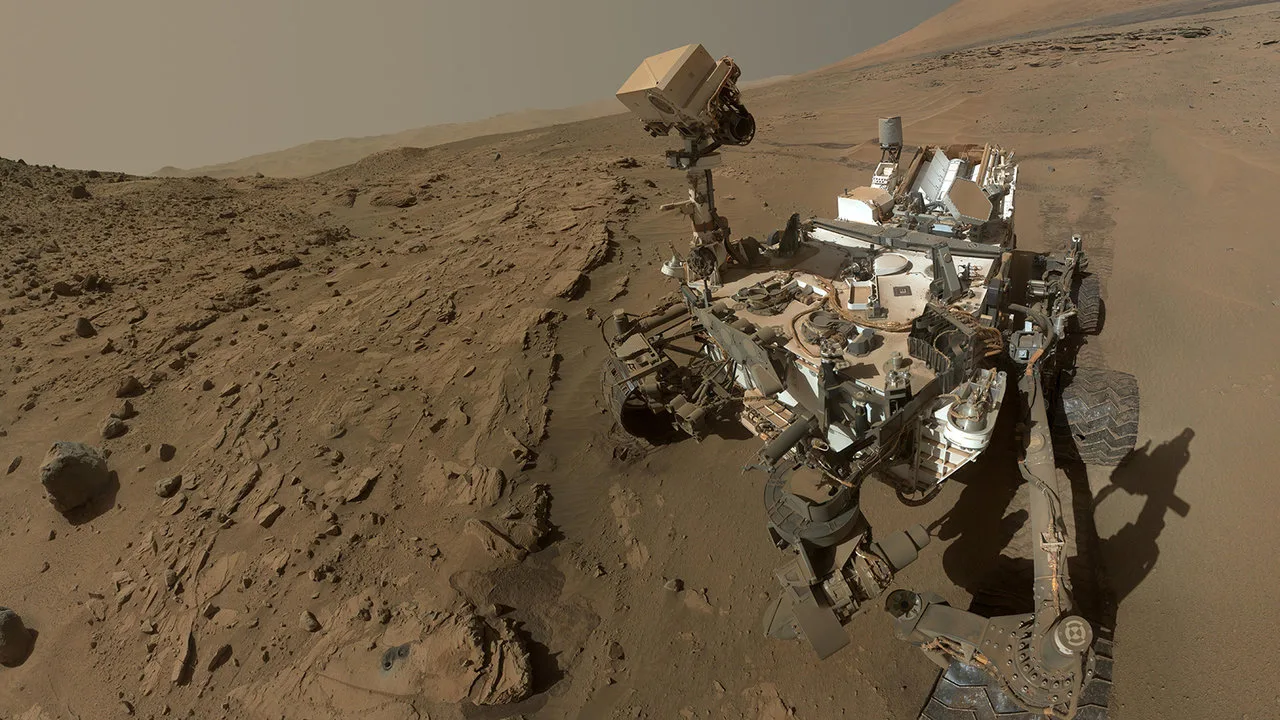
Curiosity is a car-sized Mars rover developed by NASA’s Jet Propulsion Laboratory (JPL), which is managed by Caltech in Pasadena, California. Launched as part of NASA’s Mars Exploration Program, the rover is tasked with investigating the Red Planet’s climate and geology, including the search for signs of ancient microbial life. Since landing in Gale Crater in 2012, Curiosity has been exploring Mount Sharp, uncovering evidence of Mars’ watery past. The mission is led by JPL on behalf of NASA’s Science Mission Directorate in Washington.
Never miss a breakthrough: Join the SciTechDaily newsletter.
Follow us on Google and Google News.
1 Comment
With Mars having only 40% of the gravity of Earth, does that imply that the ground is far less dense than Earth? And, if so, couldn’t all of the water just been absorbed by the less-dense ground over time? That would mean that Mars is very water-rich, but just not necessarily water-available.