

Curiosity stitched 291 Mastcam photos into a color-balanced 360° panorama of Gale Crater’s “boxwork” ridges—spiderweb-like stone lattices hardened by ancient groundwater.
Viewers can dive into an interactive video of the scene, spotting the rover’s wheel tracks, the butte nicknamed “Texoli,” and the distant crater rim. The striking patterns reveal how minerals cemented cracks billions of years ago, then wind slowly etched the surrounding rock away.

NASA’s Curiosity rover has captured a breathtaking 360-degree view on Mars, revealing a landscape covered in unusual stone ridges known as boxwork patterns. This sweeping panorama is made up of 291 individual images taken by the rover’s Mast Camera, or Mastcam, between May 15 and May 18, 2025, during its 4,451st to 4,454th Martian days on the Red Planet. The colors have been carefully adjusted to show the scene as it would appear under Earth-like lighting, giving us a vivid, true-to-life glimpse of this fascinating Martian terrain.
Explore the scene in a 360-degree video:
When viewed from space, the boxwork patterns look a bit like spiderwebs (as seen in the image on top of the page. They have fascinated scientists since before Curiosity’s 2012 landing on the Red Planet and are believed to have formed from groundwater trickling through rock cracks billions of years ago. Minerals left behind by the water hardened like cement within the rock; after eons of sandblasting by wind, the rock was carved away, revealing networks of resistant ridges within.
Curiosity’s tracks can be seen in the middle of the image. In the distance to the right is a butte nicknamed “Texoli.” Far in the distance at the top center of the image is the rim of Gale Crater. Since 2014, Curiosity has been exploring the foothills of Mount Sharp, a 3-mile-tall (5-kilometer-tall) mountain within the crater.
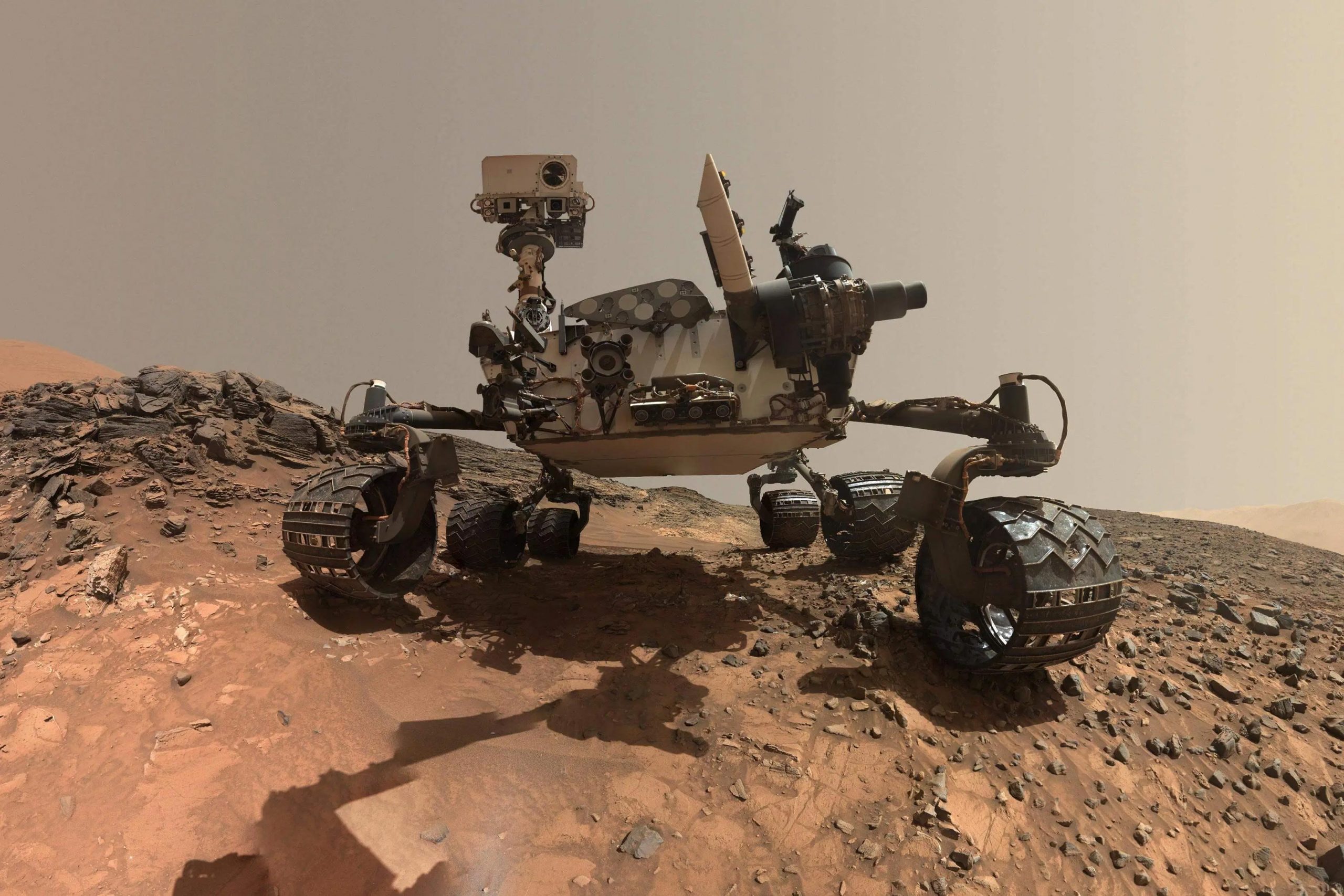
Curiosity is a Mars rover, built by the Jet Propulsion Laboratory (JPL) — a division of Caltech in Pasadena, California — and operated as part of NASA’s Mars Exploration Program. Since landing in 2012, Curiosity has been exploring Gale Crater, studying the planet’s geology and climate to assess past habitability. JPL leads the mission for NASA’s Science Mission Directorate in Washington, while the rover’s powerful Mastcam imaging system was developed and is operated by Malin Space Science Systems in San Diego
Never miss a breakthrough: Join the SciTechDaily newsletter.
Follow us on Google and Google News.
1 Comment
Does radiation pose a problem for humans on Mars and if so is their any protection for humans