
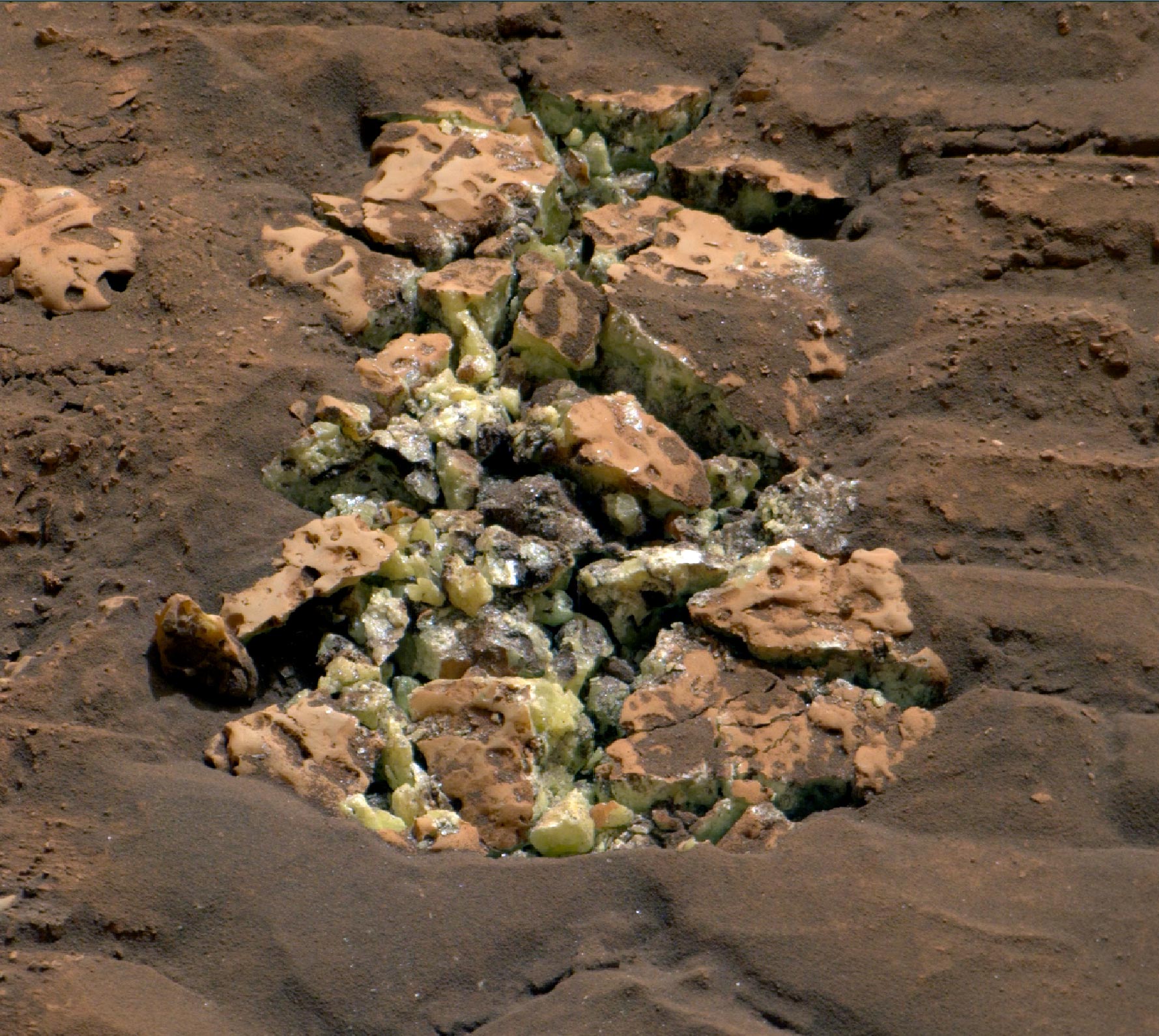
Among several recent findings, the rover has found rocks made of pure sulfur — a first on the Red Planet.
NASA’s Curiosity Mars rover recently discovered yellow sulfur crystals in a rock on Mars, revealing pure sulfur in an area known for sulfate salts. This unexpected find occurred while exploring Gediz Vallis channel on Mount Sharp, which has been associated with ancient water flows and microbial life potential. The discovery prompts new questions about Mars’ geological history and its conditions.
Unprecedented Discovery on Mars
Scientists were stunned on May 30 when a rock that NASA’s Curiosity Mars rover drove over cracked open to reveal something never seen before on the Red Planet: yellow sulfur crystals.
Since October 2023, the rover has been exploring a region of Mars rich with sulfates, a kind of salt that contains sulfur and forms as water evaporates. But where past detections have been of sulfur-based minerals — in other words, a mix of sulfur and other materials — the rock Curiosity recently cracked open is made of elemental, or pure, sulfur. It isn’t clear what relationship, if any, the elemental sulfur has to other sulfur-based minerals in the area.
While people associate sulfur with the odor of rotten eggs (the result of hydrogen sulfide gas), elemental sulfur is odorless. It forms in only a narrow range of conditions that scientists haven’t associated with the history of this location. And Curiosity found a lot of it — an entire field of bright rocks that looked similar to the one the rover crushed.
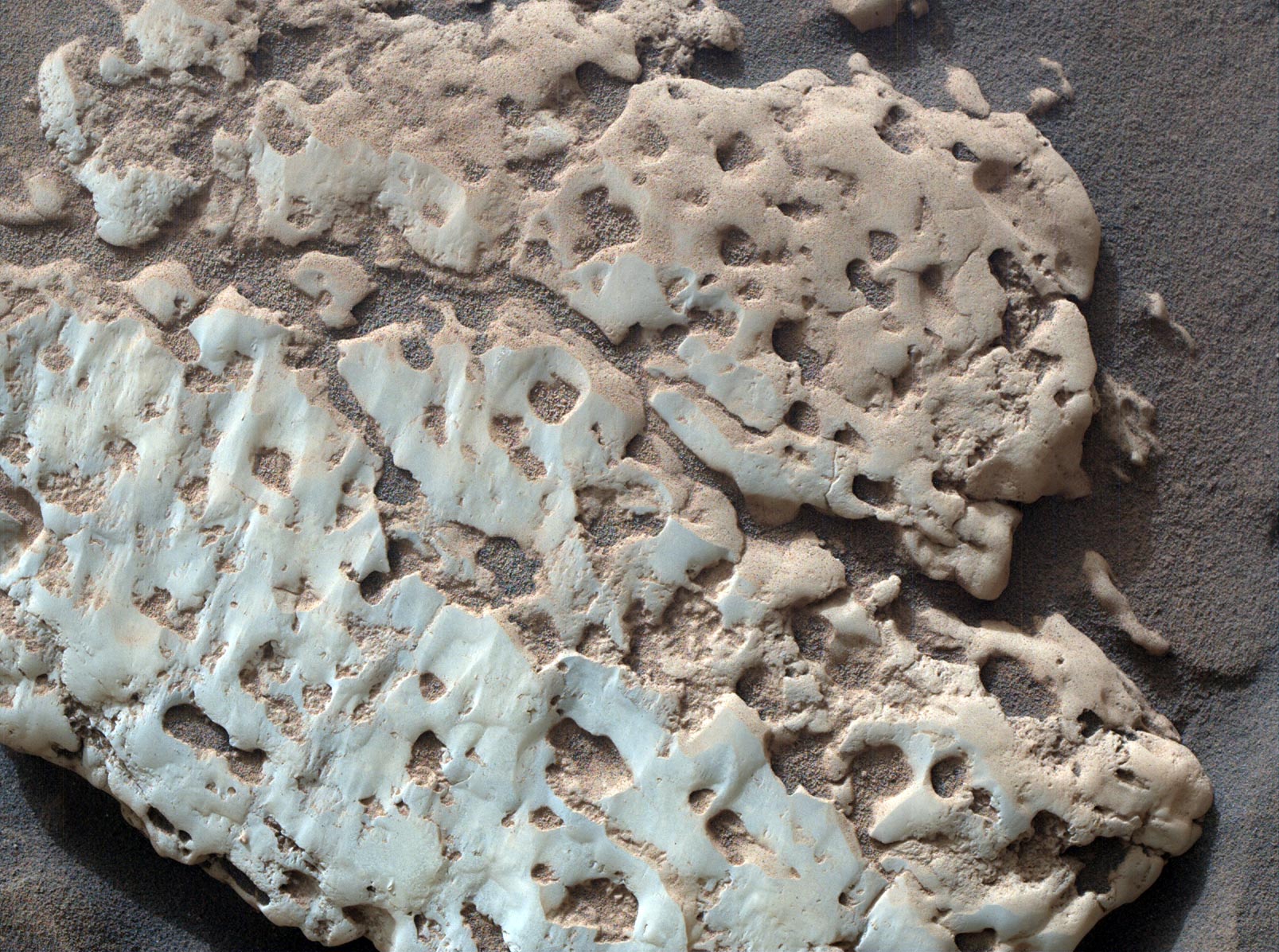
“Finding a field of stones made of pure sulfur is like finding an oasis in the desert,” said Curiosity’s project scientist, Ashwin Vasavada of NASA’s Jet Propulsion Laboratory in Southern California. “It shouldn’t be there, so now we have to explain it. Discovering strange and unexpected things is what makes planetary exploration so exciting.”
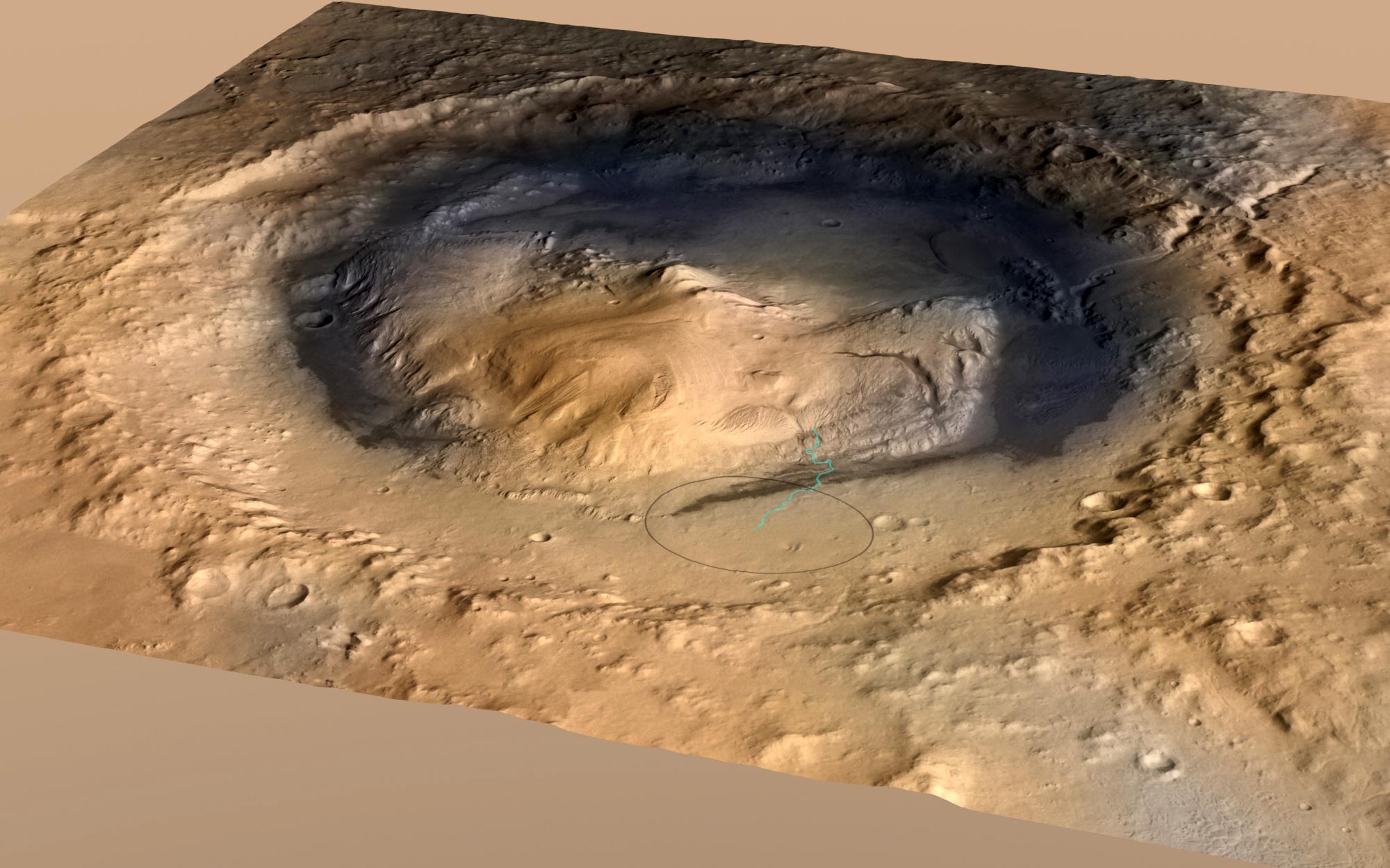
It’s one of several discoveries Curiosity has made while off-roading within Gediz Vallis channel, a groove that winds down part of the 3-mile-tall (5-kilometer-tall) Mount Sharp (see image below), the base of which the rover has been ascending since 2014. Each layer of the mountain represents a different period of Martian history. Curiosity’s mission is to study where and when the planet’s ancient terrain could have provided the nutrients needed for microbial life, if any ever formed on Mars.
Floods and Avalanches
Spotted from space years before Curiosity’s launch, Gediz Vallis channel is one of the primary reasons the science team wanted to visit this part of Mars. Scientists think that the channel was carved by flows of liquid water and debris that left a ridge of boulders and sediment extending 2 miles down the mountainside below the channel. The goal has been to develop a better understanding of how this landscape changed billions of years ago, and while recent clues have helped, there’s still much to learn from the dramatic landscape.
Since Curiosity’s arrival at the channel earlier this year, scientists have studied whether ancient floodwaters or landslides built up the large mounds of debris that rise up from the channel’s floor here. The latest clues from Curiosity suggest both played a role: some piles were likely left by violent flows of water and debris, while others appear to be the result of more local landslides.
Pan around this 360-degree video to explore Gediz Vallis channel, the location where NASA’s Curiosity Mars rover discovered sulfur crystals and drilled its 41st rock sample. The images that make up this mosaic were captured by the rover’s MastCam in June. Credit: NASA/JPL-Caltech/MSSS
Those conclusions are based on rocks found in the debris mounds: Whereas stones carried by water flows become rounded like river rocks, some of the debris mounds are riddled with more angular rocks that may have been deposited by dry avalanches.
Finally, water soaked into all the material that settled here. Chemical reactions caused by the water bleached white “halo” shapes into some of the rocks. Erosion from wind and sand has revealed these halo shapes over time.
“This was not a quiet period on Mars,” said Becky Williams, a scientist with the Planetary Science Institute in Tucson, Arizona, and the deputy principal investigator of Curiosity’s Mast Camera, or Mastcam. “There was an exciting amount of activity here. We’re looking at multiple flows down the channel, including energetic floods and boulder-rich flows.”
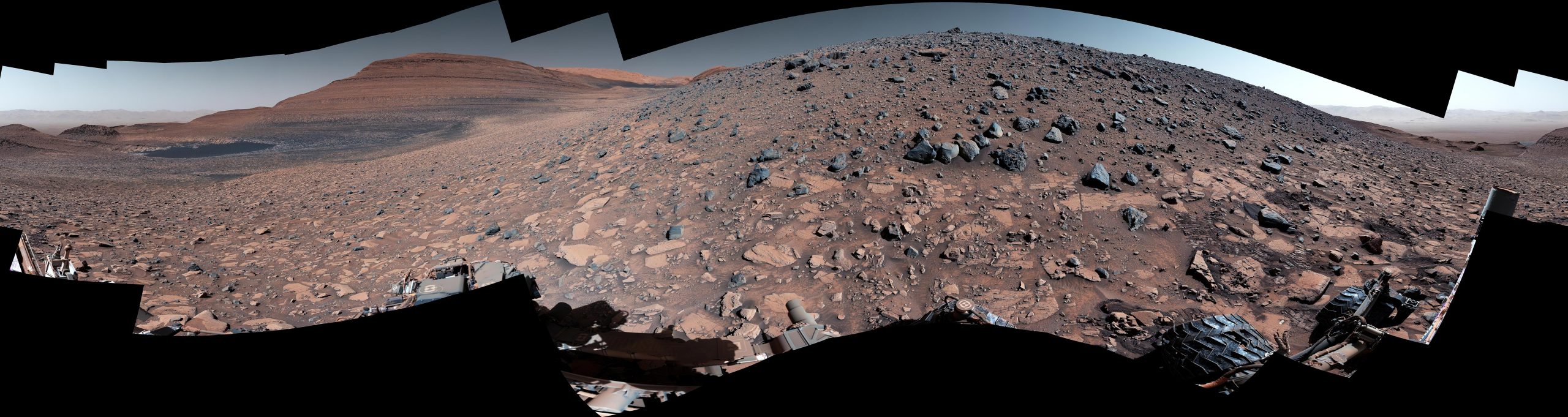
Credit: NASA/JPL-Caltech/MSSS
A Hole in 41
All this evidence of water continues to tell a more complex story than the team’s early expectations, and they’ve been eager to take a rock sample from the channel in order to learn more. On June 18, they got their chance.
While the sulfur rocks were too small and brittle to be sampled with the drill, a large rock nicknamed “Mammoth Lakes” was spotted nearby. Rover engineers had to search for a part of the rock that would allow safe drilling and find a parking spot on the loose, sloping surface.
After Curiosity bored its 41st hole using the powerful drill at the end of the rover’s 7-foot (2-meter) robotic arm, the six-wheeled scientist trickled the powderized rock into instruments inside its belly for further analysis so that scientists can determine what materials the rock is made of.
Curiosity has since driven away from Mammoth Lakes and is now off to see what other surprises are waiting to be discovered within the channel.
About NASA’s Curiosity Rover
NASA’s Curiosity Rover, officially known as the Mars Science Laboratory (MSL), is a car-sized robotic explorer that landed on Mars’ Gale Crater on August 6, 2012. Its primary mission is to investigate Martian climate and geology, specifically to determine if the planet ever had conditions suitable for microbial life. Equipped with a suite of scientific instruments, Curiosity can capture panoramic images, analyze mineral compositions, monitor environmental conditions, and drill into Martian rocks to collect samples.
Since its landing, Curiosity has made significant discoveries, including evidence of ancient water flows that suggest Mars could have supported life in the past. Managed by NASA’s Jet Propulsion Laboratory (JPL), the rover embodies advanced technology derived from previous Mars missions, enhancing its ability to navigate and endure the harsh Martian environment. Curiosity continues to send valuable data to Earth, significantly expanding our understanding of the Red Planet.
Never miss a breakthrough: Join the SciTechDaily newsletter.
Follow us on Google and Google News.