
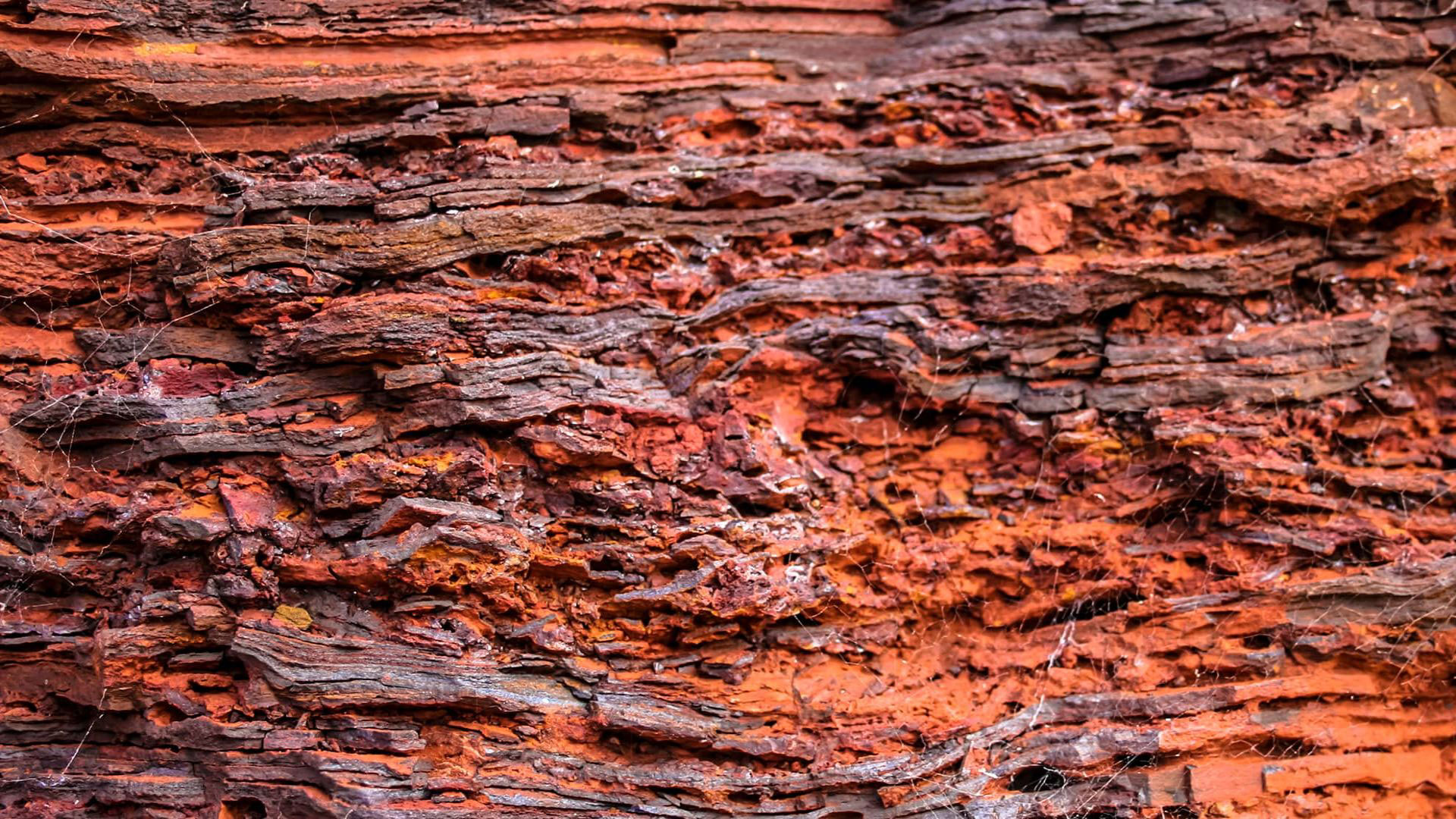
As the world searches for low-emission energy sources, researchers have identified a potentially important source of clean energy beneath Western Australia’s red soil.
Beneath Western Australia’s Pilbara region, vast iron ore deposits contain magnetite that may do more than supply raw material for industry. Research from Edith Cowan University (ECU) suggests the mineral could also help generate naturally occurring hydrogen, a resource researchers say could eventually contribute to Australia’s energy supply and export industry.
Magnetite can produce hydrogen gas when it reacts with hot water deep underground. ECU School of Engineering researchers have also identified a way to stimulate that process by injecting a solution into banded iron formations, potentially increasing the amount of natural hydrogen that could be accessed.
“Australia could be sitting on a massive, untapped energy reserve – and the potential is enormous,” Associate Professor Alireza Keshavarz said.
“There is enough hydrogen for Australia to benefit for generations, and potentially enough for us to become a major exporter of clean energy to the rest of the world.”
Hot water recreated deep underground conditions
To investigate whether the process could work under realistic subsurface conditions, researchers placed magnetite samples in water at 200°C and high pressure for 60 days, recreating conditions found deep beneath Earth’s surface.
The experiments provided detailed evidence about how natural hydrogen can form underground and what conditions are needed for production to continue.
“Western Australia has some of the world’s largest banded iron formations. If we can unlock this resource at scale, it could be transformative for our energy future,” lead author Kaveh Moghanirahimi said.
“We even see the potential for Western Australia to strengthen its energy independence during times of crisis through access to this naturally generated hydrogen.”
Water access may control hydrogen production
Professor Stefan Iglauer, from ECU’s School of Engineering, said the results bring laboratory research a step closer to natural hydrogen exploration in real geological settings.
“This work helps bridge the gap between laboratory experiments and real geological systems,” Professor Iglauer said.
“Our findings show that hydrogen production depends not only on the amount of magnetite present, but also on how easily water can access fresh mineral surfaces through fractures, pores, and permeable pathways.”
Reference: “Geometry-driven controls on hydrothermal natural hydrogen generation from magnetite mineral” by Kaveh Moghanirahimi, Lionel Esteban, Valeriya Shulakova, Muhammad Ali, Stefan Iglauer and Alireza Keshavarz, 24 February 2026, International Journal of Hydrogen Energy.
DOI: 10.1016/j.ijhydene.2026.154187
The researchers received support from the Commonwealth Scientific and Industrial Research Organisation (CSIRO) through a CSIRO PhD Scholarship, as well as funding from the Australian Research Council under grant DP220102907.
Never miss a breakthrough: Join the SciTechDaily newsletter.
Follow us on Google and Google News.
3 Comments
“Beneath Western Australia’s Pilbara region, vast iron ore deposits contain magnetite …”
The operative word here is “contain.” A quick search on the internet ( https://minedocs.com/21/Iron-ore-deposits-of-the-pilbara-craton-2017.pdf ) reveals that the deposits contain minor amounts of scattered magnetite, which are a lower grade than the bulk of of the “Supergene goethite and hematite-enriched BIF (Banded Iron Formation).” This is not a minor quibble. First of all, the magnetite is not as abundant or continuous in extent as the BIF host rocks; the grade is generally lower also. This means that the available magnetite is not as enriched as the host iron ore. Secondly, because magnetite is magnetic, it may be available more cheaply on any of thousands of ocean beaches, avoiding a need (and cost) to increase the surface area of the reactant. The west shore of the South Island of New Zealand is notoriously rich in ‘Black Sand’ (mostly magnetite and non-magnetic chromite, and gold that might help defray the mining costs).
The point being is that just because a particular chemical reaction can produce a desired product, it does not mean that the laboratory-demonstrated reaction can be scaled up in the middle-of-nowhere Pilbara, and capture the hydrogen without significant losses, and then economically ship the hydrogen to where it actually can be used. Hydrogen is notoriously difficult to move by steel pipelines or store in steel tanks.
I frequently see stories of the demonstration of the the ‘latest and greatest’ catalyst that will revolutionize ‘something.’ What I don’t read are stories about how the invention has been adopted wide-scale and actually has made an important difference. It seems that the grant committees are not doing their due diligence in asking hard questions about the probability of the reaction, if demonstrated as being possible, being economic and being scaled up to industrial levels readily.
Excellent answer, Clyde. And what’s more, completely accurate. Thankyou.
You are welcome, and thank you for the compliment. I sometimes get concerned that my critiques fall on deaf ears — or blind eyes. I’m reminded of the parable about the three monkeys, and the saying about “deaf, dumb, and blind.”