
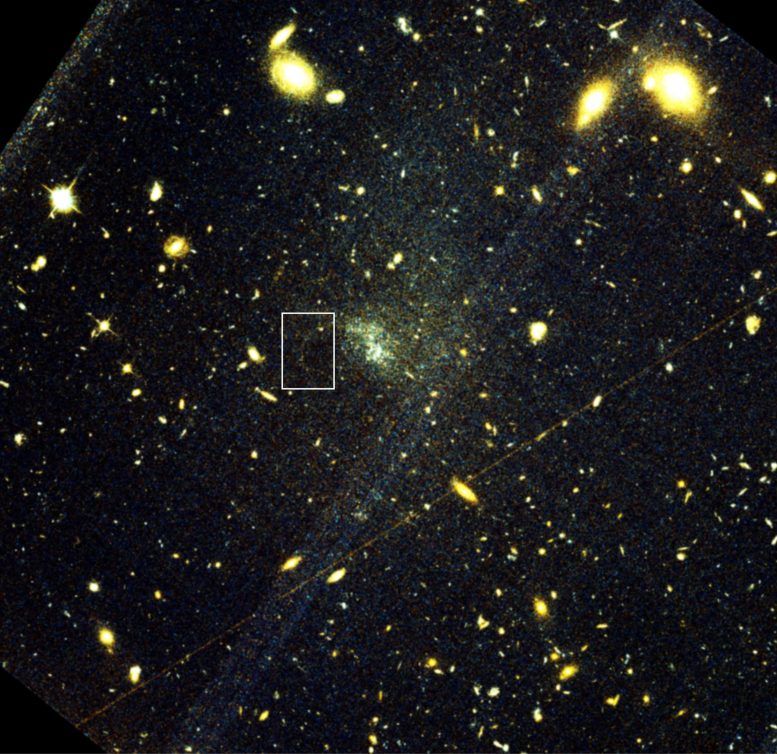
A ghostly ribbon of stars winding around a faint galaxy 115 million light-years away is giving astronomers a rare new way to trace one of the universe’s most elusive ingredients: dark matter.
The thin structure surrounds UGC 9050-Dw1, an ultra-diffuse galaxy about 115 million light-years from Earth. Researchers say it is the first known globular cluster stellar stream identified in another galaxy, extending a powerful technique for studying gravity and dark matter far beyond our own galactic neighborhood.
The finding, reported in Nature, comes from an international team that includes Northwestern University astrophysicist Tjitske Starkenburg. Julie Kiel Holm of the University of Copenhagen and Sarah Pearson of the Technical University of Denmark co-led the research.
What makes the discovery especially valuable is that the stream is more than a collection of displaced stars. Its shape preserves information about the gravitational environment through which those stars have traveled, effectively giving astronomers a visible tracer of otherwise invisible mass.
A Stellar Stream Reveals Hidden Dark Matter
“The stars in a stellar stream all travel along nearly the same orbit, and that orbit is shaped by the galaxy’s gravity,” said Northwestern’s Tjitske Starkenburg, who coauthored the study. “By modeling that gravity, we can estimate the galaxy’s total mass. We already know roughly how much of that mass comes from visible matter like stars, so the rest must be dark matter.”
Starkenburg is a research assistant professor at Northwestern’s Center for Interdisciplinary Exploration and Research in Astrophysics and specializes in extragalactic astronomy.
Globular clusters are compact, gravitationally bound groups containing large numbers of stars. But they are not immune to the gravity of the galaxies they orbit.
Over time, a host galaxy can pull stars away from a cluster. Those escaped stars tend to remain close to the cluster’s orbit rather than scattering in every direction, gradually stretching into narrow leading and trailing streams. Such structures can survive for billions of years.
How Star Clusters Become Stellar Streams
That orderly motion is what makes stellar streams so scientifically useful. Because their trajectories respond to a galaxy’s gravitational field, their shapes can reveal how mass is distributed, including mass that cannot be seen directly.
Astronomers have identified dozens of globular cluster streams in the Milky Way. Finding an equivalent structure around another galaxy has been much more difficult because distant streams have extremely low surface brightness.
UGC 9050-Dw1 offered unusually favorable conditions.
Study coauthors David Sand and Catherine Fielder, both astronomers at the University of Arizona, had worked with archival observations from NASA’s Hubble Space Telescope. While study coauthor David Hendel examined published images of the galaxy, he noticed a narrow, curved feature that looked strikingly like a stellar stream.
Hubble Spots a Stream Around UGC 9050-Dw1
The galaxy’s diffuse nature helped make the discovery possible. Ultra-diffuse galaxies contain relatively few visible stars spread across a large area, creating a dim background against which an extremely faint stream can stand out.
UGC 9050-Dw1 was already an intriguing target. Earlier research using Hubble and radio observations found that it has a distorted appearance, a prominent stellar plume, and an unusually rich population of globular clusters. Researchers estimated that it contains about 52 globular clusters, with those clusters contributing roughly 20% of the galaxy’s total light. Its unusual structure has also led astronomers to suggest that it may be the remnant of a merger between dwarf galaxies or another strong interaction.
That abundance of globular clusters makes the newly identified stream somewhat less surprising, but no less important.
Dark matter accounts for roughly 85% of the universe’s matter, yet it does not emit, absorb, or reflect light in a way that conventional telescopes can directly detect. Its presence is instead inferred from its gravitational influence on stars, galaxies, and larger cosmic structures.
Using Stellar Streams to Map Dark Matter
Stellar streams provide an unusually sensitive way to trace that influence.
After identifying the structure around UGC 9050-Dw1, the researchers generated thousands of computer simulations. They varied the properties of the original globular cluster and the distribution of matter throughout the galaxy, then compared the simulated streams with the arc seen in the observations.
The stream’s shape, color, and apparent connection to a compact object all supported the conclusion that it originated from a globular cluster. The models also favored a galaxy embedded in a massive dark matter halo, providing what the researchers describe as the first constraint on an ultra-diffuse galaxy’s halo derived from a stellar stream.
“Our results are consistent with previous studies and what they have shown about dark matter in this ultra-diffuse galaxy,” Kiel Holm said. “We are measuring it with a completely new tool for this type of galaxy, demonstrating that this method also works beyond our own galaxy.”
A New Test of Dark Matter in Distant Galaxies
The result matters because ultra-diffuse galaxies have become important testing grounds for theories of dark matter. Despite their faint appearance, they can have very different inferred dark matter properties, and astronomers continue to debate how these unusual galaxies form and evolve. The new stream offers an independent way to investigate that hidden mass.
Measuring a galaxy’s total mass is only one possibility.
A sufficiently thin stellar stream can also act like a cosmic detector. If a compact concentration of dark matter passes near or through the stream, its gravity can disturb the stars, potentially producing gaps, clumps, or other irregularities.
“Thin stellar streams can develop gaps or clumps when small concentrations of dark matter pass through them,” Starkenburg said. “Astronomers have long debated whether we’ve seen this happen in streams within the Milky Way. If we can confirm that’s what’s causing these features, that will give us an entirely new way to test how dark matter is distributed—and ultimately learn more about its fundamental nature.”
Dark Matter Could Leave Scars in Star Streams
Competing ideas about dark matter can predict different amounts and distributions of small dark matter structures. Stellar streams therefore have the potential to test dark matter on scales that can be difficult to investigate using entire galaxies alone. Researchers have already been developing methods for extracting information about dark matter halo structure from streams around external galaxies.
For now, UGC 9050-Dw1 represents a single example. Finding many more streams would allow scientists to compare dark matter environments across different galaxies rather than relying largely on the Milky Way.
That opportunity could soon expand dramatically.
The European Space Agency’s Euclid mission and NASA’s Nancy Grace Roman Space Telescope are designed to survey far larger portions of the sky than Hubble can efficiently cover. Roman, in particular, has long been considered a promising tool for searching for globular cluster streams in nearby galaxies and for looking for small disturbances within them.
“It’s exciting that we discovered a thin stellar stream around a galaxy other than our own with already-existing Hubble Space Telescope data and confirmed it with ground-based telescope data,” Starkenburg said. “That makes it very promising for the new telescopes becoming available, including the Roman Space Telescope, which can see an area 100 times larger than that of the Hubble.”
Reference: “Evidence for the first globular cluster stellar stream beyond the Milky Way” by Julie Kiel Holm, Sarah Pearson, Jacob Nibauer, David J. Sand, Adrian M. Price-Whelan, Tjitske Starkenburg, David Hendel and Catherine Fielder, 12 August 2026, Nature.
DOI: 10.1038/s41586-026-10878-w
The study was supported by the Villum Foundation, the European Union, the National Science Foundation, and NASA.
Never miss a breakthrough: Join the SciTechDaily newsletter.
Follow us on Google and Google News.
1 Comment
As a now eighty-two year old lay American male I still don’t like ‘raining on the parade’ of any promising young researchers but the fact of the matter is I’ve been demonstrating the rotation intensifying effects of radiant lines of gravity force online since 2012 (https://odysee.com/@charlesgshaver:d/1Gravity:8). As such it negates needing dark matter to explain missing gravity. Despite months of unexpected delays, I hope I’m now on the verge of disproving time dilation at ground level, attempting to publish a lay paper for professional reviews and ultimately producing and uploading a fifth low-budget demonstration video to my ad-free video channel for all to see. It needs doing so astrophysics can resume advancing.