
A rare cosmic explosion has revealed the hidden core of a massive star, stripped of its outer layers and bursting with silicon and sulfur.
Named SN2021yfj, the supernova challenges long-standing theories and provides the first glimpse deep inside a dying stellar giant.
A New Kind of Supernova
An international collaboration led by astrophysicists at Northwestern University has identified a completely new kind of exploding star, or supernova, one that contains unusually high amounts of silicon, sulfur, and argon.
Normally, when massive stars collapse in a supernova, astronomers detect strong traces of lighter elements such as hydrogen and helium. The recently observed event, named SN 2021yfj, stood out because its chemical fingerprint appeared to be very different.
For decades, scientists have proposed that giant stars are structured in layers, much like the rings of an onion. The outer shells should be made of lighter elements, while progressively heavier elements are found deeper inside, ending with an iron core at the center.
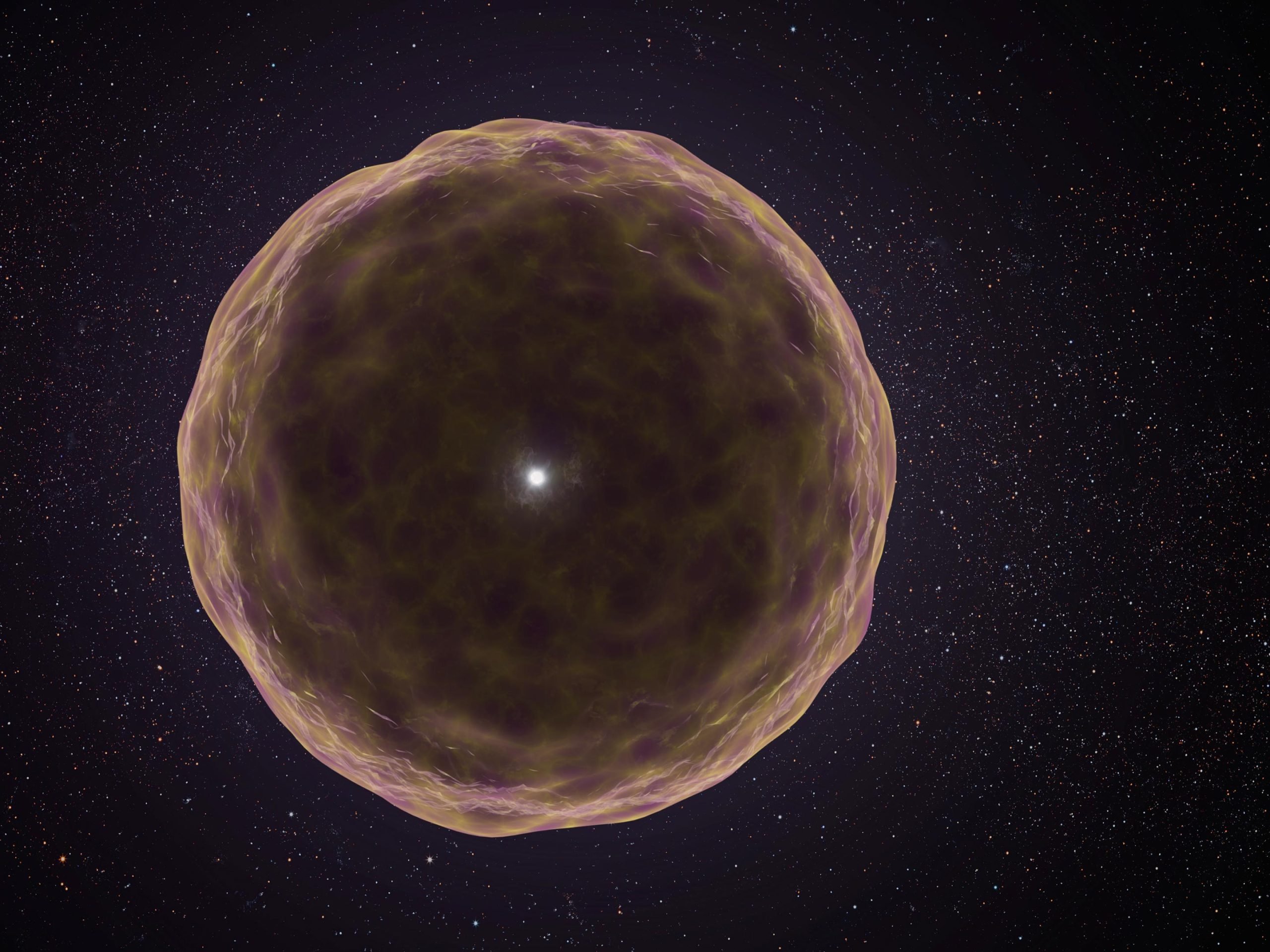
Near the end of its life, SN 2021yfj’s stripped-to-the-bone progenitor underwent two rare and extremely violent pair-instability episodes, ejecting shells rich in silicon (grey), sulphur (yellow), and argon (purple). The collision of these massive shells is so violent that it created a brilliant supernova that could still be seen at a distance of 2.2 billion light-years. SN 2021yfj is so unusual that it defines a new class, Type Ien, and the star itself may have survived the event. Credit: W.M. Keck Observatory/Adam Makarenko
Stripped to the Core
Observations of SN 2021yfj suggest that the star had somehow shed its outer shells of hydrogen, helium, and carbon — exposing its inner regions rich in silicon and sulfur — before it finally exploded. This rare finding provides the first direct glimpse into the long-hypothesized layered interiors of massive stars and allows scientists to see what lies deep inside, only moments before stellar death. The results were published on August 20 in the journal Nature.
“This is the first time we have seen a star that was essentially stripped to the bone,” said Northwestern’s Steve Schulze, who led the study. “It shows us how stars are structured and proves that stars can lose a lot of material before they explode. Not only can they lose their outermost layers, but they can be completely stripped all the way down and still produce a brilliant explosion that we can observe from very, very far distances.”
Challenging Old Theories
“This event quite literally looks like nothing anyone has ever seen before,” added Northwestern’s Adam Miller, a senior author on the study. “It was almost so weird that we thought maybe we didn’t observe the correct object. This star is telling us that our ideas and theories for how stars evolve are too narrow. It’s not that our textbooks are incorrect, but they clearly do not fully capture everything produced in nature. There must be more exotic pathways for a massive star to end its life that we hadn’t considered.”
Schulze, a specialist in the universe’s most extreme transient events, is a research associate at Northwestern’s Center for Interdisciplinary Exploration and Research in Astrophysics (CIERA). Miller is an assistant professor of physics and astronomy at Northwestern’s Weinberg College of Arts and Sciences, as well as a leading member of both CIERA and the NSF-Simons AI Institute for the Sky.
A Hot, Burning Onion
Weighing in at 10 to 100 times heavier than our sun, massive stars are powered by nuclear fusion. In that process, intense pressure and extreme heat in the stellar core cause lighter elements to fuse together, generating heavier elements. When the temperature and density increase in the core, burning begins in the outer layers. As the star evolves over time, successively heavier elements are burned in the core, while lighter elements are burned in a series of shells surrounding the core. This process continues, eventually leading to a core of iron. When the iron core collapses, it triggers a supernova or forms a black hole.
Although massive stars typically shed layers before exploding, SN2021yfj ejected far more material than scientists had ever previously detected. Other observations of “stripped stars” have revealed layers of helium or carbon and oxygen — exposed after the outer hydrogen envelope was lost. But astrophysicists had never glimpsed anything deeper than that — hinting that something extremely violent and extraordinary must be at play.
Chasing Down a Cosmic Oddity
Schulze and their team discovered SN2021yfj in September 2021, using Northwestern’s access to the Zwicky Transient Facility (ZTF). Located just east of San Diego, ZTF uses a wide-field camera to scan the entire visible night sky. Since its launch, ZTF has become the world’s primary discovery engine for astronomical transients — fleeting phenomena like supernovae that flare up suddenly and then quickly fade.
After looking through ZTF data, Schulze spotted an extremely luminous object in a star-forming region located 2.2 billion light-years from Earth.
To gain more information about the mysterious object, the team wanted to obtain its spectrum, which breaks down dispersed light into component colors. Each color represents a different element. So, by analyzing a supernova’s spectrum, scientists can uncover which elements are present in the explosion.
Although Schulze immediately leapt into action, their spectrum search hit multiple dead ends. Telescopes around the globe were either unavailable or could not see through the clouds to obtain a clear image. Luckily, the team received a surprise from an astronomy colleague, who gathered a spectrum using instruments at the W.M. Keck Observatory in Hawai‘i.
A Rare Astronomical Rescue
“We thought we had fully lost our opportunity to obtain these observations,” said Miller. “So, we went to bed disappointed. But the next morning, a colleague at UC Berkeley unexpectedly provided a spectrum. Without that spectrum we may have never realized that this was a strange and unusual explosion.”
“We saw an interesting explosion, but we had no idea what it was,” Schulze said of SN2021yfj. “Almost instantly, we realized it was something we had never seen before, so we needed to study it with all available resources.”
Something Very Violent
Instead of typical helium, carbon, nitrogen and oxygen — found in other stripped supernovae — the spectrum was dominated by strong signals of silicon, sulfur and argon. Nuclear fusion produces these heavier elements within a massive star’s deep interior during its final stages of life.
“This star lost most of the material that it produced throughout its lifetime,” Schulze said. “So, we could only see the material formed during the months right before its explosion. Something very violent must have happened to cause that.”
While the precise cause of this phenomenon remains an open question, Schulze and Miller propose a rare and powerful process was at play. They are exploring multiple scenarios, including interactions with a potential companion star, a massive pre-supernova eruption or even unusually strong stellar winds.
But, most likely, the team posits this mysterious supernova is the result of a massive star literally tearing itself apart. As the star’s core squeezes inward under its own gravity, it becomes even hotter and denser. The extreme heat and density then reignite nuclear fusion with such incredible intensity that it causes a powerful burst of energy that pushes away the star’s outer layers. Each time the star undergoes a new pair-instability episode, the corresponding pulse sheds more material.
A Single, Stunning Example
“One of the most recent shell ejections collided with a pre-existing shell, which produced the brilliant emission that we saw as SN2021yfj,” Schulze said.
“While we have a theory for how nature created this particular explosion,” Miller said, “I wouldn’t bet my life that it’s correct, because we still only have one discovered example. This star really underscores the need to uncover more of these rare supernovae to better understand their nature and how they form.”
Reference: “Extremely stripped supernova reveals a silicon and sulfur formation site” by Steve Schulze, Avishay Gal-Yam, Luc Dessart, Adam A. Miller, Stan E. Woosley, Yi Yang (杨轶), Mattia Bulla, Ofer Yaron, Jesper Sollerman, Alexei V. Filippenko, K-Ryan Hinds, Daniel A. Perley, Daichi Tsuna, Ragnhild Lunnan, Nikhil Sarin, Seán J. Brennan, Thomas G. Brink, Rachel J. Bruch, Ping Chen, Kaustav K. Das, Suhail Dhawan, Claes Fransson, Christoffer Fremling, Anjasha Gangopadhyay, Ido Irani, Anders Jerkstrand, Nikola Knežević, Doron Kushnir, Keiichi Maeda, Kate Maguire, Eran Ofek, Conor M. B. Omand, Yu-Jing Qin, Yashvi Sharma, Tawny Sit, Gokul P. Srinivasaragavan, Nora L. Strothjohann, Yuki Takei, Eli Waxman, Lin Yan, Yuhan Yao, WeiKang Zheng, Erez A. Zimmerman, Eric C. Bellm, Michael W. Coughlin, Frank J. Masci, Josiah Purdum, Mickaël Rigault, Avery Wold and Shrinivas R. Kulkarni, 20 August 2025, Nature.
DOI: 10.1038/s41586-025-09375-3
The study was supported by the National Science Foundation. Support from CIERA provided access to ZTF telescope data.
Never miss a breakthrough: Join the SciTechDaily newsletter.
Follow us on Google and Google News.