
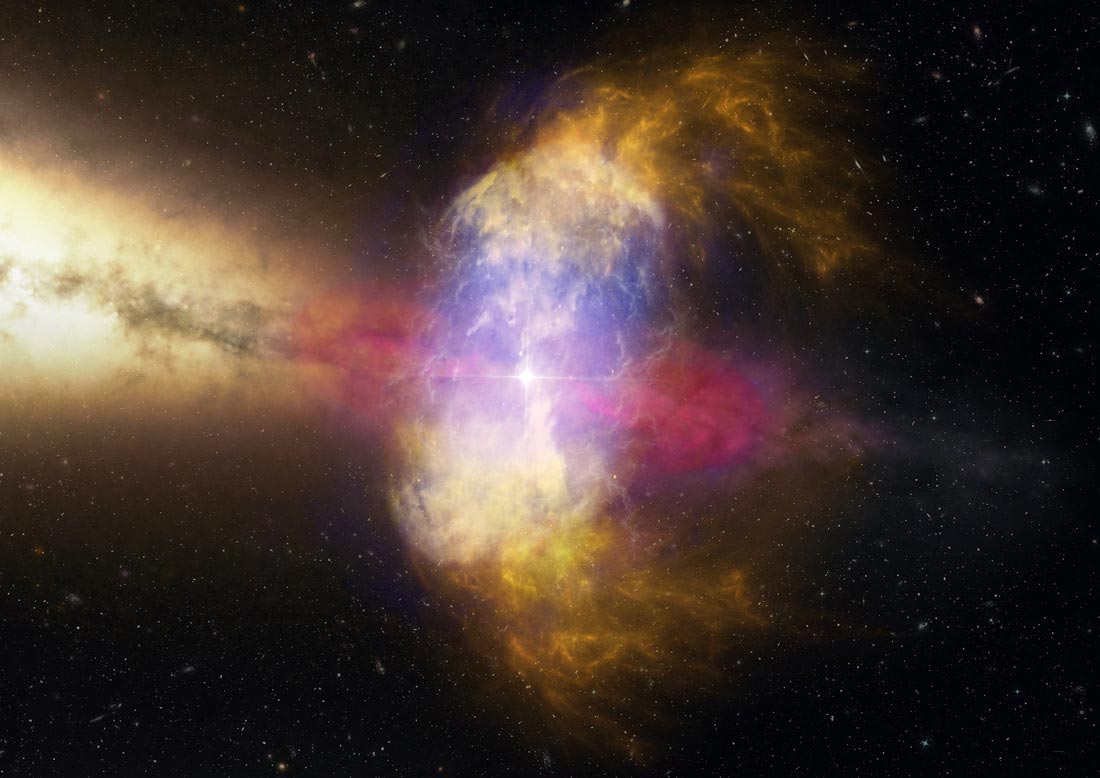
Supernova blasts can swell nearby stars in binary systems, creating brief, bright, cool phases. Simulations help explain this rare phenomenon and offer clues to stellar evolution.
What happens if a supernova explosion goes off right beside another star? The star swells up, which scientists predict as a frequent occurrence in the Universe. Supernova explosions are the dramatic deaths of massive stars that are about 8 times heavier than our Sun.
Most of these massive stars are found in binary systems, where two stars closely orbit each other, so many supernovae occur in binaries. The presence of a companion star can also greatly influence how stars evolve and explode. For this reason, astronomers have long been searching for companion stars after supernovae — a handful have been discovered over the past few decades and some were found to have unusually low temperatures.
When a star explodes in a binary system, the debris from the explosion violently strikes the companion star. Usually, there’s not enough energy to damage the whole star, but it heats up the star’s surface instead. The heat then causes the star to swell up, like having a huge burn blister on your skin. This star blister can be 10 to 100 times larger than the star itself.
How the Star Changes
The swollen star appears very bright and cool, which might explain why some discovered companion stars had low temperatures. Its inflated state only lasts for an ‘astronomically’ short while — after a few years or decades, the blister can “heal” and the star shrinks back to its original form.
In their recently published study by a team of scientists led by OzGrav postdoctoral researcher Dr. Ryosuke Hirai (Monash University), the team carried out hundreds of computer simulations to investigate how companion stars inflate, or swell up, depending on their interaction with a nearby supernova. It was found that the luminosity of inflated stars is only correlated to their mass and doesn’t depend on the strength of the interaction with supernova. The duration of the swelling is also longer when the two stars are closer in distance.
“We applied our results to a supernova called SN2006jc, which has a companion star with a low temperature. If this is in fact an inflated star as we believe, we expect it should rapidly shrink in the next few years,” explains Hirai
The number of companion stars detected after supernovae are steadily growing over the years. If scientists can observe an inflated companion star and its contraction, these data correlations can measure the properties of the binary system before the explosion — these insights are extremely rare and important for understanding how massive stars evolve.
“We think it’s important to not only find companion stars after supernovae, but to monitor them for a few years to decades to see if it shrinks back,” says Hirai.
Reference: “Observability of inflated companion stars after supernovae in massive binaries” by Misa Ogata, Ryosuke Hirai and Kotaro Hijikawa, 21 May 2021, Monthly Notices of the Royal Astronomical Society.
DOI: 10.1093/mnras/stab1439
Never miss a breakthrough: Join the SciTechDaily newsletter.
Follow us on Google and Google News.
2 Comments
When a massive star runs out of fuel, it collapses on itself, creating a supernova that can outshine an entire galaxy. The intense explosion hurls the outer layers of the star into space and produces powerful shock waves. The remains of the star and the material it encounters are heated to millions of degrees and can emit intense X-ray radiation for thousands of years. and if IK Pegasi, the closest candidate we have for a supernova, is 150 light-years away, it will outshine the Sun and the shock waves will be only be felt out to about 10 light-years. But how is it, that is a binary system, the companion star is only Blistered ?
Good question!
The companion star expose a very small segment of sky area as seen from the supernova, while the supernova remains are literary the embers that encapsulated (or partook of!) the explosion. A companion situated 10 au away would 1 % of Sun’s area compared to our own Sun as we see it, or 0.05 degrees or ~ 10^-4 of the radiation output.
The paper explains the companion effect details, which entails another factor of 10 loss:
“Using the hydrodynamical code HORMONE (Hirai et al. 2016),
they carried out 2D hydrodynamical simulations of SN blast waves
colliding with their companions. As the ejecta hits the surface of
the star, they form a forward shock that sweeps through the whole
star and escapes from the other side. During this process, part of the
kinetic energy of the ejecta is deposited into the envelope and drives
it out of thermal equilibrium. There is hardly any mass stripped in
this process, with only .1 % of the mass lost even in the most extreme
cases. They identified that most of the deposited energy is located
near the surface layers and the excess energy declines as it goes deeper
into the star. They also found that the total injected energy is ∼8–10 %
of the energy intersected by the secondary. This can be understood
as a product of three factors; 1) a factor (𝛾 −1)/(𝛾 +1) ∼ 1/4, where
𝛾 is the adiabatic index, which accounts for the energy thermalised
at the bow shock that forms ahead of the star, 2) a geometrical factor
1/2 accounting for the deflection of ejecta at the stellar surface, 3)
a factor ∼2/3 that accounts for the reduction in cross section due to
stellar compression during the ejecta passage.”
So everything else alike millions of kelvins would become tens of thousands K added, or about a few times the Sun surface temperature, beneath those surface layers – barely noticeable.