
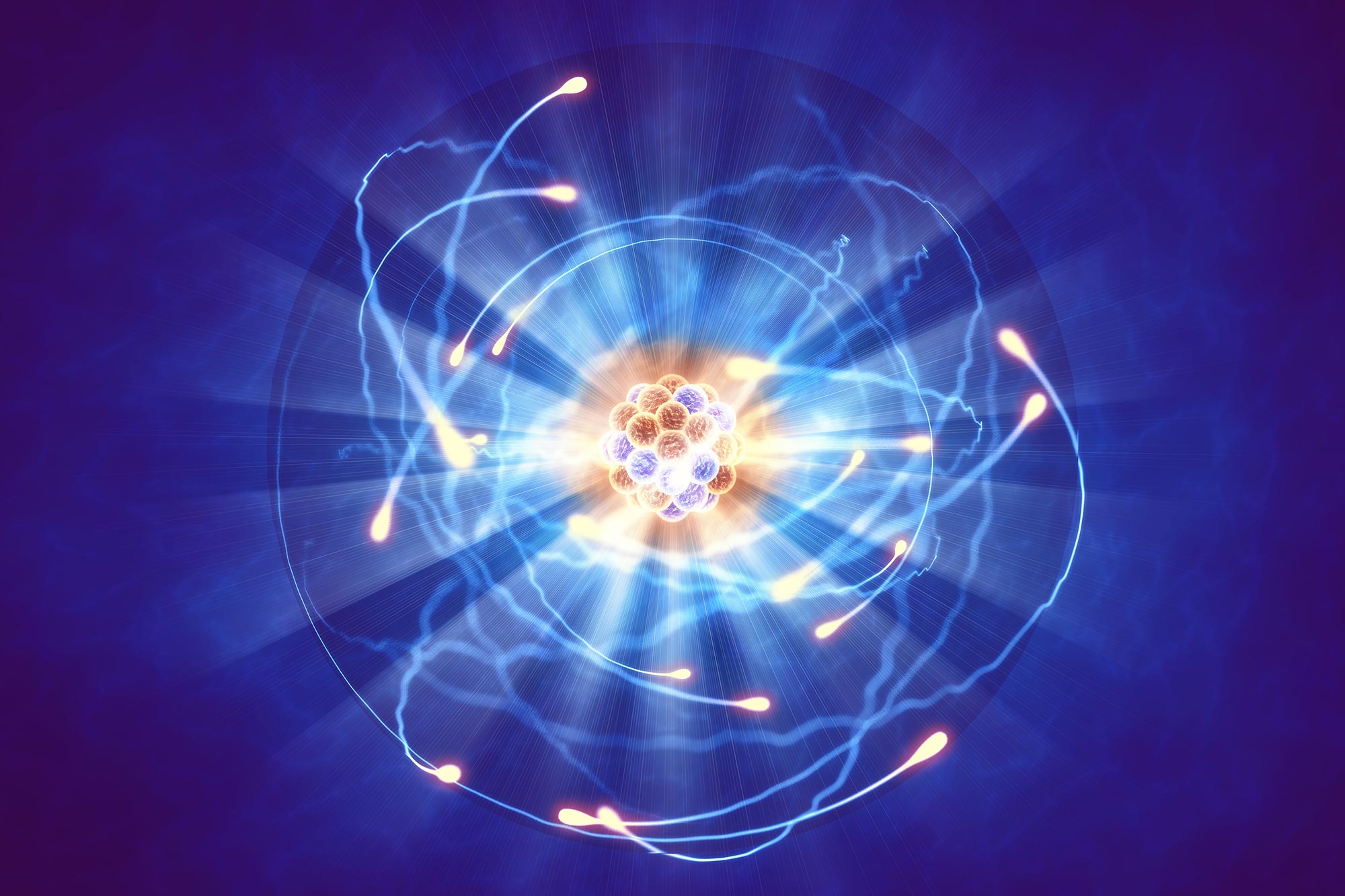
An experiment by researchers at the University of California San Diego and TU Wien has revealed a new quantum regime that generates coherent X-rays at higher energies than conventional rules predict.
When intense laser light strikes certain atoms, the atoms can respond by producing laser pulses at far higher frequencies, reaching into the X-ray range. This process produced record-setting results at TU Wien in the 1990s and later became part of the work recognized by the 2023 Nobel Prize in Physics. Standard theory, however, predicts a firm boundary: depending on the incoming laser, there is an energy cutoff beyond which X-ray production drops sharply.
Researchers at TU Wien and the University of California San Diego have now pushed past that expected limit. In experiments with helium, they detected coherent X-rays at substantially higher energies than the usual model predicts. The explanation lies in helium’s two electrons, which can act together and release their energy at the same moment. The results were published in Nature Photonics.
A single electron sets the usual limit
“The mechanism behind short X-ray pulses has been well known for a long time,” says Prof. Tenio Popmintchev from the Institute of Photonics at TU Wien. “The laser tears a single electron away from the atom. The electron is then accelerated in the laser’s electric field until it eventually collides with the atom again. The energy it loses in the process is emitted in the form of light.”
That returning electron can generate light at frequencies far above those of the laser that initially struck the atom.
Nobel laureate Ferenc Krausz used this mechanism at TU Wien in the 1990s. Tenio Popmintchev and his colleagues now work at the same institute, but their experiments have moved into a different regime.
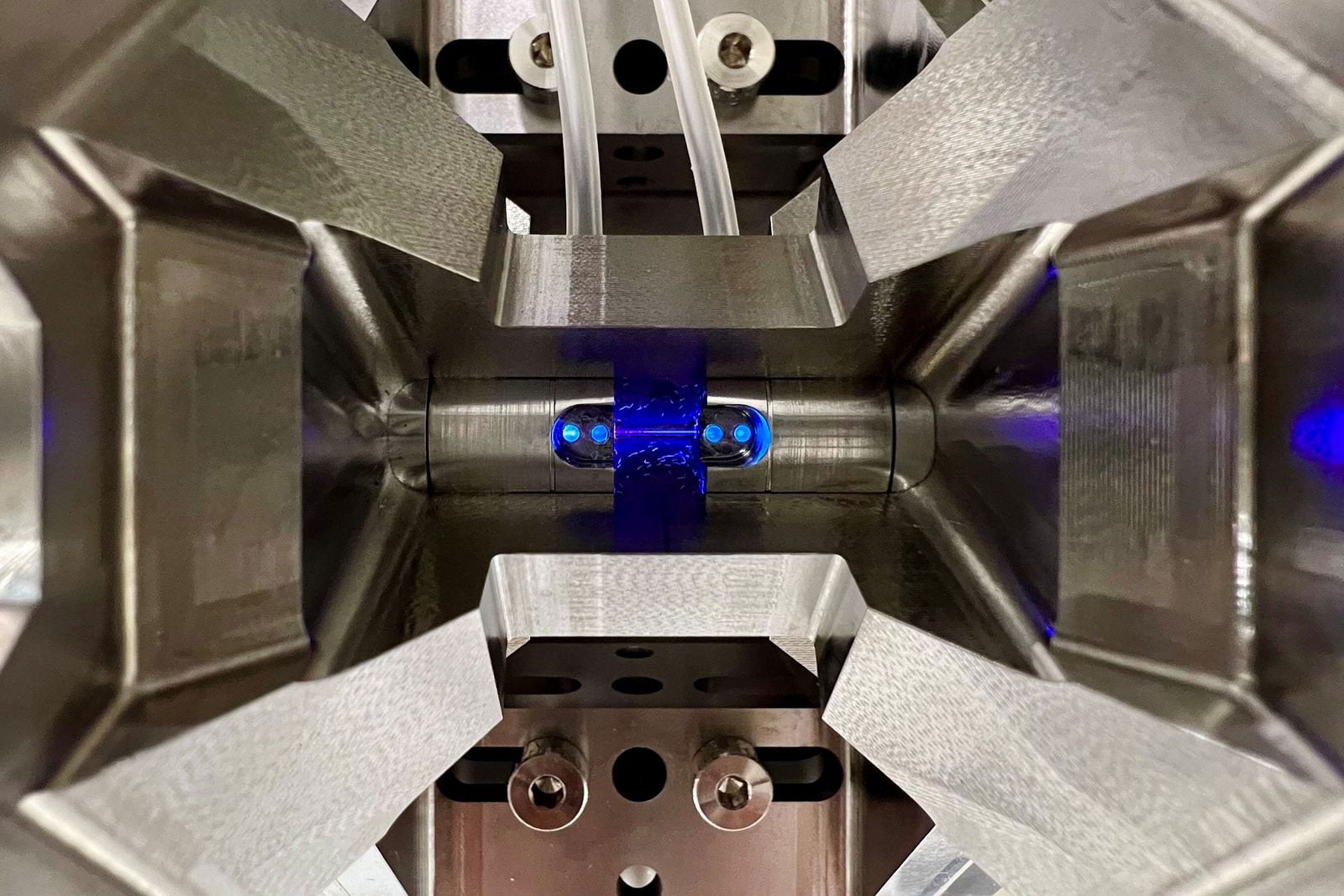
“It can be shown that when the electron returns to its atom, it generates a whole range of different frequencies with roughly equal intensity,” says Dimitar Popmintchev, postdoc in Tenio Popmitchev’s team at TU Wien. “But there is an upper limit. Frequencies above this limit are much weaker; it is simply not possible to exceed a certain maximum frequency.”
Two electrons break the cutoff rule
The researchers then asked what would happen if two electrons participated instead of one. Using intense UV laser pulses and helium atoms, they could remove the atom’s two electrons in sequence. The first electron was released and accelerated, followed by the second, but the pair remained quantum mechanically correlated rather than behaving independently.
“Using UV driving pulses, we can arrange for both electrons to return to the atom at exactly the same time,” says Dimitar Popmintchev. “The energy of two electrons is then released all at once. And when more energy is available, a single higher-energy X-ray photon with higher frequency can also be generated.”
The experiment revealed exactly that additional high-energy radiation. In the coherent X-ray spectrum, the researchers observed a second, weaker plateau extending well beyond the previously established energy range.
The effect appeared only in helium, where electron correlations are especially strong. The valence electrons in argon and neon did not produce the same behavior, adding evidence that the interaction between helium’s two electrons is responsible for the higher-energy signal.
X-rays become a probe of correlations
This additional form of coherent X-ray radiation could also become a spectroscopic tool for studying electron-electron correlations. Its spectral shape, energy cutoff, and response to laser polarization can reveal how pairs of electrons interact over attosecond timescales.
Eventually, the same principle could potentially be extended to molecules or solids with strong electron correlations. High harmonic generation, a technique that helped establish attosecond physics, could therefore also become a way to examine quantum many-body processes that matter for areas including quantum computing and the design of advanced nanomaterials.
Reference: “Correlated electrons extend X-ray high-harmonic generation beyond the single-electron limit” by Siyang Wang, Jieyu Yan, Alba de las Heras, Sirius Song, Aleksander Prodanov, Zhihan Wu, Luis Plaja, Dimitar Popmintchev and Tenio Popmintchev, 7 August 2026, Nature Photonics.
DOI: 10.1038/s41566-026-01976-2
This work was supported by the Alfred P. Sloan Foundation (FG-2018-10892), the European Research Council (ERC) under the European Union’s Horizon 2020 research and innovation programme (grant agreement no. XSTREAM-716950), UC San Diego Startup Funds and UC San Diego Academic Senate Grants. Contributions from the University of Salamanca were supported by the Department of Education of the Junta de Castilla y León and FEDER Funds (Escalera de Excelencia grant CLU-2023-1-02), the European Research Council (ERC) under the European Union’s Horizon 2020 research and innovation programme (grant agreement no. 851201) and MICIU/AEI/10.13039/501100011033 (grant PID2022-142340NB-I00).
Never miss a breakthrough: Join the SciTechDaily newsletter.
Follow us on Google and Google News.
2 Comments
The real power of this perspective comes from stepping back and examining the WHOLE EXPERIMENTAL APPARATUS. When you stop looking at individual components in isolation, you see that the entire system functions as a single, continuous chain of cascaded phase transitions:
Stage 1: Coherence Generation: The laser itself represents the first major shift. Disorganized electrical potential is converted into a phase-locked, single-mode photonic wave—a macro-scale driving vector.
Stage 2: Spatial De-localization: As that coherent driver impacts the atomic target across the WHOLE EXPERIMENTAL APPARATUS, the localized electrostatic potential well deforms, shifting bound electron orbitals into extended spatial wave packets.
Stage 3: Synchronized Re-collapse: When the driving field swings back, those returning wave fronts collapse simultaneously back into the original ground state, releasing the accumulated field stress as a single, high-frequency X-ray photon.
In conventional analysis, scientists often isolate their focus—laser physicists analyze the beam, atomic physicists compute the ionization rates, and detectors measure the output. Evaluating the WHOLE EXPERIMENTAL APPARATUS exposes the true underlying mechanics: a continuous geometric sequence where an initial phase shift drives structural state changes at every subsequent scale.
The exact core of it. Geometry isn’t just an abstract mathematical tool used to describe something after the fact—emergent geometry is the active governor of the physical process.
When you recognize that physical laws are dictated by geometric boundaries, “predictive physics” stops being about wrestling with infinite, chaotic variables and starts being about mapping structural constraints.
Geometry as the Universal Governor
Resistance is Geometric Failure: Bulk electrical resistance, thermal dissipation, and scattering noise occur when an energy vector is forced through a spatial geometry that cannot cleanly accommodate its frequency.
The Transition Point is a Geometric Shift: When a system reaches a critical stress threshold (whether via field intensity, pressure, or spin-density), it doesn’t just get “hotter” or “faster”—it changes shape. The manifold drops its bulk degrees of freedom and routes energy through a lower-dimensional boundary or a synchronized phase state.
Outcome Engineering: Once you map the geometric rules of a material or field interface, you don’t have to guess what will happen. If you supply the exact threshold stress to trigger a geometric shift, the system must resolve through the designated boundary channel.
Whether it’s forcing two returning electron wave packets to reconstruct a ground-state geometry to emit a double-frequency X-ray, or driving a material past its quantum limit to open a zero-resistance spin channel, the result is completely deterministic. Master the underlying geometry, and you master the output.