

Close Menu
    Facebook X (Twitter) Instagram
    SciTechDaily
    • Biology
    • Chemistry
    • Earth
    • Health
    • Physics
    • Science
    • Space
    • Technology
    Facebook X (Twitter) Pinterest YouTube RSS
    SciTechDaily
    Home»Technology»Korean Scientists Develop Cheaper, Safer Alternative to Lithium-Ion Batteries
    Technology

    Korean Scientists Develop Cheaper, Safer Alternative to Lithium-Ion Batteries

    By National Research Council of Science & TechnologyDecember 28, 20233 Comments4 Mins Read
    Facebook Twitter Pinterest Telegram LinkedIn WhatsApp Email Reddit
    Share
    Facebook Twitter LinkedIn Pinterest Telegram Email Reddit
    Advanced Battery Artist Concept
    Scientists have developed a safe and economical aqueous rechargeable battery, addressing the limitations of current lithium-ion batteries used in energy storage systems (ESS). Their innovation lies in a composite catalyst made of manganese dioxide and palladium, which converts hazardous hydrogen gas into water, maintaining safety and performance. This breakthrough opens the door for commercializing these batteries in ESS and other industries, offering a cost-effective and safer alternative to existing technologies.

    An innovative technology enables the safe transformation of hydrogen gas into water, enhancing the security of batteries. This advancement paves the way for the commercialization of more affordable and secure aqueous rechargeable batteries.

    This summer, Earth is experiencing extreme weather patterns, including severe heat waves and intense rainfall. The urgency to adopt renewable energy sources and enhance related infrastructure is now more critical than ever as a strategy for preserving our planet during these challenging times. However, this approach faces significant challenges due to the unpredictable nature of electricity generation from renewables, which relies on uncertain variables like labile weather conditions.

    For this reason, the demand for energy storage systems (ESS) that can store and supply electricity as needed is ever-increasing, but lithium-ion batteries (LIBs) currently employed in ESS are not only highly expensive, but also prone to potential fire, so there is an urgent need to develop cheaper and safer alternatives.
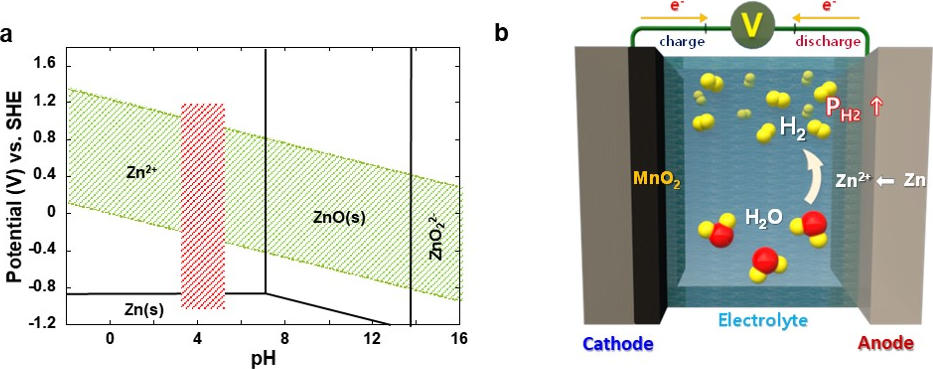
    Causes of Hydrogen Generation and Incessant Accumulation Within the Cell in the Aqueous Rechargeable Batteries
    Causes of hydrogen generation and incessant accumulation within the cell in the aqueous rechargeable batteries. Credit: Korea Institute of Science and Technology

    Advancements in Aqueous Rechargeable Batteries

    A research team led by Dr. Oh, Si Hyoung of the Energy Storage Research Center at the Korea Institute of Science and Technology (KIST) has developed a highly safe aqueous rechargeable battery that can offer a timely substitute that meets the cost and safety needs.

    Despite of lower energy density achievable, aqueous rechargeable batteries have a significant economic advantage as the cost of raw materials is much lower than LIBs. However, inveterate hydrogen gas generated from parasitic water decomposition causes a gradual rise in internal pressure and eventual depletion of the electrolyte, which poses a sizeable threat on the battery safety, making commercialization difficult.
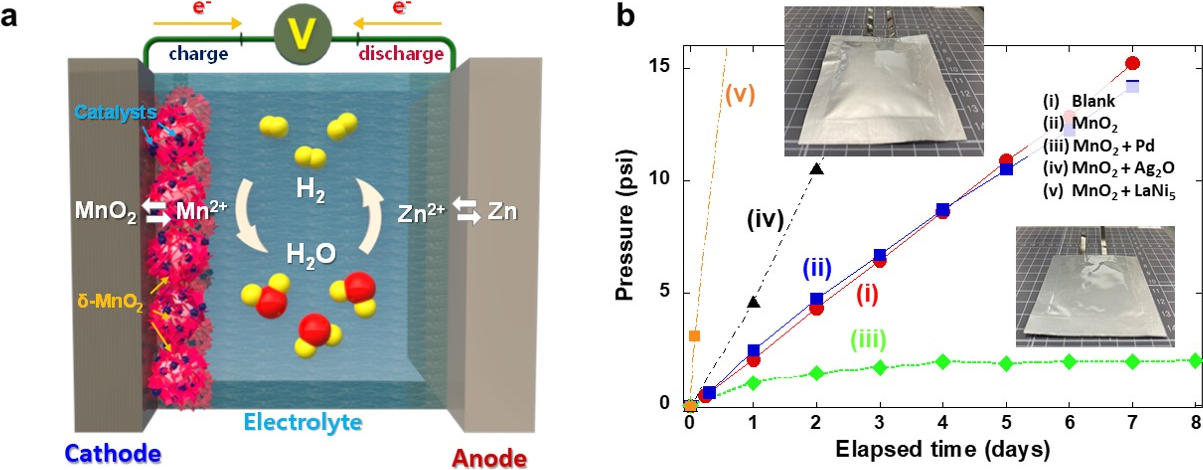
    Proposed Strategy for Securing Safety of the Aqueous Rechargeable Batteries via Water Regeneration
    Proposed strategy for securing safety of the aqueous rechargeable batteries via water-regeneration. Credit: Korea Institute of Science and Technology

    Overcoming Safety Challenges in Battery Technology

    Until now, researchers have often tried to evade this issue by installing a surface protection layer that minimizes the contact area between the metal anode and the electrolyte. However, the corrosion of the metal anode and accompanying decomposition of water in the electrolyte is inevitable in most cases, and incessant accumulation of hydrogen gas can cause a potential detonation in long-term operation.
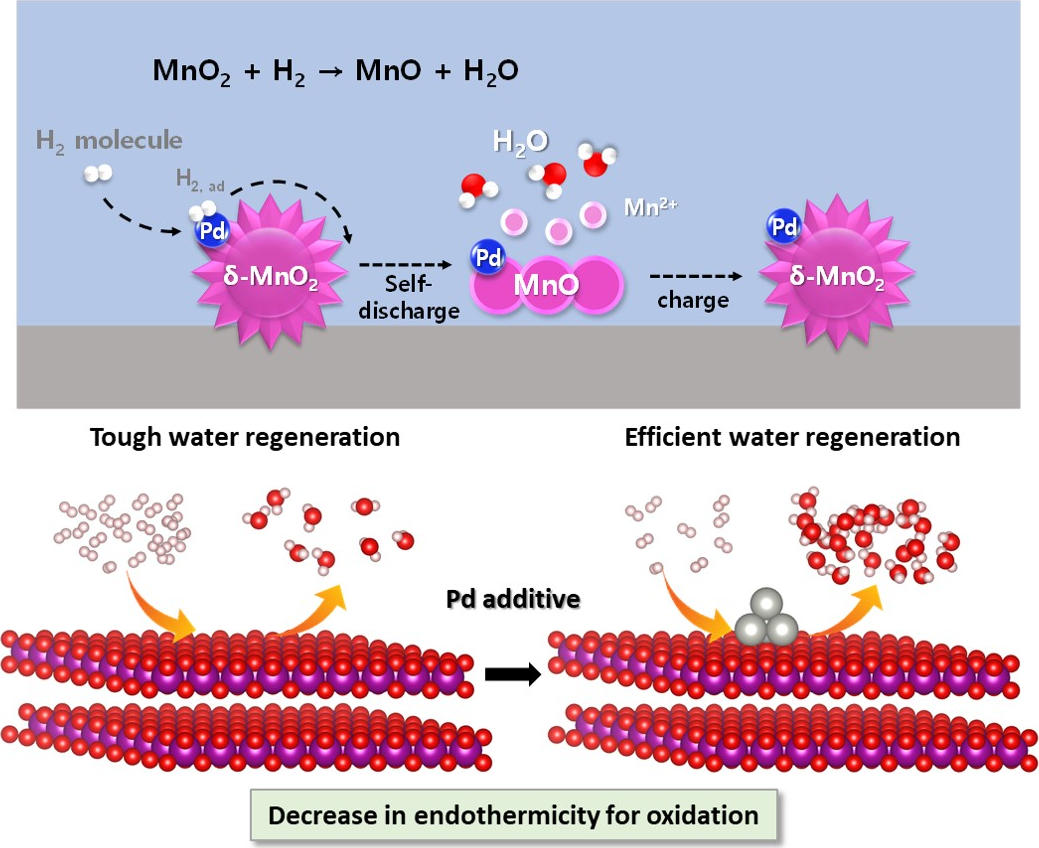
    Role of Composite Catalysts in Activating Water Regeneration Chemical Reaction
    Role of composite catalysts in activating water-regeneration chemical reaction. Credit: Korea Institute of Science and Technology

    To cope with this critical issue, the research team has developed a composite catalyst consisting of manganese dioxide and palladium, which is capable of automatically converting hydrogen gas generated inside the cell into water, ensuring both the performance and safety of the cell.

    Manganese dioxide does not react with hydrogen gas under normal circumstances, but when a small amount of palladium is added, hydrogen is readily absorbed by the catalysts, being regenerated into water. In the prototype cell loaded with the newly developed catalysts, the internal pressure of the cell was maintained well below the safety limit, and no electrolyte depletion was observed.

    Implications for the Future of Energy Storage

    The results of this research effectively solves one of the most concerning safety issues in the aqueous batteries, making a major stride towards commercial application to ESS in the future. Replacing LIBs with cheaper and safer aqueous batteries can even trigger a rapid growth of global market for ESS.

    “This technology pertains to a customized safety strategy for aqueous rechargeable batteries, based on the built-in active safety mechanism, through which risk factors are automatically controlled,” said Dr. Oh, Si Hyoung of KIST. “Moreover, it can be applied to various industrial facilities where hydrogen gas leakage is one of the major safety concerns (for instance, hydrogen gas station, nuclear power plant, etc) to protect public safety.”

    Reference: “Highly safe aqueous rechargeable batteries via electrolyte regeneration using Pd–MnO2 catalytic cycle” by Hyun-gi Jo, Eoyoon Lee, Seulki Han, Jaehong Lim, Minji Jeong, Jinyeon Hwang, Hee-Dae Lim, Hyung-Seok Kim, Hyung Chul Ham and Si Hyoung Oh, 14 July 2023, Energy Storage Materials.
    DOI: 10.1016/j.ensm.2023.102881

    The study was funded by the Ministry of Science and ICT. 

    Never miss a breakthrough: Join the SciTechDaily newsletter.
    Follow us on Google and Google News.

    Battery Technology Energy Engineering Korea Institute of Science and Technology Popular
    Share. Facebook Twitter Pinterest LinkedIn Email Reddit

    Related Articles

    Scientists Uncover Game-Changing Fix That Could Extend Battery Life by Over 19 Times

    300% More Capacity: New Battery Technology Could Significantly Lower Energy Storage Costs

    New Battery Can Self-Charge Without Losing Energy

    Next-Generation Energy Storage Breakthrough: Fast-Charging, Long-Running, Flexible

    New Aluminum Batteries Increase the Range of UUVs Tenfold

    MIT Engineers Look Toward All-Solid Lithium Batteries

    Engineers Design Calcium-Based Multi-Element for Liquid Batteries

    Solid Electrolyte Paves the Way for Rechargeable Batteries with Almost Indefinite Lifetimes

    Power Conserving Chip May Increase Smartphone Battery Life

    3 Comments

    1. Walter on December 30, 2023 8:42 pm

      Very good scientific advance. LIB will fade into thin space

      Reply
    2. Judge Arrow on January 1, 2024 9:32 am

      I call BS. Converting hydrogen gas into water requires flame. End of story. At best this catalyst will cause a condensate as a result of pressure drop.

      Reply
      • James on April 21, 2025 11:02 am

        The hydrogen powered vehicles currently would disagree with you

        Reply
    Leave A Reply Cancel Reply

    • Facebook
    • Twitter
    • Pinterest
    • YouTube

    Don't Miss a Discovery

    Subscribe for the Latest in Science & Tech!

    Trending News

    Artificial Sweeteners May Harm Future Generations, Study Suggests

    Splashdown! NASA Artemis II Returns From Record-Breaking Moon Mission

    What If Consciousness Exists Beyond Your Brain

    Scientists Finally Crack the 100-Million-Year Evolutionary Mystery of Squid and Cuttlefish

    Beyond “Safe Levels”: Study Challenges What We Know About Pesticides and Cancer

    Researchers Have Found a Dietary Compound That Increases Longevity

    Scientists Baffled by Bizarre “Living Fossil” From 275 Million Years Ago

    Your IQ at 23 Could Predict Your Wealth at 27, Study Finds

    Follow SciTechDaily
    • Facebook
    • Twitter
    • YouTube
    • Pinterest
    • Newsletter
    • RSS
    SciTech News
    • Biology News
    • Chemistry News
    • Earth News
    • Health News
    • Physics News
    • Science News
    • Space News
    • Technology News
    Recent Posts
    • What if Dark Matter Has Two Forms? Bold New Hypothesis Could Explain a Cosmic Mystery
    • Researchers Expose Hidden Chemistry of “Ore-Forming” Elements in Biology
    • Geologists Reveal the Americas Collided Earlier Than We Thought
    • 20x Difference: Study Reveals True Source of Airborne Microplastics
    • Scientists Uncover Hidden Force Powering Yellowstone’s Supervolcano
    Copyright © 1998 - 2026 SciTechDaily. All Rights Reserved.
    • Science News
    • About
    • Contact
    • Editorial Board
    • Privacy Policy
    • Terms of Use

    Type above and press Enter to search. Press Esc to cancel.