

Scientists Propose Converting Tall Buildings Into Batteries
In order to ensure that the supply and demand of electricity are appropriately balanced, energy storage technologies are becoming more necessary due to the significant decline in the cost of renewable energy sources, such as wind and solar power. The electricity quality in metropolitan areas may be improved by using a novel energy storage idea proposed by International Institute for Applied Systems Analysis (IIASA) researchers, which could transform tall buildings into batteries.
The ability of the globe to produce electricity via the use of solar energy, wind power, and other renewable technologies has been growing significantly over the last few years, and by 2026, it is anticipated that this capacity will have increased by more than 60% from 2020 levels. This is equal to the combined present total global power capacity of nuclear and fossil fuels. The International Energy Agency estimates that through 2026, renewable energy sources will actually be responsible for about 95% of the growth in the world’s power capacity, with solar photovoltaics accounting for more than half of that increase. But to advance toward a low- or zero-carbon society, innovative solutions are needed, as well as an alternative to conventional energy systems for energy storage and consumption.
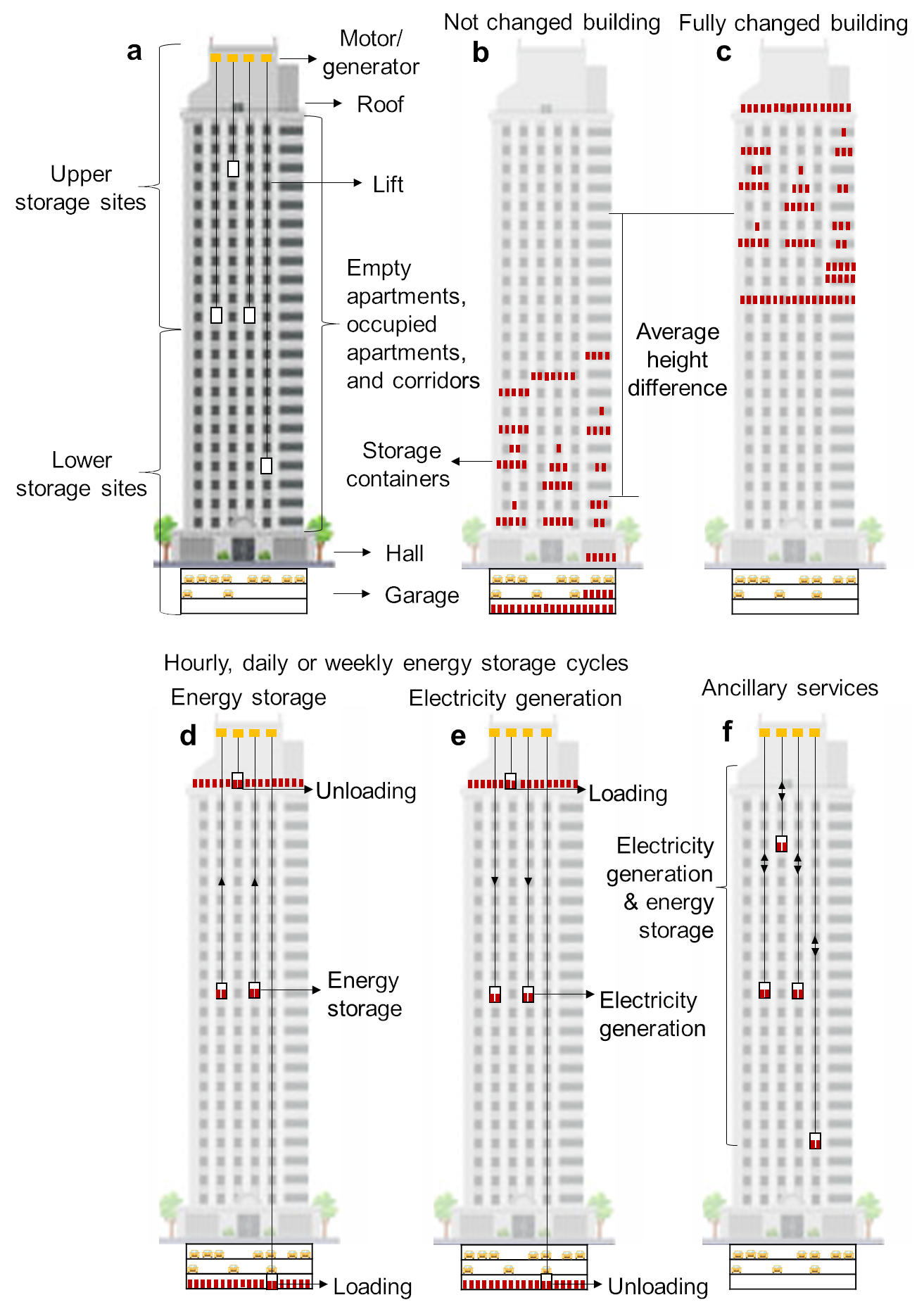
In their study that was recently published in the journal Energy, IIASA researchers proposed a novel gravitational-based energy storage system that makes use of elevators and vacant apartments in tall buildings. This strange concept, named Lift Energy Storage Technology (LEST) by the authors, stores energy by lifting wet sand containers or other high-density materials that are remotely moved in and out of a lift using autonomous trailer devices. LEST is an intriguing possibility since high-rise buildings already have elevators built, thus there is no need for more investment or space occupancy but rather uses what is already there in a novel manner to produce value for the electrical grid and the building owner.
Elevators as Energy Storage Systems in High-Rise Buildings
“I have always been fascinated with topics involving potential energy, in other words, generating energy with changes in altitude, such as hydropower, pumped-storage, buoyancy, and gravity energy storage. The concept of gravity energy storage has also recently received significant attention in the scientific community and start-ups. The concept of LEST came to me after having spent a considerable amount of time going up and down in a lift since recently moving into an apartment on the 14th floor,” explains lead author Julian Hunt, a researcher in the IIASA Sustainable Service Systems Research Group.
According to the authors, the main challenge in making a gravity energy storage solution viable is the power capacity cost. The most important benefit of LEST is that the power capacity is already installed in lifts with regenerative braking systems. There are over 18 million lifts in operation globally, and many of these spend a significant amount of time sitting still. The idea is that when the lifts are not being used to transport people, they can be used to store or generate electricity.
As with any new system, there are still a few details that need to be further refined before the system can be deployed. This includes finding room to store the weights the system relies on at the top of the building when the system is fully charged, and at the bottom of the building when the system is discharged. Empty apartments or corridors could be viable options in this regard. Another consideration is the ceiling bearing capacity of existing buildings where the system is installed, that is, the total mass in kilograms per square meter that the ceiling can support without collapsing. Being able to store energy where electricity is mostly consumed, such as in cities, however, will greatly benefit the energy grid and LEST can provide affordable and decentralized ancillary services, which could, in turn, improve the power quality in an urban setting.
Potential Benefits of Decentralized Energy Storage for Urban Power Grids
“Environmentally friendly and flexible storage technologies like LEST are set to become more and more valuable to society in a future where a large share of its electricity comes from renewables. Therefore, policymakers and power system regulators need to adopt strategies to incentivize end users, in this case, high-rise buildings, to share their distributed storage resources, such as LEST, with the central grid. The coordinated utilization of such distributed resources alleviates the need for investment in large-scale central storage systems,” concludes study coauthor Behnam Zakeri, a researcher in the IIASA Integrated Assessment and Climate Change Research Group.
Reference: “Lift Energy Storage Technology: A solution for decentralized urban energy storage” by Julian David Hunt, Andreas Nascimento, Behnam Zakeri, Jakub Jurasz, Paweł B. Dąbek, Paulo Sergio Franco Barbosa, Roberto Brandão, Nivalde José de Castro, Walter Leal Filho and Keywan Riahi, 25 May 2022, Energy.
DOI: 10.1016/j.energy.2022.124102
Never miss a breakthrough: Join the SciTechDaily newsletter.
Follow us on Google and Google News.
1 Comment
Great, all we need is the equivalent of a municipal water tower with a tank above and below for every home. Then it would have enough storage for those cloudy, windless days. If you said we need small nuclear plants in a de-centralized grid, I wouldn’t be laughing.