
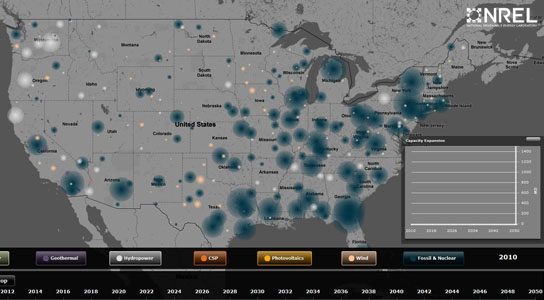
A new report from the National Renewable Energy Laboratory suggests that renewable electricity generation from today’s technologies, in combination with a more flexible electric system, is more than adequate to supply 80% of total U.S. electricity generation in 2050.
A report published by the National Renewable Energy Laboratory (NREL), the Renewable Electricity Futures Study (RE Futures), is an initial investigation of the extent to which renewable energy supply can meet the electricity demands of the continental United States over the next several decades. This study explores the implications and challenges of very high renewable electricity generation levels—from 30% up to 90%, focusing on 80%, of all U.S. electricity generation from renewable technologies—in 2050. At such high levels of renewable electricity generation, the unique characteristics of some renewable resources, specifically geographical distribution and variability and uncertainty in output, pose challenges to the operability of the nation’s electric system.
Key Findings
- Renewable electricity generation from technologies that are commercially available today, in combination with a more flexible electric system, is more than adequate to supply 80% of total U.S. electricity generation in 2050 while meeting electricity demand on an hourly basis in every region of the country.
- Increased electric system flexibility, needed to enable electricity supply-demand balance with high levels of renewable generation, can come from a portfolio of supply- and demand-side options, including flexible conventional generation, grid storage, new transmission, more responsive loads, and changes in power system operations.
- The abundance and diversity of U.S. renewable energy resources can support multiple combinations of renewable technologies that result in deep reductions in electric sector greenhouse gas emissions and water use.
- The direct incremental cost associated with high renewable generation is comparable to published cost estimates of other clean energy scenarios. Improvement in the cost and performance of renewable technologies is the most impactful lever for reducing this incremental cost.
RE Futures provides initial answers to important questions about the integration of high penetrations of renewable electricity technologies from a national perspective, focusing on key technical implications. The study explores electricity grid integration using models with unprecedented geographic and time resolution for the contiguous United States to assess whether the U.S. power system can supply electricity to meet customer demand on an hourly basis with high levels of renewable electricity, including variable wind and solar generation.
RE Futures, funded by the U.S. Department of Energy’s Office of Energy Efficiency and Renewable Energy, is a collaboration with more than 110 contributors from 35 organizations including national laboratories, industry, universities, and non-governmental organizations.
As the most comprehensive analysis of high-penetration renewable electricity of the continental United States to date, the study can inform broader discussion of the evolution of the electric system and electricity markets towards clean systems. RE Futures results indicate that renewable generation could play a more significant role in the U.S. electricity system than previously thought and that further work is warranted to investigate this clean generation pathway.
Renewable Electricity Futures Report
- Volume 1: Exploration of High-Penetration Renewable Electricity Futures (includes Executive Summary)
- Volume 2: Renewable Electricity Generation and Storage Technologies
- Volume 3: End-Use Electricity Demand
- Volume 4: Bulk Electric Power Systems: Operations and Transmission Planning
Modeling and Cost Data
- Energy models used in the study:
- Regional Energy Deployment System (ReEDS).
- Technology cost and performance assumptions used in scenario analysis:
- Black & Veatch report on Cost and Performance Data for Power Generation Technologies – documents assumptions used for baseline and incremental technology improvement scenarios
- Transparent Cost Database/Open Energy Information (pending public release) – includes cost (capital and operating) and capacity factor assumptions for renewable generation technologies used for baseline, incremental technology improvement, and evolutionary technology improvement scenarios, along with other published and DOE program estimates for these technologies.
Never miss a breakthrough: Join the SciTechDaily newsletter.
Follow us on Google and Google News.