
Close Menu
    Facebook X (Twitter) Instagram
    SciTechDaily
    • Biology
    • Chemistry
    • Earth
    • Health
    • Physics
    • Science
    • Space
    • Technology
    Facebook X (Twitter) Pinterest YouTube RSS
    SciTechDaily
    Home»Technology»Carbon-Netural Thermocell Could Harvest ‘Waste Heat’
    Technology

    Carbon-Netural Thermocell Could Harvest ‘Waste Heat’

    By Monash UniversityJuly 16, 2013No Comments3 Mins Read
    Facebook Twitter Pinterest Telegram LinkedIn WhatsApp Email Reddit
    Share
    Facebook Twitter LinkedIn Pinterest Telegram Email Reddit
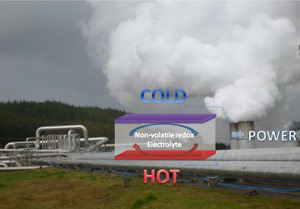
    New Carbon Netural Thermocell Could Harvest Waste Heat
    A new, carbon-netural thermocell could harvest waste heat from power stations and convert it into electricity. Credit: Doug MacFarlane and Theodore Abraham

    Researchers from Monash University have developed a liquid-based thermocell that could harvest waste heat and convert it into electricity with no carbon emissions.

    Harvesting waste heat from power stations and even vehicle exhaust pipes could soon provide a valuable supply of electricity.

    A small team of Monash University researchers working under the Australian Research Council (ARC) Center of Excellence for Electromaterials Science (ACES) has developed an ionic liquid-based thermocell. Thermocell technology is based on harnessing the thermal energy from the difference in temperature between two surfaces and converting that energy into electricity. The research is published in the journal Energy and Environmental Science.

    Led by Monash University researcher and Australian Laureate Fellow Professor Doug MacFarlane and Monash University PhD student Theodore Abraham, the collaborative project developed the thermocell device with the highest power outputs yet reported and no carbon emissions.

    The new thermocell could be used to generate electricity from low grade steam in coal fired power stations at temperatures around 130°C. This would be implemented by having the steam pass over the outer surface of the hot electrode to keep it hot while the other electrode is air or water cooled.


    PhD student Theodore Abraham explains how the thermocell works.

    Professor MacFarlane said the breakthrough included the development of a novel ionic liquid-based redox electrolyte.

    “We have found that it can work at elevated temperatures typical of important heat sources, as opposed to water-based systems, which cannot operate at temperatures above 100 degrees Celsius (212 degrees Fahrenheit),” Professor MacFarlane said.

    “The device offers the possibility of a cheap and flexible design suitable for harvesting waste heat in the 100- to 200-degree Celsius (212- to 392-degree Fahrenheit) range.”

    PhD student Theodore Abraham said that by using heat already produced in industrial processes that would otherwise be untapped, the thermocell is an attractive method of relieving some of the present reliance on fossil fuels.

    “The major benefit of a thermocell is that it harnesses energy that is already readily out there; you’re just harnessing energy that is otherwise lost to surroundings,” Mr Abraham said.

    Mr Abraham was supervised by Dr Jenny Pringle of Deakin University who said the development was a significant achievement for a PhD student.

    “The advance we made with this system was that we are generating more electrical energy than any previous power cell in this temperature range,” Dr Pringle said.

    ACES Director Professor Gordon Wallace said that it took a multitude of skills to tackle complex issues as encountered here.

    “Our unique research environment within ACES provides an opportunity to acquire these skills in a cutting-edge research environment,” Dr Wallace said.

    Reference: “High Seebeck coefficient redox ionic liquid electrolytes for thermal energy harvesting” by Theodore J. Abraham, Douglas R. MacFarlanea and Jennifer M. Pringle, 17 June 2013, Energy & Environment Science.
    DOI: 10.1039/C3EE41608A

    Image: Doug MacFarlane and Theodore Abraham

    Never miss a breakthrough: Join the SciTechDaily newsletter.
    Follow us on Google and Google News.

    Electricity Materials Science Monash University Renewable Energy Thermodynamics Thermoelectrics
    Share. Facebook Twitter Pinterest LinkedIn Email Reddit

    Related Articles

    New Graphene Tech Powers Supercapacitors To Rival Traditional Batteries

    New Engineering Strategy Makes Graphene-Based Supercapacitors Viable for Widespread Use

    Researchers Develop First Fully Integrated Nanosystem for Artificial Photosynthesis

    Thermal Cloak Molds the Flow of Heat Around an Object

    MOF Powered by Sunlight Could Help Drastically Cut Carbon Emissions

    Wind Could Power Half the World by 2030

    Screening-Engineered Field-Effect Photovoltaics Could Accelerate the Usage of Solar Energy

    Highly Transparent Polymer Solar Cell Produces Energy by Absorbing Near-Infrared Light

    National Renewable Energy Laboratory Energy Analysis

    Leave A Reply Cancel Reply

    • Facebook
    • Twitter
    • Pinterest
    • YouTube

    Don't Miss a Discovery

    Subscribe for the Latest in Science & Tech!

    Trending News

    5 Simple Ways To Remember More and Forget Less

    The Atomic Gap That Could Cost the Semiconductor Industry Billions

    Researchers Finally Solve 50-Year-Old Blood Group Mystery

    Scientists Discover “Molecular Switch” That Fuels Alzheimer’s Brain Inflammation

    Trees Emit Tiny Lightning Flashes During Storms and Scientists Finally Prove It

    Pomegranate Compound Could Help Protect Against Heart Disease

    Your Blood Test Might Already Show Alzheimer’s Risk

    Scientists Were Wrong About This Strange “Rule-Breaking” Particle

    Follow SciTechDaily
    • Facebook
    • Twitter
    • YouTube
    • Pinterest
    • Newsletter
    • RSS
    SciTech News
    • Biology News
    • Chemistry News
    • Earth News
    • Health News
    • Physics News
    • Science News
    • Space News
    • Technology News
    Recent Posts
    • Scientists Complete Largest 3D Map of the Universe to Probe Dark Energy
    • Hidden Parasite Found in Popular Portuguese Lake Raises Health Concerns
    • This Simple Trick Can Boost Your Workout Endurance by 20%
    • This Popular Supplement May Interfere With Cancer Treatment, Scientists Warn
    • Scientists Propose Radical New Way To Detect Alien Life – Without Traditional Biosignatures
    Copyright © 1998 - 2026 SciTechDaily. All Rights Reserved.
    • Science News
    • About
    • Contact
    • Editorial Board
    • Privacy Policy
    • Terms of Use

    Type above and press Enter to search. Press Esc to cancel.