
A team of OzGrav scientists has designed a table-top demo to teach gravitational-wave detection, using sound to represent continuous waves. The demonstration helps both physics and engineering students explore signal processing and cross-disciplinary research.
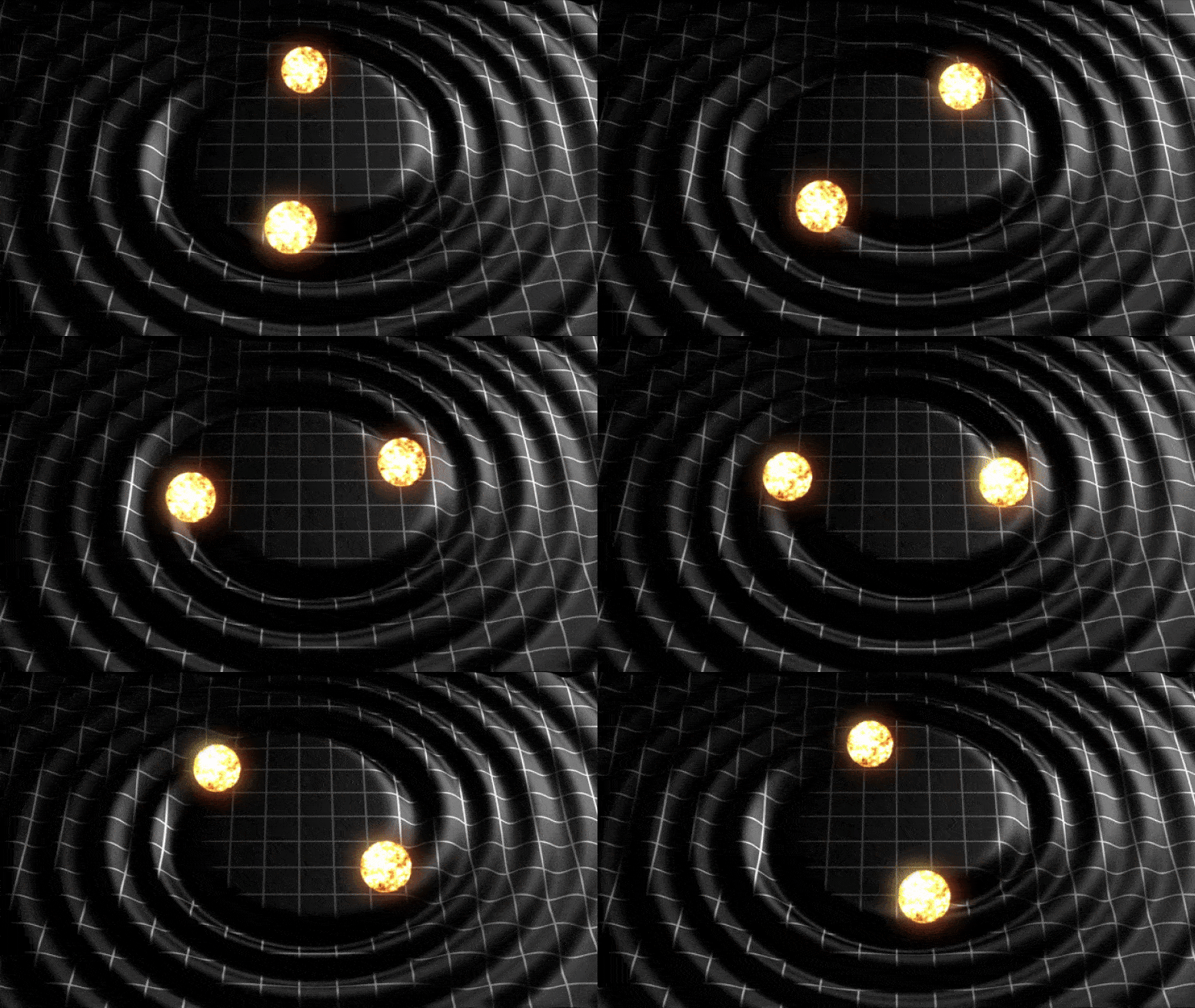
Gravitational waves are ripples in space-time created by distant astronomical objects and detected by large complex detectors (like LIGO, Virgo, and KAGRA). Finding gravitational-wave signals in detector data is a complicated task requiring advanced signal processing techniques and supercomputing resources. Due to this complexity, explaining gravitational-wave searches in the undergraduate laboratory is difficult, especially because live demonstration using a gravitational-wave detector or supercomputer is not possible. Through simplification and analogy, table-top demonstrations are effective in explaining these searches and techniques.
A team of OzGrav scientists, across multiple institutions and disciplines, have designed a table-top demonstration with data analysis examples to explain gravitational-wave searches and signal processing techniques. The demonstration can be used as a teaching tool in both physics and engineering undergraduate laboratories and is to be published in the American Journal of Physics.
Lead author of the project James Gardner (who was an OzGrav undergraduate student at the University of Melbourne during the project and now a postgraduate researcher at the Australian National University) explains: “This demonstration offers some charming insights into a live field of research that students like me should appreciate for its recency compared to the age of most ideas they encounter.”
Table-Top Gravitational-Wave Demonstrations
Gravitational wave detectors are very complicated and huge — laser light is sent down tubes kilometers long! But the workings of a gravitational-wave detector can be demonstrated using table-top equipment. Researchers at the University of Adelaide have developed AMIGO to do just that! Deeksha Beniwal, co-author of this study and an OzGrav PhD student at the University of Adelaide explains: “With AMIGO, the portable interferometer, we can easily share how LIGO uses the fundamental properties of light to detect ripples from the most distant reaches of the universe.”
This work expands on the portable interferometer demonstration with a selection of examples for students in both physics and electrical engineering. Changrong Liu, co-author of this study and an OzGrav PhD student in electrical engineering at the University of Melbourne, explains: “This project offers a great opportunity for electrical engineering students like me to put some of their knowledge into the real and exciting physical world.”
Explaining the Hunt for Continuous Gravitational Waves
To demonstrate searching for signals with the table-top set up, the team first needed to make some fake signals to find! This is where the analogy of sound comes in: audio signals are used to mimic gravitational waves interacting with the detector. The team focused on demonstrating the hunt for continuous gravitational waves, a type of gravitational wave that hasn’t been detected yet.
Hannah Middleton, co-author of the study and an OzGrav Associate Investigator (at the University of Birmingham), explains: “Continuous waves are long-lasting signals from spinning neutron stars. These signals should be present in the detector data all the time, but the challenge is to find them. This demonstration is directly inspired by the techniques developed by OzGrav physicists and electrical engineers in the hunt for continuous gravitational waves!“
A continuous wave signal can be slowly changing in frequency, so the audio signals used in this demonstration also change in frequency. ”We show, through using sound as an analog to gravitational waves, what it takes to detect a wandering tone: a long signal that slowly changes pitch like whalesong,” explains Gardner.
Prof. Andrew Melatos, co-author of this study and leader of the OzGrav-Melbourne node explains: “We hope that undergraduate educators will emphasize the cross-disciplinary spirit of the project and use it as an opportunity to speak more broadly to students about careers at the intersection of physics and engineering. The future is very bright career-wise for students with experience in cross-disciplinary collaboration”
Written by OzGrav Assoc. Investigator Hannah Middleton (University of Birmingham) and OzGrav postgrad researcher James Gardner (ANU).
Reference: “Continuous gravitational waves in the lab: Recovering audio signals with a table-top optical microphone” by James W. Gardner, Hannah Middleton, Changrong Liu, Andrew Melatos, Robin Evans, William Moran, Deeksha Beniwal, Huy Tuong Cao, Craig Ingram, Daniel Brown and Sebastian Ng, 23 March 2022, American Journal of Physics.
DOI: 10.1119/10.0009409
Never miss a breakthrough: Join the SciTechDaily newsletter.
Follow us on Google and Google News.