
Close Menu
    Facebook X (Twitter) Instagram
    SciTechDaily
    • Biology
    • Chemistry
    • Earth
    • Health
    • Physics
    • Science
    • Space
    • Technology
    Facebook X (Twitter) Pinterest YouTube RSS
    SciTechDaily
    Home»Health»Plant Compound Shows Promise for Treating Food Allergies
    Health

    Plant Compound Shows Promise for Treating Food Allergies

    By Experimental BiologyApril 6, 2022No Comments3 Mins Read
    Facebook Twitter Pinterest Telegram LinkedIn WhatsApp Email Reddit
    Share
    Facebook Twitter LinkedIn Pinterest Telegram Email Reddit
    Protein Protein Interactions
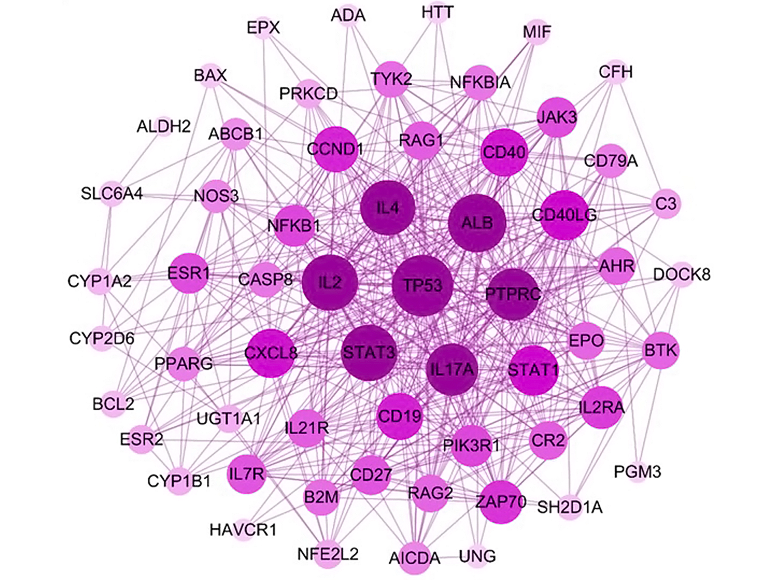
    This protein-protein interactions network was constructed by mapping potential targets in food allergy, IgE, and mast cell diseases to the Strings database. The size of the node from large to small is proportional to its degree value in the network. The circles represent the therapeutic targets, and the purple lines represent the interaction between the nodes. Credit: Ibrahim Musa, New York Medical College

    Study uncovers new drug targets for treating other allergic disorders.

    Researchers combined advanced computational methods with experimental studies to gain new insight, at the cell level, into how the plant compound formononetin might be used to treat food allergies. With nearly 10% of the world population affected by food allergies — which are sometimes life-threatening — new treatments are critically needed.

    Formononetin is found in plants and herbs such as red clover and green beans and has been shown to have anticancer properties. It is a phytoestrogen, meaning that it has a structure similar to the hormone estrogen and can bind to the body’s estrogen receptors.

    “Our findings show that formononetin is a particularly good therapeutic candidate for treating food allergies,” said Ibrahim Musa, a doctoral candidate in pathology, microbiology and immunology at New York Medical College. “Our research also revealed new mechanisms and targets that can be utilized to design future drugs for treating food allergies and other allergic disorders or to prevent severe anaphylaxis seen in allergic diseases.”

    Musa presented the new research at the American Society for Biochemistry and Molecular Biology annual meeting during the Experimental Biology (EB) 2022 meeting, which was held on April 2-5, 2022, in Philadelphia.

    Formononetin’s Impact on Food Allergies

    Food allergies occur when the immune system treats a food or something in a food as a threat. This causes the immune system to produce immunoglobulin E (IgE) antibodies that react to the food and can cause allergy symptoms such as hives, asthma, itching, trouble breathing or diarrhea.

    In previous studies, the researchers identified formononetin as a potential therapeutic for allergies because it decreased IgE production. To find out more, the researchers turned to an approach known as systems pharmacology. This involved using data from publicly available databases to identify gene and protein targets regulated in food allergy and mast cells diseases. Mast cells also play an important role in IgE-mediated allergic diseases.

    Once they identified gene and protein targets, the researchers validated them using cultured cell lines that are commonly used in allergy studies. These cell experiments showed that formononetin did influence the expression of gene and protein targets identified using systems pharmacology.

    Systems Pharmacology and Allergy Research

    “Our study demonstrates that system pharmacology can be used to predict drug/ compound–target interaction,” said Musa. “What’s more, the mechanism of action identified for formononetin is also important for other allergic diseases such as allergic asthma and hay fever. This suggests that formononetin or other therapeutic candidates that decrease IgE production could be useful for treating these diseases.”

    The researchers have developed a mouse model of peanut allergy that they plan to use to study formononetin and identify potential side effects.

    Ibrahim Musa will present this research from 12:30–1:45 p.m. Tuesday, April 5, in Exhibit/Poster Hall A-B, Pennsylvania Convention Center (Poster Board Number A235) (abstract). This work will be featured in a virtual press conference from 11–11:45 a.m. EDT on Friday, April 1 (RSVP by Thursday, March 31). Contact the media team for more information or to obtain a free press pass to attend the meeting.

    Meeting: Experimental Biology 2022

    Never miss a breakthrough: Join the SciTechDaily newsletter.
    Follow us on Google and Google News.

    Allergy Immunology Pharmaceuticals
    Share. Facebook Twitter Pinterest LinkedIn Email Reddit

    Related Articles

    Several FDA-Approved Drugs Could Be Repurposed To Treat People Infected With COVID-19

    Is Modern Society Too Clean, Leading to Defective Immune Systems in Children?

    New Allergy Guidelines for Schools Recommend Against Food Bans

    New Compound Created That Targets Enzyme Linked to Autoimmune Disorders & Severe COVID-19

    How Vitamins, Steroids and Potential Antivirals Might Might Help Combat COVID-19

    Antidepressant Fluvoxamine May Prevent COVID-19 Infections From Worsening

    Rapid Method Finds Potent COVID-19 Antibody Among a Trillion Possibilities

    Seaweed Extract Outperforms Remdesivir in Blocking COVID-19 Virus in Cell Studies

    FDA Approved Drug May Help Calm Cytokine Storm in COVID-19

    Leave A Reply Cancel Reply

    • Facebook
    • Twitter
    • Pinterest
    • YouTube

    Don't Miss a Discovery

    Subscribe for the Latest in Science & Tech!

    Trending News

    Monster Storms on Jupiter Unleash Lightning Beyond Anything on Earth

    Scientists Create “Liquid Gears” That Spin Without Touching

    The Simple Habit That Could Help Prevent Cancer

    Millions Take These IBS Drugs, But a New Study Finds Serious Risks

    Scientists Unlock Hidden Secrets of 2,300-Year-Old Mummies Using Cutting-Edge CT Scanner

    Bread Might Be Making You Gain Weight Even Without Eating More Calories

    Scientists Discover Massive Magma Reservoir Beneath Tuscany

    Europe’s Most Active Volcano Just Got Stranger – Here’s Why Scientists Are Rethinking It

    Follow SciTechDaily
    • Facebook
    • Twitter
    • YouTube
    • Pinterest
    • Newsletter
    • RSS
    SciTech News
    • Biology News
    • Chemistry News
    • Earth News
    • Health News
    • Physics News
    • Science News
    • Space News
    • Technology News
    Recent Posts
    • 25-Year Study Uncovers Hidden Paths and Early Warning Signs of Blood Cancer
    • Not Just Snoring – New Research Reveals Sleep Apnea May Be Damaging Your Muscles
    • Scientists Discover a Surprising Reason Intermittent Fasting Extends Life
    • Scientists Discover a New Meteor Shower From a Mysterious Crumbling Asteroid
    • This Simple Fruit Wash Could Make Produce Safer and Last Days Longer
    Copyright © 1998 - 2026 SciTechDaily. All Rights Reserved.
    • Science News
    • About
    • Contact
    • Editorial Board
    • Privacy Policy
    • Terms of Use

    Type above and press Enter to search. Press Esc to cancel.