
Molten-Salt Battery Marks Step Toward Seasonal Storage of Grid-Scale Energy
Scientists have developed a battery designed for the electric grid that can store energy for months without losing much storage capacity.
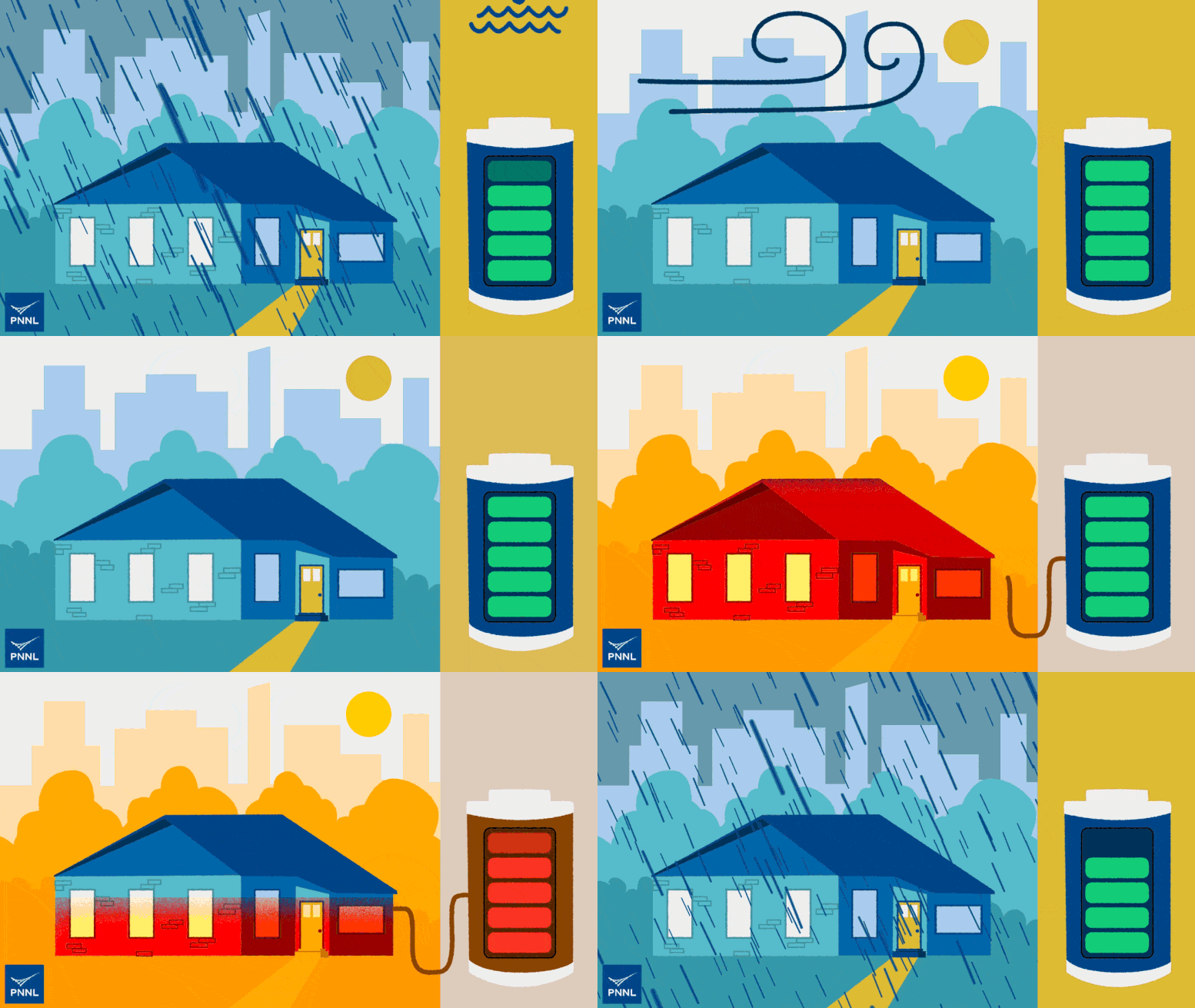
The creation of the “freeze-thaw battery,” which freezes its energy for later use, is a step toward batteries that may be used for seasonal storage: saving energy in one season, such as spring, and using it in another, such as fall.
The prototype is small, roughly the size of a hockey puck. However, the science behind the device has enormous promise, foreshadowing a day when energy from intermittent sources, such as sunlight and wind, can be stored for extended periods of time. The study by scientists at the Department of Energy’s Pacific Northwest National Laboratory was published online on March 23, 2022, in the journal Cell Reports Physical Science.
“Longer-duration energy storage technologies are important for increasing the resilience of the grid when incorporating a large amount of renewable energy,” said Imre Gyuk, director of Energy Storage at DOE’s Office of Electricity, which funded the work. “This research marks an important step toward a seasonal battery storage solution that overcomes the self-discharge limitations of today’s battery technologies.”
Harnessing and Packaging Nature’s Energy
Renewable sources ebb and flow with nature’s cycles. That makes it difficult to include them in a reliable, steady stream of electricity. In the Pacific Northwest in the spring, for instance, rivers heavy with runoff power hydroelectric dams to the max just as winds blow fiercely down the Columbia Gorge. All that power must be harnessed immediately or stored for a few days at most.
Grid operators would love to harness that springtime energy, store it in large batteries, then release it late in the year when the region’s winds are slow, the rivers are low, and demand for electricity peaks.
The batteries would also enhance utilities’ ability to weather a power outage during severe storms, making large amounts of energy available to be fed into the grid after a hurricane, a wildfire or other calamity.
“It’s a lot like growing food in your garden in the spring, putting the extra in a container in your freezer, and then thawing it out for dinner in the winter,” said first author Minyuan “Miller” Li.
The battery is first charged by heating it up to 180 degrees Celsius, allowing ions to flow through the liquid electrolyte to create chemical energy. Then, the battery is cooled to room temperature, essentially locking in the battery’s energy. The electrolyte becomes solid and the ions that shuttle energy stay nearly still. When the energy is needed, the battery is reheated and the energy flows.
The freeze-thaw phenomenon is possible because the battery’s electrolyte is molten salt—a molecular cousin of ordinary table salt. The material is liquid at higher temperatures but solid at room temperature.
The freeze-thaw concept dodges a problem familiar to anyone who has let their car sit unused for too long: a battery that self-discharges as it sits idle. A fast discharge rate, like that of batteries in most cars or laptops, would hamper a grid battery designed to store energy for months. Notably, the PNNL freeze-thaw battery has retained 92 percent of its capacity over 12 weeks.
In other words, the energy doesn’t degrade much; it’s preserved, just like food in a freezer.

Ordinary Ingredients a Plus
The team avoided rare, expensive and highly reactive materials. Instead, the aluminum-nickel molten-salt battery is chock full of Earth-abundant, common materials. The anode and cathode are solid plates of aluminum and nickel, respectively. They’re immersed in a sea of molten-salt electrolyte that is solid at room temperature but flows as a liquid when heated. The team added sulfur—another common, low-cost element—to the electrolyte to enhance the battery’s energy capacity.
One of the biggest advantages of the battery is the composition of a component, called a separator, placed between the anode and the cathode. Most higher-temperature molten-salt batteries require a ceramic separator, which can be more expensive to make and susceptible to breakage during the freeze-thaw cycle. The PNNL battery uses simple fiberglass, possible because of the battery’s stable chemistry. This cuts costs and makes the battery sturdier when undergoing freeze-thaw cycles.
“Reducing battery costs is critical. That is why we’ve chosen common, less-expensive materials to work with, and why we focused on removing the ceramic separator,” said corresponding author Guosheng Li, who led the study.

The battery’s energy is stored at a materials cost of about $23 per kilowatt-hour, measured before a recent jump in the cost of nickel. The team is exploring the use of iron, which is less expensive, in hopes of bringing the materials cost down to around $6 per kilowatt-hour, roughly 15 times less than the materials cost of today’s lithium-ion batteries.
The battery’s theoretical energy density is 260 watt-hours per kilogram—higher than today’s lead-acid and flow batteries.
Researchers point out that batteries designed for seasonal storage would likely charge and discharge just once or twice a year. Unlike batteries designed to power electric cars, laptops or other consumer devices, they don’t need to last hundreds or thousands of cycles.
“You can start to envision something like a large battery on a 40-foot tractor-trailer parked at a wind farm,” said coauthor Vince Sprenkle, senior strategic advisor at PNNL. “The battery is charged in the spring and then the truck is driven down the road to a substation where the battery is available if needed during the summer heat.”
Battelle, which operates PNNL, has filed for a patent on the technology. More information is available here.
Other authors of the paper include PNNL researchers Evgueni Polikarpov, Nathan Canfield, Mark Engelhard, J. Mark Weller and David Reed, and former PNNL scientist Xiaowen Zhan.
Reference: “A freeze-thaw molten salt battery for seasonal storage” by Minyuan M. Li, Xiaowen Zhan, Evgueni Polikarpov, Nathan L. Canfield, Mark H. Engelhard, J. Mark Weller, David M. Reed, Vincent L. Sprenkle and Guosheng Li, 23 March 2022, Cell Reports Physical Science.
DOI: 10.1016/j.xcrp.2022.100821
Never miss a breakthrough: Join the SciTechDaily newsletter.
Follow us on Google and Google News.