
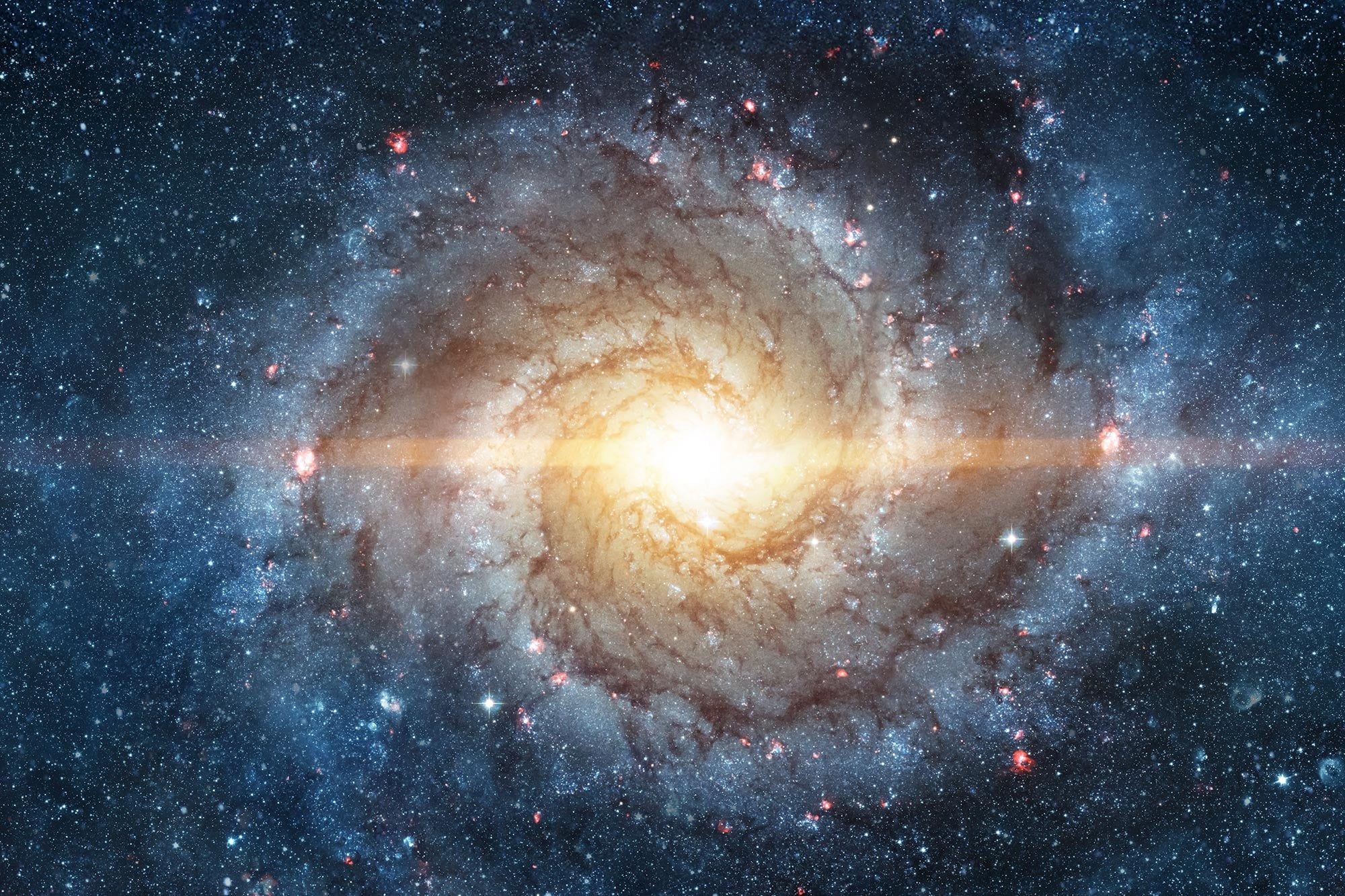
Astronomers have uncovered a hidden population of dusty galaxies that formed just one billion years after the Big Bang, offering a new glimpse into the universe’s formative years.
An international collaboration of 48 astronomers from 14 countries, led by researchers at the University of Massachusetts Amherst, has identified a previously hidden group of dusty, star-forming galaxies located at the outer reaches of the observable universe. These galaxies took shape just one billion years after the Big Bang, which scientists estimate occurred about 13.7 billion years ago.
The newly identified galaxies could represent a transitional stage in galaxy evolution. They may connect extremely distant, luminous galaxies that formed around 13.3 billion years ago with early “quiescent,” or dead, galaxies that had already stopped producing new stars roughly 2 billion years after the Big Bang. The findings, published in The Astrophysical Journal Letters, challenge established models of how the universe developed and suggest that the standard timeline of cosmic history may need revision.
“My research involves trying to identify and understand a population of rare, dusty star-forming galaxies that were only discovered at the end of the 1990s,” says Jorge Zavala, assistant professor of astronomy at UMass Amherst and the paper’s lead author.
These galaxies have long been difficult to observe because they are rich in cosmic dust. That dust absorbs ultraviolet (UV) and visible light, which makes the galaxies nearly impossible to detect with telescopes that rely on those parts of the electromagnetic spectrum.
The situation changed with the development of submillimeter telescopes, which are designed to observe longer wavelengths of light. When dust absorbs UV and visible radiation, it heats up and re-emits that energy as infrared light. Submillimeter instruments can detect this infrared glow, allowing astronomers to study regions of the universe that were once hidden from view.
Combining ALMA and JWST
To carry out their research, Zavala and his colleagues first used the Atacama Large Millimeter/submillimeter Array (ALMA) in Chile. With ALMA, they identified about 400 bright, dust-rich galaxies.
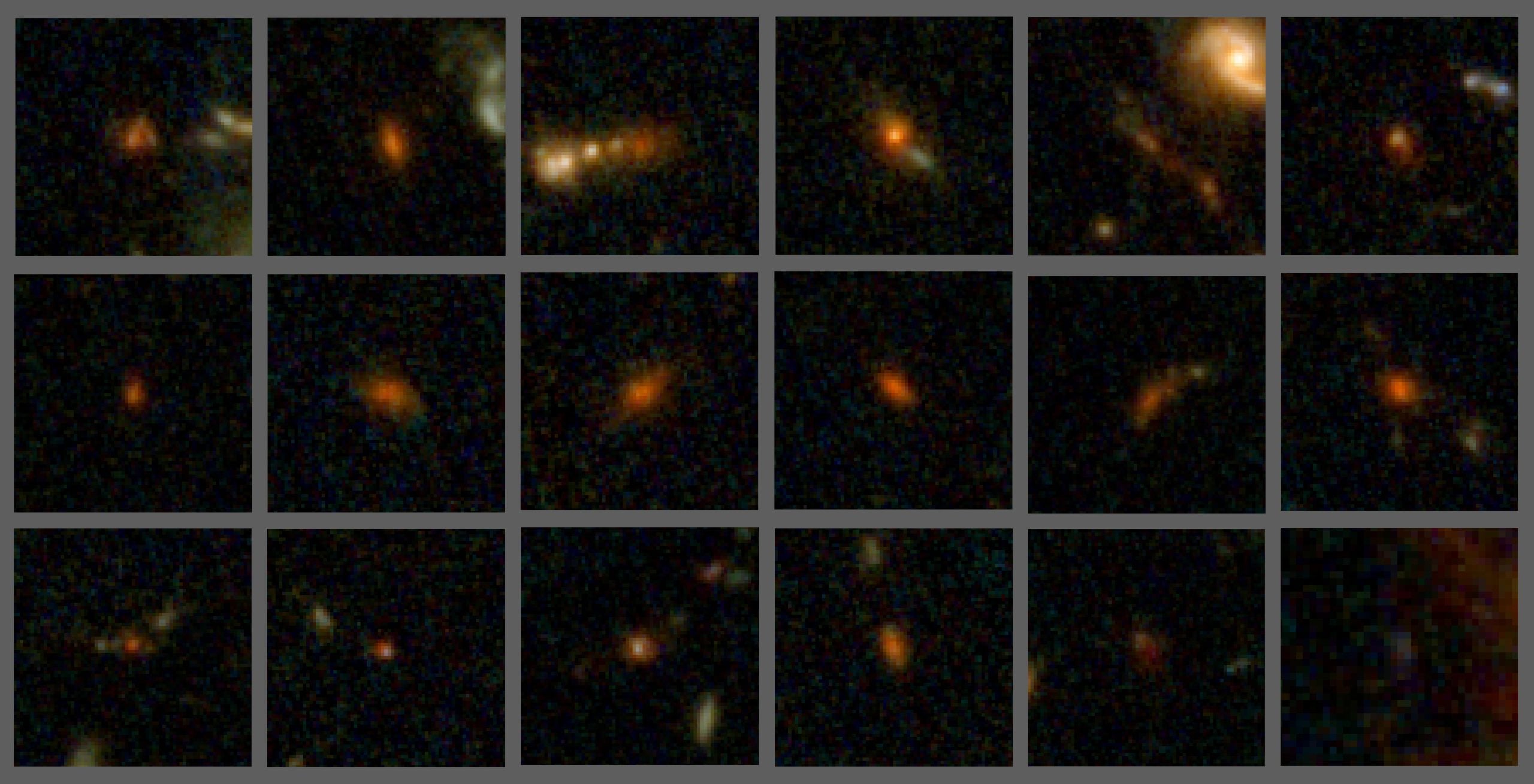
Next, they examined near-infrared data from NASA’s recently launched James Webb Space Telescope to locate about 70 faint dusty galaxy candidates near the edge of the observable universe. Most of these objects had not previously been detected.
The team then returned to the ALMA observations and combined, or “stacked,” the data to strengthen the faint signals. This approach confirmed that the galaxies are indeed dusty systems that formed nearly 13 billion years ago.
Rethinking the Timeline of Star Formation
Beyond the technical achievement, the discovery has significant implications for understanding the early universe.
“Dusty galaxies are massive galaxies with large amounts of metals and cosmic dust,” Zavala says. “And these galaxies are very old, which means stars were being formed in the early universe, earlier than our current models predict.”
The research also suggests a possible link between these galaxies and two other unusual populations. One group consists of ultrabright, star-forming galaxies that appeared shortly after the Big Bang (recently discovered by JWST). The other includes older, massive “quiescent” galaxies that have largely ceased forming stars.
“It’s as if we now have snapshots of the lifecycle of these rare galaxies,” Zavala notes. “The ultrabright ones are young galaxies, the quiescent ones are in their old age, and the ones we found are young adults.”
Much more work will be required to test this idea. However, if the team’s interpretation is correct, it would indicate that existing models of cosmic evolution are incomplete. It would also mean that intense star formation began earlier in the universe’s history than scientists previously believed.
Zavala emphasizes that the project depended on extensive international cooperation, with contributions from researchers and institutions around the world and support from the U.S. National Science Foundation.
Reference: “ALMA and JWST Identification of Faint Dusty Star-forming Galaxies up to z ∼ 8 and Their Connection with Other Galaxy Populations” by Jorge A. Zavala, Andreas L. Faisst, Manuel Aravena, Caitlin M. Casey, Jeyhan S. Kartaltepe, Felix Martinez, John D. Silverman, Sune Toft, Ezequiel Treister, Hollis B. Akins, Hiddo Algera, Karina Barboza, Andrew J. Battisti, Gabriel Brammer, Zheng Cai, Jaclyn Champagne, Nicole E. Drakos, Eiichi Egami, Xiaohui Fan, Maximilien Franco, Yoshinobu Fudamoto, Seiji Fujimoto, Steven Gillman, Ghassem Gozaliasl, Santosh Harish, Xiangyu Jin, Koki Kakiichi, Darshan Kakkad, Anton M. Koekemoer, Ruqiu Lin, Daizhong Liu, Arianna S. Long, Georgios E. Magdis, Sinclaire Manning, Crystal L. Martin, Jed McKinney, Romain Meyer, Giulia Rodighiero, Victoria Salazar, David B. Sanders, Marko Shuntov, Margherita Talia, Takumi S. Tanaka, Feige Wang, Wuji Wang, Stephen M. Wilkins, Jinyi Yang and Min S. Yun, 11 February 2026, The Astrophysical Journal Letters.
DOI: 10.3847/2041-8213/ae382a
Never miss a breakthrough: Join the SciTechDaily newsletter.
Follow us on Google and Google News.
1 Comment
As a layman doing research in theoretical physics, I propose that the universe is a system of super galaxy-clusters that remains pulsating due to the thermodynamic process of internal energy changing into speed and back.
The previous contraction heats up the clusters due to the increase in internal energies. Out of the millions of objects that revolve around the galactic centre, some just get heated up, while some disintegrate into clouds of hydrogen and helium through fission and become relatively colder. Once expansion starts, the former just cools and will appear like burnt out stars, while the latter contract and get heated causing fusion thus creating young stars.