
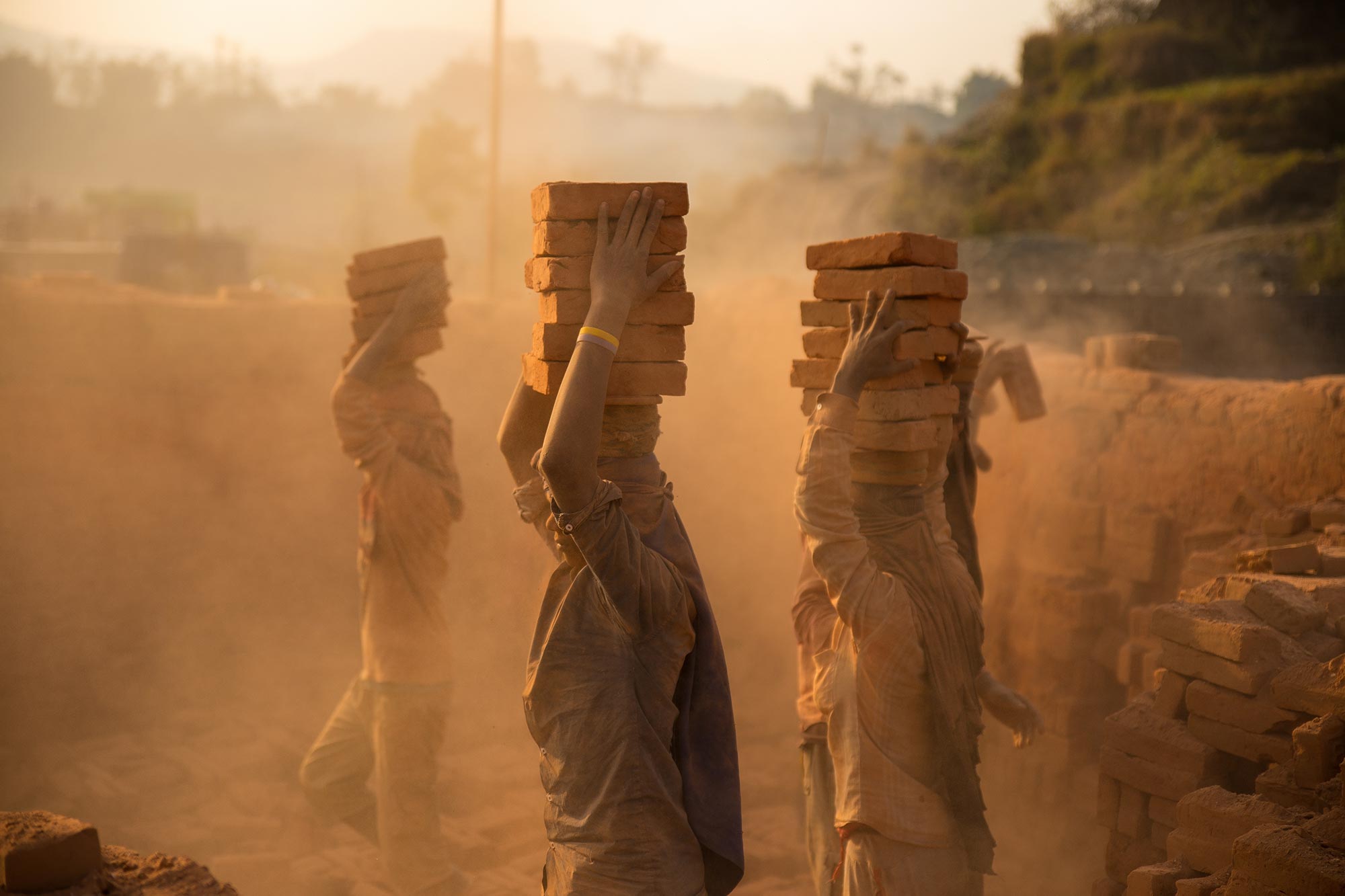
Bangladesh’s brick kilns found a way to pollute less and earn more, but workers saw no measurable improvement in their pay or working conditions.
Simple adjustments to how coal is fed and bricks are stacked helped traditional kilns burn less fuel, release less pollution, and produce better bricks. Yet a companion study found no measurable improvement in wages, health, child labor, or coercive working conditions during the study period.
The findings expose a gap between improving an industry’s performance and improving life for its workforce. They also suggest that protecting workers requires measures aimed directly at their needs.
The multiyear research effort involved Nina Brooks, an assistant professor at the University of Michigan’s School for Environment and Sustainability and a faculty affiliate of its Center for South Asian Studies.
A Cleaner Way To Make Bricks
Bangladesh’s rapid urban growth depends on an industry with a substantial environmental footprint. The country is the world’s fourth-largest brick producer, and roughly 8,000 traditional kilns supply more than 90% of its domestic brick consumption. Alongside carbon emissions, the kilns release fine particles known as PM2.5. Ambient air pollution causes 4.9 million premature deaths globally, with South Asia accounting for 32% of them.
Brooks began investigating brickmaking about eight years ago during her doctoral studies. She and her collaborators mapped kilns with satellite imagery and machine learning, studied regulation, and examined health effects in communities downwind. Their work revealed why restricting kiln locations alone could not solve the pollution problem.
“Bangladesh is one of the world’s most densely populated countries,” Brooks said. “It is not feasible to move brick kilns away from all schools, health facilities, and urban centers that may be harmed by the pollution.”
Instead, researchers worked with owners, managers, and workers to improve existing operations. They introduced more continuous coal feeding, brick-stacking arrangements that improved airflow, and measures to reduce heat loss. None required replacing kilns or purchasing major new equipment.
Less Fuel, Better Bricks
After a small pilot, the team expanded the approach to hundreds of kilns. Results published in Science showed that training and technical support reduced energy use by about 10.5% across kilns assigned to the program. Estimated emissions fell by 171 metric tons (about 188.5 US tons) of carbon dioxide and 0.45 metric tons (about 990 pounds) of PM2.5 per kiln over a firing season.
Among kilns that adopted the practices because of the program, energy use dropped about 23%, while carbon dioxide and PM2.5 emissions each fell roughly 20%. Owners spent less on fuel and produced a greater proportion of higher-quality bricks.
Adoption had increased when researchers returned the next firing season, suggesting the changes had staying power. “Because the changes are economically beneficial for owners, they had a strong incentive to continue following them,” Brooks said.
For businesses facing expensive equipment upgrades and authorities struggling to enforce environmental rules, the findings offered a practical route to cleaner production.
Workers Saw No Measurable Gains
The researchers then examined whether those business benefits reached workers. Bangladesh’s brick industry relies on a large, mostly informal workforce whose employment can involve debt, advance payments, long hours, hazardous conditions, and restrictions on leaving. A companion study in the Proceedings of the National Academy of Sciences examined 246 kilns in the Khulna Division and included private interviews with 1,442 workers.
Seventy percent of workers reported having no personal protective equipment, and 71% lacked a formal labor contract. Forty-two percent described restrictions on movement or communication. Across the sample, roughly 20% met the U.S. Department of State’s definitions of labor trafficking. At nearly half the kilns, at least 1 in 6 workers met those definitions.
Adult workers also reported child labor at more than 70% of the kilns, with most reported cases involving children ages 14 to 17.
The intervention lowered fuel costs by 9.6% and improved brick quality by 8.1%, but researchers detected no corresponding improvement in trafficking, child labor, wages, health, or working conditions. Although changes were possible within the study period, the economic gains did not produce measurable benefits for workers.
Why Productivity Was Not Enough
Higher productivity is often expected to help employees through better pay or conditions. The kiln studies show why that outcome cannot be assumed when coercion and limited bargaining power shape the labor market.
“In many countries, not just Bangladesh, labor laws are hard to enforce, particularly in informal sectors. So, it’s critical to find other ways to protect workers from exploitation,” said Grant Miller, a professor of medicine at Stanford University. “Our study shows that we cannot rely on productivity gains alone to do that, at least not in the short run. Finding approaches that work beyond regulation is a central goal of our ongoing research.”
Why Some Kiln Owners Hesitated
Expanding the cleaner production program revealed that kiln owners in other regions were more reluctant to adopt the changes. In districts around Dhaka, owners were considerably less likely to adopt the practices than those in Khulna. Yet participating kilns achieved comparable reductions in fuel use and emissions, Brooks said. “So, we’re seeing greater hesitation,” she said. “But once they adopt, we see the same benefits.”
Sameer Maithel, the research team’s lead technical expert, said the reasons are still being investigated. Owners operating on narrow margins may hesitate to change familiar methods while facing unpredictable coal prices, brick demand, and regulation. Differences in kiln size, land, and production practices can also make adoption easier in one location than another.
“Informal brick production in South Asia faces a lot of uncertainty: weather, energy prices, market demand, and regulation all shift unpredictably. Many kiln owners also have limited technical and managerial support, and conditions vary from region to region,” Maithel said. “All of this makes scaling up slow and complex, and it takes sustained, dedicated effort.”
Putting Worker Protection First
The lack of improvement for workers has prompted the team to test more direct measures. During the most recent brickmaking season, researchers returned to Khulna with recommendations developed through pilot work and conversations with workers.
They recommended masks for people crushing coal, goggles and protective footwear for fire workers, and head protection for brick carriers. Other measures included sanitation and cooking facilities, shaded rest areas, clean water, heat-stress awareness, and information about child labor.
“None of the owners I interviewed objected to improving conditions for workers, though some disagreed with specific components. They saw the cost as negligible compared to what they spend running a kiln. As they put it, if workers do better work because of it, it’s worth doing,” said Mohammad Saeed Munim, a research officer in the Health Systems and Population Studies Division of the International Centre for Diarrhoeal Disease Research in Bangladesh.
Researchers had expected more resistance. Owners’ willingness to consider these changes now gives the team an opportunity to test whether targeting workers’ daily needs can deliver improvements that greater productivity alone did not.
References:
“Reducing emissions and air pollution from informal brick kilns: Evidence from Bangladesh” by Nina Brooks, Debashish Biswas, Sameer Maithel, Grant Miller, Aprajit Mahajan, M. Rofi Uddin, Shoeb Ahmed, Moogdho Mahzab, Mahbubur Rahman and Stephen P. Luby, 8 May 2025, Science.
DOI: 10.1126/science.adr7394
“Productivity gains and work conditions in coercive labor markets: Experimental evidence from the Bangladesh brick sector” by Grant Miller, Debashish Biswas, Aprajit Mahajan, Kimberly Singer Babiarz, Nina Brooks, Jessie Brunner, Sania Ashraf, Jack Shane, Alvise Scarabosio, Sameer Maithel, Shoeb Ahmed, Moogdho Mahzab, Mohammad Rofi Uddin, Mahbubur Rahman and Stephen P. Luby, 16 July 2026, Proceedings of the National Academy of Sciences.
DOI: 10.1073/pnas.2528388123
Never miss a breakthrough: Join the SciTechDaily newsletter.
Follow us on Google and Google News.