
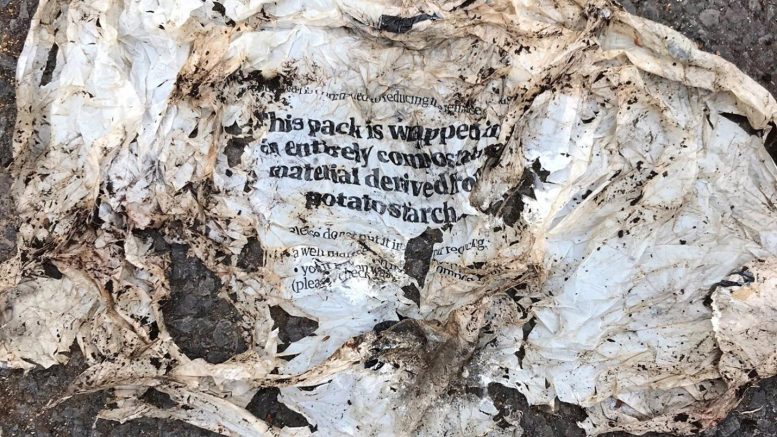
In a UK-wide study, researchers found that 60% of home-compostable plastics do not fully disintegrate in home compost bins, and inevitably end up in our soil. The study also found that citizens are confused about the labels of compostable and biodegradable plastics, leading to incorrect plastic waste disposal. These results highlight the need to revise and redesign this supposedly sustainable plastic waste management system.
Global plastic pollution remains one of the biggest environmental challenges of our time. A new OECD report shows that plastic consumption has quadrupled over the past 30 years. Globally, only 9% of plastic waste is recycled, while 50% ends up in landfills, 22% evades waste management systems, and 19% is incinerated.
In response to this pollution crisis, several countries have set targets to eliminate all single-use plastics and to make plastic packaging 100% recyclable, reusable, or compostable by 2025.
Compostable plastics are becoming more common as the demand for sustainable products grows. The main applications of compostable plastics include food packaging, bags; cups and plates, cutlery, and bio-waste bags. But there are some fundamental problems with these types of plastics. They are largely unregulated and claims around their environmental benefits are often exaggerated.
Now, in a new study published in Frontiers in Sustainability, researchers at University College London found that consumers are often confused about the meaning of the labels of compostable plastics, and that a large portion of compostable plastics do not fully disintegrate under home composting conditions.
(Un)compostable Plastics
‘Compostable plastic’ describes a material that can undergo biological degradation in a compost site at a rate consistent with other known compostable materials, leaving no visible (toxic) residues.
However, compostable plastics are currently incompatible with most waste management systems. There exists no harmonized international standard for home compostable plastics. The fate of these plastics, when thrown away or sorted for recycling, is therefore either incineration or landfill.
“The typical fate of landfill or incineration is not usually communicated to customers so the environmental claims made for compostable packaging can be misleading,” said corresponding author Danielle Purkiss.
The Big Compost Experiment
Purkiss and her colleagues designed a three-part citizen science study, The Big Compost Experiment, to investigate what the public thinks about home compostable plastics, how we deal with them, and whether they fully disintegrate in our compost.
First, participants from across the UK completed an online survey about opinions and behavior surrounding compostable plastics and food waste. Then, participants were invited to take part in a home composting experiment. Lastly, those who participated in part two were sent a request to search for traces of their chosen compostable plastic items in their composter. The researchers collected the data over a period of 24 months.
“Our study was created in response to feedback from the public and stakeholders from industry, policy, and third sector organizations, which highlighted many systemic issues in the manufacturing, use, and disposal of compostable plastic packaging,” explained Purkiss.
The results show a general willingness to make sustainable choices by buying compostable plastics. However, participants showed confusion about the labeling and identification of these plastics. Out of a randomized sample of 50 item images, the researchers found that 46% showed no identifiable home composting certification or standards labeling and 14% showed industrial composting certification.
“This shows that there is a current lack of clear labeling and communication to ensure that the public can identify what is industrially compostable or home compostable packaging, and how to dispose of it correctly,” said Purkiss.
But a more shocking result is that 60% of plastic certified as home compostable did not fully disintegrate in home compost bins.
“Compostable packaging does not break down effectively in the range of UK home composting conditions, creating plastic pollution,” Purkiss added. “Even packaging that has been certified as home compostable is not breaking down effectively.”
The participants indicated that they use their compost in their flower and vegetable gardens. As the results of the experiment show that the compost contains plastic that has not fully disintegrated, plastic inevitably ends up in soil of UK citizens.
The experiment also showed that compost bins are important sites for biodiversity, with pictures sent in by the participants showing 14 different categories of organisms such as fungi, mites, and worms.
Revising the System
The question remains whether compostable plastics serve as a solution to our widespread plastic pollution problem.
“Compostable plastics are potentially useful for products that are not suited to recycling due to contamination such as tea bags, fruit labels, take-away food packaging, and certain hygiene products. These products typically end up in landfill,” explained Purkiss.
But the research shows that, in this case, the better solution is to send compostable plastics to industrial composting facilities, where composting conditions are regulated.
“We have shown that home composting, being uncontrolled, is largely ineffective and is not a good method of disposal for compostable packaging,” said Purkiss.
Overall, there is a need for the revision and improvement of home compostable plastics. “The idea that a material can be sustainable is a widespread misconception. Only a system of production, collection, and reprocessing of a material can be sustainable,” concluded Purkiss.
Reference: “The Big Compost Experiment: Using citizen science to assess the impact and effectiveness of biodegradable and compostable plastics in UK home composting” by Danielle Purkiss, Ayşe Lisa Allison, Fabiana Lorencatto, Susan Michie and Mark Miodownik, 3 November 2022, Frontiers in Sustainability.
DOI: 10.3389/frsus.2022.942724
Never miss a breakthrough: Join the SciTechDaily newsletter.
Follow us on Google and Google News.
1 Comment
And you trust the Science”. Scientist lie for profit just like everyone else. Nothing is as it seems. But you would not know that sitting at your terminal looking for truth where there is none.