
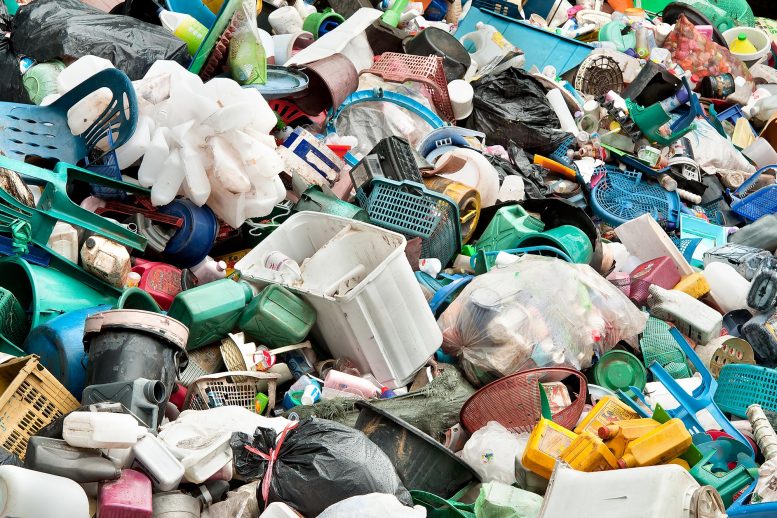
NREL Calculates Lost Value of Landfilled Plastic in U.S.
With mountains of plastic trash piling up in landfills and experts anticipating that there will be more plastics in the ocean by weight than fish by 2050, the enormous environmental threat posed by plastics is widely acknowledged. The scientific community is less familiar with the lost energy opportunity. In a nutshell, plastic waste also wastes energy.
Scientists from the U.S. Department of Energy’s (DOE’s) National Renewable Energy Laboratory (NREL) found that the energy value of landfilled plastic garbage in 2019 was enough to supply 5% of the electricity consumed by the country’s transportation sector or 5.5% by the industrial sector.
They also released data on how much plastic garbage has been placed in landfills on a regional, state, and county level and the situation is worse than previously thought. According to NREL, the quantity of plastic garbage in the United States is 44 million metric tons. Using a somewhat different methodology, the US Environmental Protection Agency calculates the quantity to be 32.2 million metric tons.
“For us to tackle plastic waste pollution, we really need to understand better where those resources are,” said Anelia Milbrandt, a senior research analyst at NREL and co-author of a new paper, “Quantification and evaluation of plastic waste in the United States,” published in the journal Resources, Conservation & Recycling. “We would like to bring awareness to communities about the potential for these materials.”
Her NREL co-authors are Kamyria Coney, Alex Badgett, and Gregg Beckham. A senior research fellow, Beckham heads the BOTTLE Consortium, a collaborative launched last year in an effort to address the waste-plastics problem.
Economic Opportunities in Recovering Plastic Waste
By identifying areas with large quantities of plastic waste, the scientists are hoping to highlight the economic opportunities that could arise by recovering their value through different processes. Only about 5% of the waste plastic in the United States was recycled in 2019, while 86% was left in landfills. The rest was burned to generate electricity.
NREL’s analysis of the discarded plastics examined seven materials—variously used to make bottles, CDs, milk jugs, take-out containers, and bags, among other items. Communities across the country spent about $2.3 billion on plastic waste disposal in 2019.
The researchers noted the amount of landfilled plastic waste in the United States has been increasing because of several factors, including low recycling rates, population growth, consumer preference for single-use plastics, and low disposal fees in certain parts of the country. The problem has been exacerbated by China’s refusal beginning in 2017 to import nonindustrial plastic waste from the United States.
Developing a Circular Economy for Plastics
Developing new recycling techniques for plastics would create incentives for a circular economy, where what once was discarded would be reused instead of virgin plastics. The market value of landfilled plastic ranges from $4.5 billion to $9.9 billion, or $7.2 billion on average, the researchers estimated. The embodied energy in the waste plastic—an indicator of how much energy it took to manufacture the materials—equates to about 12% of the country’s energy consumption by the industrial sector.
“Plastic waste is not just an environmental issue. It’s a waste management issue. It’s also a land use issue because landfills are closing in many areas.”
Anelia Milbrandt
Some types of plastic are separated and recycled, chiefly polyethylene terephthalate (commonly known as PET), used to make soda bottles; and high-density polyethylene, used for milk jugs and shampoo bottles, but these still represent a significant percentage of plastics found in landfills.
The filmy plastic used for bags is among the most prevalent type found in landfills.
Potential Solutions for Tackling Plastic Waste
The researchers pointed out two possible solutions for the plastics not being recycled: Develop new products that rely on these plastics to encourage their sorting and collection, and develop advanced sorting technologies that could eventually lead to increased use of recycled materials.
“I’m hoping this paper also increases awareness for industry and investors to look for opportunities,” Milbrandt said.
The amount of plastic waste correlates with population size. California, Texas, and Florida are the three most populous states and also have the largest amount of landfilled plastic waste. New York, however, is fourth for population, but it ships much of its waste outside of the state.
“Plastic waste is not just an environmental issue. It’s a waste management issue. It’s also a land use issue because landfills are closing in many areas,” Milbrandt said. “What do we do with all that waste? It has to go somewhere. I believe local governments and industry developers will see a benefit of this report by providing them information to support decisions.”
DOE’s Bioenergy Technologies Office funded the research.
NREL is the U.S. Department of Energy’s primary national laboratory for renewable energy and energy efficiency research and development. NREL is operated for the Energy Department by the Alliance for Sustainable Energy, LLC.
Reference: “Quantification and evaluation of plastic waste in the United States” by Anelia Milbrandt, Kamyria Coney, Alex Badgett and Gregg T. Beckham, 22 April 2022, Resources, Conservation and Recycling.
DOI: 10.1016/j.resconrec.2022.106363
Never miss a breakthrough: Join the SciTechDaily newsletter.
Follow us on Google and Google News.
1 Comment
I was diagnosed with Parkinson’s disease a year ago at the age of 67. For several months I had noticed tremors in my right hand and the shaking of my right foot when I was sitting. My normally beautiful cursive writing was now small cramped printing. And I tended to lose my balance. Neurologist had me walk down the hall and said I didn’t swing my right arm. I had never noticed! I was in denial for a while as there is no history in my family of parents and five older siblings, but I had to accept I had classic symptoms. I was taking amantadine and carbidopa/levodopa and was about to start physical therapy to strengthen muscles. Finally, I was introduced to Kycuyu Health Clinic and their effective Parkinson’s herbal protocol. This protocol relieved symptoms significantly, even better than the medications I was given. After First month on treatment, my tremors mysterious stopped, had improvement walking. After I completed the treatment, all symptoms were gone. I live a more productive life. I was fortunate to have the loving support of my husband and family. I make it a point to appreciate every day!