
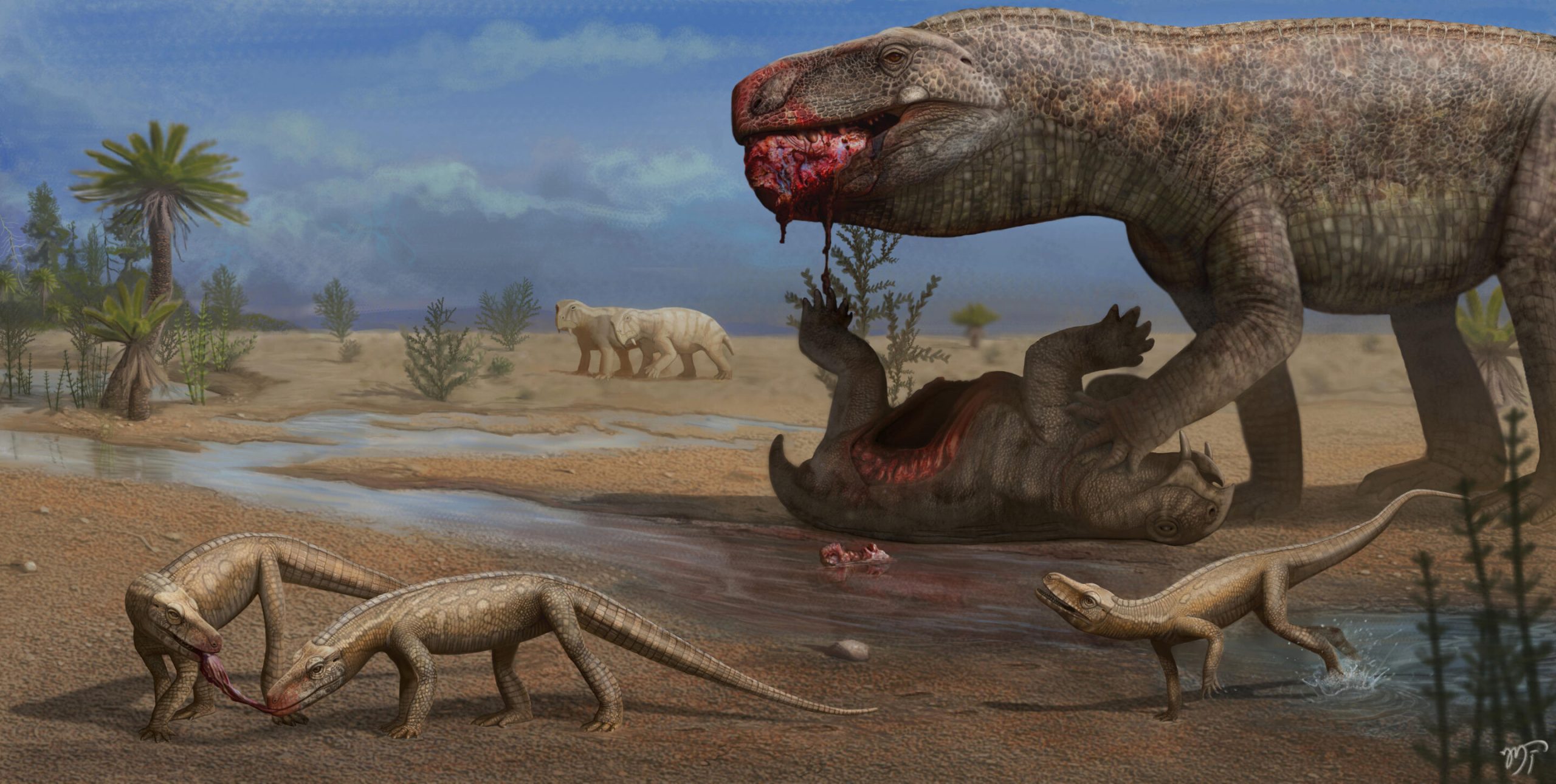
The discovery of Parvosuchus aurelioi, a new species of ancient predatory reptile from the pseudosuchian group, was reported in Brazil. Dating back to about 237 million years ago during the Middle-Late Triassic period, this find adds significant insight into the diversity of early reptiles before the dominance of dinosaurs.
A paper published in Scientific Reports details the finding of a new, ancient predatory reptile known as Parvosuchus aurelioi in Brazil. This creature belongs to a group of crocodile-like reptiles called pseudosuchians. Dating back to roughly 237 million years ago, during the Middle-Late Triassic period, this specimen represents the first discovery of a small predatory reptile of its type in the country.
Prior to the dominance of the dinosaurs, pseudosuchians were a common form of ancient quadruped reptile during the Triassic Period (252 – 201 million years ago), with some species amongst the largest carnivores of the time. Smaller pseudosuchians known as gracilisuchids lived alongside these apex predators and have been found in areas such as China and Argentina.
Unveiling Parvosuchus aurelioi
Now, Rodrigo Müller reports the discovery of a new species of gracilisuchid based on a specimen found in the Santa Maria Formation in Brazil. The partial skeleton dates to approximately 237 million years ago and consists of a complete skull including the lower jaw, 11 dorsal vertebrae, a pelvis, and partially preserved limbs. The author names the new species Parvosuchus aurelioi which derives from ‘parvus’ (small) and ‘suchus’ (crocodile) and honors the amateur paleontologist Pedro Lucas Porcela Aurélio, who discovered the fossil materials.
The skull measures 14.4 centimeters (5.7 inches) in length and features long slender jaws with pointed teeth that curved backward, and several skull openings. The skeleton is lightly built and estimated to be less than one meter long in total length. These features classify P. aurelioi as a gracilisuchid, which makes it the first species from this group to be confirmed in Brazil, according to the author. This finding highlights the diversity among pseudosuchians in the Triassic, he adds.
Reference: “A new small-sized predatory pseudosuchian archosaur from the Middle-Late Triassic of Southern Brazil” by Rodrigo T. Müller, 20 June 2024, Scientific Reports.
DOI: 10.1038/s41598-024-63313-3
Never miss a breakthrough: Join the SciTechDaily newsletter.
Follow us on Google and Google News.
10 Comments
This is a dinosaur not a early thecodont and thecodont mean crocodilian teeth like these animal t.rex gator .clearly pseudosuchian are dinosaur they have serrated teeth ziphodont teeth there hip socket is open they have wide skull like tetanuran dinosaur which is not bird like the back leg is bigger than the front leg like the scitech photo show they have many sacral vertebrae some are bipedal it hard tell if dinosaur is bipedal the
Famous dinosaur gator famous for being quadrupedal is a bipedal tetanuran dinosaur they cliam it is quadrupedal because it has advance mammal quadrupedal feature clearly has long carpal like bipedal dinosaur lost in some pseudosuchus dinosaur but they do not have advance mammal quadrupedal feature found in eusuchian mesoeucrocodylian today modern crocodilian has it the hand has to change because more speed
Gator has 2 sacral like herrerasaurus very primitive for dinosaur and pseudosuchian but herrerasaurus is bipedal theropod dinosaur a early dinosaur the last surviving spinosauridae dinosaur the modern crocodilian is allso bipedal they have video of modern crocodilian being bipedal and scientific report the gator hip socket is open not as open as fossil mesoeucrocodylia the gator type.
The gator type fossil mesoeucrocodylia allso has 3 sacral .only thecodont with a open hip socket like dinosaur are early gator type mesoeucrocodylia close to spinosauridae they are big and circle only saw two won were land the other extremely aquatic
Clearly pseudosuchian has tetanuran dinosaur feature with wider skull but clearly they are very primitive dinosaur they lack Cingulum teeth and the most sensoritive face in the animal kingdom.they are so primitive I thought they did not have lacrimal foraman they have it only saw one mite be many .gator only tetanuran with 5finger marine reptile grow there finger back
Gator finger are same as predator dinosaur it is grasping claws some how this has surviving this very strange it did not evolve this against walk evolution the first finger is short a quadrupedal feature but still has big grasping thumb claw a feature dinosaur other reptile were never grasping bipedal predator the toe is different because it’s land quadrupedal toe like dinosaur no grasping if gator was not dinosaur all claws would be the same clearly is a spinosauridae
Pseudosuchian are primitive dinosaur but they lack palate teeth found in primitive reptile like tuatara the early dinosaur eoraptor so pseudosuchian has advance feature .dinosaur has many quadrupedal gait it was very divers like human ankle and lack of fourth trochanter these feature likely is mimic mammal because mammal do not use tail to walk a advance feature early mammal that live Australia today allso has human ankle like gator and femur rarely move
Some fossil mesoeucrocodylia has digigrade on arm and leg they say these are quadrupedal .but they say the same thing about modern crocodilian because it has advance mammal quadrupedal feature but they are video of them doing bipedal . digigrade is found in dinosaur and mammal birds a very advance feature that show they were warm blooded because they were fast then why a reptile has it because it is warm blooded there is no evidence of coldbloodness in modern crocodilian
The early mammal live today in Australia allso has furcula and look like today bird furcula better dinosaur furcula a match bird furcula
Quadrupedal is diverse when you have mammal type walking dinosaur were trying new things it is more complex than they think .the Australia early mammal femur leg move like bird no air sac thou bird furcula is not fuse dinosaur furcula is fuse the pterosaur the mammal allso is fuse it is not mobile bipedal dinosaur furcula is not fuse to sternum they lack hypocleidium furcula bird allso not fuse to sternum but has hypocleidum furcula very mobile furcula pectoral girdle very convergent evolution there is a tuatara like animal with human ankle a mammal with a furcula