
Close Menu
    Facebook X (Twitter) Instagram
    SciTechDaily
    • Biology
    • Chemistry
    • Earth
    • Health
    • Physics
    • Science
    • Space
    • Technology
    Facebook X (Twitter) Pinterest YouTube RSS
    SciTechDaily
    Home»Science»49 Feet Long – Ancient Giant Snake Discovered in India
    Science

    49 Feet Long – Ancient Giant Snake Discovered in India

    By Scientific ReportsApril 20, 20246 Comments2 Mins Read
    Facebook Twitter Pinterest Telegram LinkedIn WhatsApp Email Reddit
    Share
    Facebook Twitter LinkedIn Pinterest Telegram Email Reddit
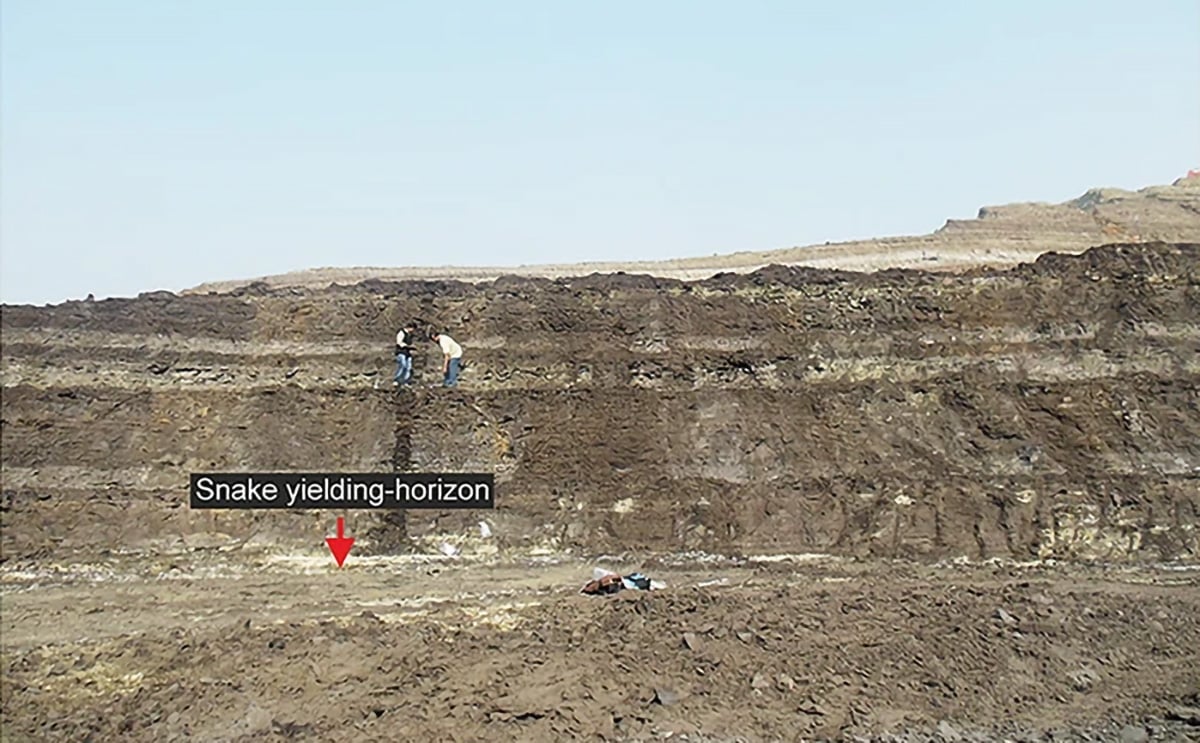
    Panoramic View of the Vasuki Indicus Fossil Site
    Researchers have discovered a new ancient snake species, Vasuki Indicus, in Gujarat, India, which may have been one of the largest snakes ever, reaching up to 15 meters in length and dating back 47 million years. Credit: Scientific Reports (2024). DOI: 10.1038/s41598-024-58377-0

    New research published in Scientific Reports suggests that a recently identified ancient snake species, named Vasuki Indicus, may have been among the largest snakes ever. This species, which existed approximately 47 million years ago in Gujarat, India, reached lengths of 11 to 15 meters (36 – 49 feet). Belonging to the now-extinct madtsoiidae family, Vasuki Indicus represents a unique lineage that originated in India.

    Debajit Datta and Sunil Bajpai describe a new specimen recovered from the Panandhro Lignite Mine, Kutch, Gujarat State, India, which dates to the Middle Eocene period, approximately 47 million years ago. The new species is named Vasuki Indicus after the mythical snake round the neck of the Hindu deity Shiva and in reference to its country of discovery, India. The authors describe 27 mostly well-preserved vertebra, some of which are articulated, which appear to be from a fully-grown animal.

    Size Estimation and Ecological Role

    The vertebrae measure between 37.5 and 62.7 millimeters in length and 62.4 and 111.4 millimeters in width, suggesting a broad, cylindrical body. Extrapolating from this, the authors estimate that V. Indicus may have reached between 10.9 and 15.2 meters in length. This is comparable in size to the longest known snake to have ever lived, the extinct Titanoboa, although the authors highlight the uncertainty around these estimates. They further speculate that V. Indicus’s large size made it a slow-moving, ambush predator akin to an anaconda.

    The authors identify V. Indicus as belonging to the madtsoiidae family, which existed for around 100 million years from the Late Cretaceous to the Late Pleistocene and lived in a broad geographical range including Africa, Europe, and India. They suggest that V. Indicus represents a lineage of large madtsoiids that originated in the Indian subcontinent and spread via southern Europe to Africa during the Eocene, approximately 56 to 34 million years ago.

    Reference: “Largest known madtsoiid snake from warm Eocene period of India suggests intercontinental Gondwana dispersal” by Debajit Datta, and Sunil Bajpai, 18 April 2024, Scientific Reports.
    DOI: 10.1038/s41598-024-58377-0

    Never miss a breakthrough: Join the SciTechDaily newsletter.
    Follow us on Google and Google News.

    Fossils Paleontology Popular Scientific Reports Snake
    Share. Facebook Twitter Pinterest LinkedIn Email Reddit

    Related Articles

    “Weird” Species of Ancient Snake Discovered in England

    Ancient Crocodile-Like Reptile Discovered in Brazil

    “Big John” Triceratops Specimen Has Skull Injuries That May Have Come From Combat With Another Dinosaur

    All Living Snakes Evolved From a Few Survivors of Asteroid That Killed the Dinosaurs

    Prehistoric Fossilized Eocene Epoch Turtles Died Locked In Coitus

    Cretaceous Period Sankofa Pyrenaica Fossilized Eggs Are Unusually Shaped

    Titanoboa, a Paleogene Period 40-Foot Long Snake

    Microraptor Feathers Were Black With Iridescent Sheen

    Hundreds of Lost Fossils From the Darwin Collection Rediscovered by the British Geological Survey

    6 Comments

    1. Michael Clark on April 20, 2024 1:20 pm

      At 47 Million Year ago, the surface gravity should about 74 % of the Earth’s current surface gravity. The animal Area to Volume Ratio is 2.45^(2/3) / 2.45 = 0.741 785.
      The snake at 47 million years ago would be 2.45 times the volume of a comparable snake found today. The Problem is: Which snake do you compare it to ? It would be around 2.45 times the volume times 0.74 gravity = 1.813 time the weight. You would still not want to meet this snake when it is hungry.

      Reply
    2. James Pecic on April 21, 2024 6:26 am

      Why do you think gravity was lower in the past? That would have inferred that the earths distance from the sun and orbital speed would have been different than today. Seems unlikely.

      Reply
    3. Daylin Griffin on April 25, 2024 9:31 am

      Is the actual mass of the Earth greater now than it was 47 million years ago? Wouldn’t it have to be for it to influence the gravity on earth surface? Does that mean animals could dive deeper on the ocean as it would influence ocean pressure as well?

      Reply
    4. Michael nelson on April 25, 2024 4:49 pm

      Water does not compress, I would think that regardless of the gravitational pull the only influence on depth and pressure would be the atmospheric weight. Depth + 14.7 / 14.7 == Atmospheres absolute. , I think 🤔

      Reply
    5. Kanak Attak on April 27, 2024 5:05 am

      It came from a time before this land was called India from the descendants of the first Eve who was called Lilith who eventually migrated down to the Sumatras and then Polynesia which is mentioned in the Kumulipo which is the most ancient of genealogies which connects all the nationalities of the world 🌍 🌎

      Reply
    6. Kanak Attak on April 27, 2024 5:08 am

      In the Hawaiian Kumulipo , Lilith is called Lilinoe but known as Lilith in the Middle East

      Reply
    Leave A Reply Cancel Reply

    • Facebook
    • Twitter
    • Pinterest
    • YouTube

    Don't Miss a Discovery

    Subscribe for the Latest in Science & Tech!

    Trending News

    Scientists Uncover Potential Brain Risks of Popular Fish Oil Supplements

    Scientists Discover a Surprising Way To Make Bread Healthier and More Nutritious

    After 60 Years, Scientists Uncover Unexpected Brain Effects of Popular Diabetes Drug Metformin

    New Research Uncovers Hidden Side Effects of Popular Weight-Loss Drugs

    Scientists Rethink Extreme Warming After Surprising Ocean Discovery

    Landmark Study Links Never Marrying to Significantly Higher Cancer Risk

    Researchers Discover Unknown Beetle Species Just Steps From Their Lab

    Largest-Ever Study Finds Medicinal Cannabis Ineffective for Anxiety, Depression, PTSD

    Follow SciTechDaily
    • Facebook
    • Twitter
    • YouTube
    • Pinterest
    • Newsletter
    • RSS
    SciTech News
    • Biology News
    • Chemistry News
    • Earth News
    • Health News
    • Physics News
    • Science News
    • Space News
    • Technology News
    Recent Posts
    • Early Warning Signals of Esophageal Cancer May Be Hiding in Plain Sight
    • Researchers Have Discovered a THC-Free Cannabis Compound That May Replace Opioids
    • Common Blood Pressure Drug Shows Surprising Power Against Deadly Antibiotic-Resistant Superbug
    • Students Build Dark Matter Detector and Set New Experimental Limits
    • Scientists Discover Caffeine Can Repair Key Memory Circuits After Sleep Loss
    Copyright © 1998 - 2026 SciTechDaily. All Rights Reserved.
    • Science News
    • About
    • Contact
    • Editorial Board
    • Privacy Policy
    • Terms of Use

    Type above and press Enter to search. Press Esc to cancel.