
Close Menu
    Facebook X (Twitter) Instagram
    SciTechDaily
    • Biology
    • Chemistry
    • Earth
    • Health
    • Physics
    • Science
    • Space
    • Technology
    Facebook X (Twitter) Pinterest YouTube RSS
    SciTechDaily
    Home»Biology»New Flower From 100 Million Years Ago Brings Sunburst Holiday Beauty to 2020
    Biology

    New Flower From 100 Million Years Ago Brings Sunburst Holiday Beauty to 2020

    By Oregon State UniversityDecember 23, 2020No Comments3 Mins Read
    Facebook Twitter Pinterest Telegram LinkedIn WhatsApp Email Reddit
    Share
    Facebook Twitter LinkedIn Pinterest Telegram Email Reddit
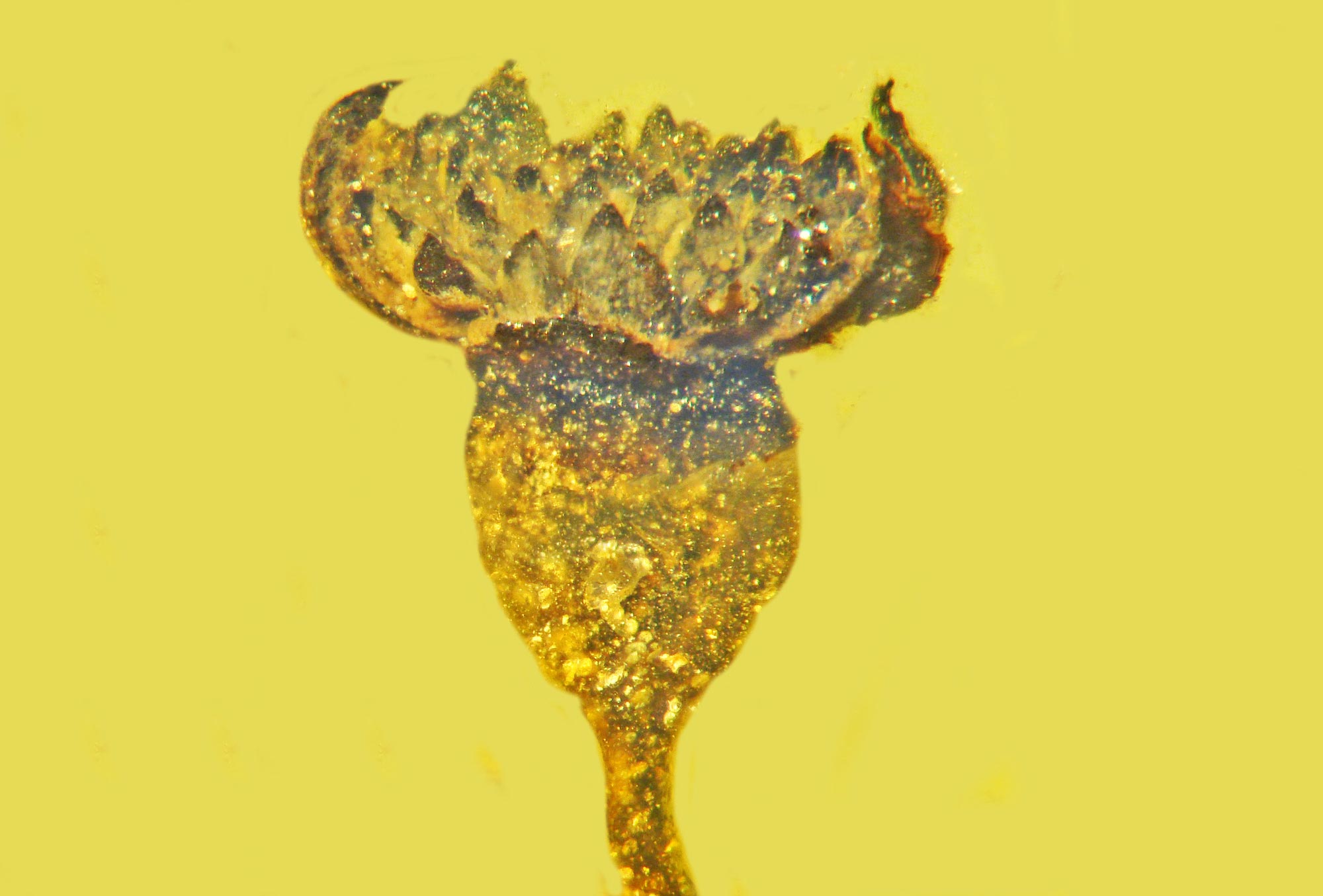
    Valviloculus pleristaminis
    Valviloculus pleristaminis. Credit: George Poinar Jr., OSU

    Oregon State University researchers have identified a spectacular new genus and species of flower from the mid-Cretaceous period, a male specimen whose sunburst-like reach for the heavens was frozen in time by Burmese amber.

    “This isn’t quite a Christmas flower but it is a beauty, especially considering it was part of a forest that existed 100 million years ago,” said George Poinar Jr., professor emeritus in the OSU College of Science.

    Findings were published in the Journal of the Botanical Research Institute of Texas.

    “The male flower is tiny, about 2 millimeters across, but it has some 50 stamens arranged like a spiral, with anthers pointing toward the sky,” said Poinar, an international expert in using plant and animal life forms preserved in amber to learn more about the biology and ecology of the distant past.

    A stamen consists of an anther – the pollen-producing head – and a filament, the stalk that connects the anther to the flower.

    “Despite being so small, the detail still remaining is amazing,” Poinar said. “Our specimen was probably part of a cluster on the plant that contained many similar flowers, some possibly female.”
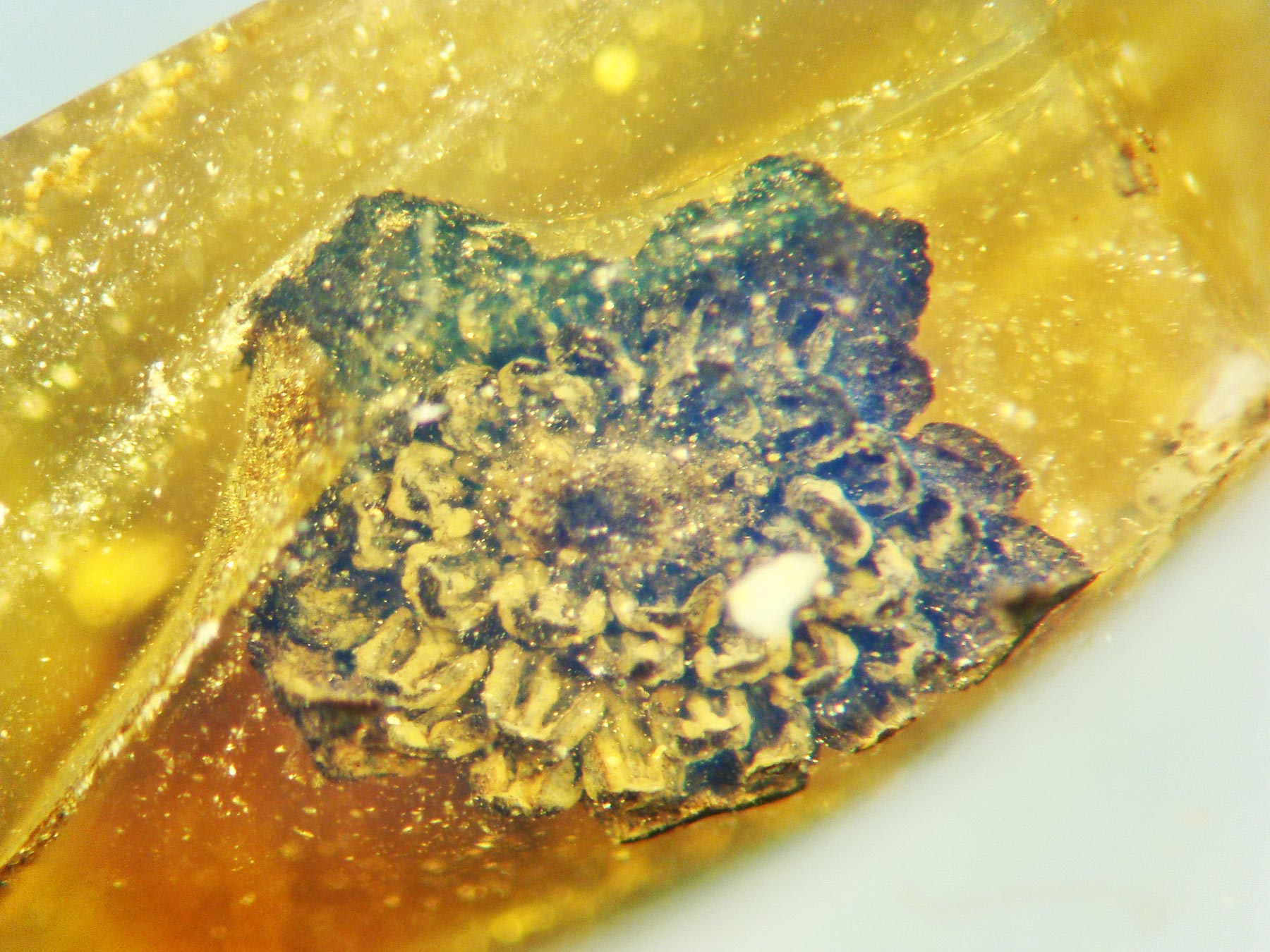
    Valviloculus pleristaminis Amber
    Valviloculus pleristaminis. Credit: George Poinar Jr., OSU

    The new discovery has an egg-shaped, hollow floral cup – the part of the flower from which the stamens emanate; an outer layer consisting of six petal-like components known as tepals; and two-chamber anthers, with pollen sacs that split open via laterally hinged valves.

    Poinar and collaborators at OSU and the U.S. Department of Agriculture named the new flower Valviloculus pleristaminis. Valva is the Latin term for the leaf on a folding door, loculus means compartment, plerus refers to many, and staminis reflects the flower’s dozens of male sex organs.

    The flower became encased in amber on the ancient supercontinent of Gondwana and rafted on a continental plate some 4,000 miles across the ocean from Australia to Southeast Asia, Poinar said.

    Geologists have been debating just when this chunk of land – known as the West Burma Block – broke away from Gondwana. Some believe it was 200 million years ago; others claim it was more like 500 million years ago.

    Numerous angiosperm flowers have been discovered in Burmese amber, the majority of which have been described by Poinar and a colleague at Oregon State, Kenton Chambers, who also collaborated on this research.

    Angiosperms are vascular plants with stems, roots and leaves, with eggs that are fertilized and develop inside the flower.

    Since angiosperms only evolved and diversified about 100 million years ago, the West Burma Block could not have broken off from Gondwana before then, Poinar said, which is much later than dates that have been suggested by geologists.

    Reference: ” Valviloculus pleristaminis gen. et sp. nov., a Lauralean fossil flower with valvate anthers from mid-Cretaceous Myanmar amber ” by George O. Poinar Jr., Kenton L. Chambers, Urszula T. Iwaniec and Fernando E. Vega, 7 December 2020, Journal of the Botanical Research Institute of Texas.
    DOI: 10.17348/jbrit.v14.i2.1014

    Joining Poinar and Chambers, a botany and plant pathology researcher in the OSU College of Agricultural Sciences, on the paper were Oregon State’s Urszula Iwaniec and the USDA’s Fernando Vega. Iwaniec is a researcher in the Skeletal Biology Laboratory in the College of Public Health and Human Sciences and Vega works in the Sustainable Perennial Crops Laboratory in Beltsville, Maryland.

    Never miss a breakthrough: Join the SciTechDaily newsletter.
    Follow us on Google and Google News.

    Archaeology Evolution Oregon State University Plant Science
    Share. Facebook Twitter Pinterest LinkedIn Email Reddit

    Related Articles

    71 New Species From 2019 Described by Scientists: From Geckos to Goblin Spiders

    Recently Discovered Parasitic Wasp Is Enemy of Serious Alien Pest in North America

    Hunting and Ivory Trade Likely Drove Icelandic Walrus to Extinction

    Meet the ‘Mold Pigs,’ a Newly Discovered Invertebrate From 30 Million Years Ago

    This 370 Million Year Old Monster Hunted With Massive Fangs and a Death Crush

    1 Billion Years of Evolution Illuminated by Genetic Sequencing of 1,100 Plants

    DNA Methylation Data Offers First Glimpse at What Ancient Denisovans May Have Looked Like

    Scientists Discover Oldest Directly Dated Homo Sapiens Fossil Outside of Africa

    Improved Estimates of DNA’s Mutation Rate Paint Clearer Picture of Human Prehistory

    Leave A Reply Cancel Reply

    • Facebook
    • Twitter
    • Pinterest
    • YouTube

    Don't Miss a Discovery

    Subscribe for the Latest in Science & Tech!

    Trending News

    Artificial Sweeteners May Harm Future Generations, Study Suggests

    Splashdown! NASA Artemis II Returns From Record-Breaking Moon Mission

    What If Consciousness Exists Beyond Your Brain

    Scientists Finally Crack the 100-Million-Year Evolutionary Mystery of Squid and Cuttlefish

    Beyond “Safe Levels”: Study Challenges What We Know About Pesticides and Cancer

    Researchers Have Found a Dietary Compound That Increases Longevity

    Scientists Baffled by Bizarre “Living Fossil” From 275 Million Years Ago

    Your IQ at 23 Could Predict Your Wealth at 27, Study Finds

    Follow SciTechDaily
    • Facebook
    • Twitter
    • YouTube
    • Pinterest
    • Newsletter
    • RSS
    SciTech News
    • Biology News
    • Chemistry News
    • Earth News
    • Health News
    • Physics News
    • Science News
    • Space News
    • Technology News
    Recent Posts
    • AI Could Detect Early Signs of Alzheimer’s in Under a Minute – Far Before Traditional Tests
    • What if Dark Matter Has Two Forms? Bold New Hypothesis Could Explain a Cosmic Mystery
    • Researchers Expose Hidden Chemistry of “Ore-Forming” Elements in Biology
    • Geologists Reveal the Americas Collided Earlier Than We Thought
    • 20x Difference: Study Reveals True Source of Airborne Microplastics
    Copyright © 1998 - 2026 SciTechDaily. All Rights Reserved.
    • Science News
    • About
    • Contact
    • Editorial Board
    • Privacy Policy
    • Terms of Use

    Type above and press Enter to search. Press Esc to cancel.