

Few exoplanets have the radiation needed for oxygen-based photosynthesis. Only Kepler-442b nears Earth-like potential, while red dwarfs likely can’t support complex life.
A new analysis of known exoplanets has revealed that Earth-like conditions on potentially habitable planets may be much rarer than previously thought. The work focuses on the conditions required for oxygen-based photosynthesis to develop on a planet, which would enable complex biospheres of the type found on Earth. The study was recently published in the Monthly Notices of the Royal Astronomical Society.
The number of confirmed planets in our own Milky Way galaxy now numbers into the thousands. However, planets that are both Earth-like and in the habitable zone — the region around a star where the temperature is just right for liquid water to exist on the surface — are much less common.
At the moment, only a handful of such rocky and potentially habitable exoplanets are known. However, the new research indicates that none of these has the theoretical conditions to sustain an Earth-like biosphere by means of ‘oxygenic’ photosynthesis — the mechanism plants on Earth use to convert light and carbon dioxide into oxygen and nutrients.
Only one of those planets comes close to receiving the stellar radiation necessary to sustain a large biosphere: Kepler-442b, a rocky planet about twice the mass of the Earth, orbiting a moderately hot star around 1,200 light-years away.
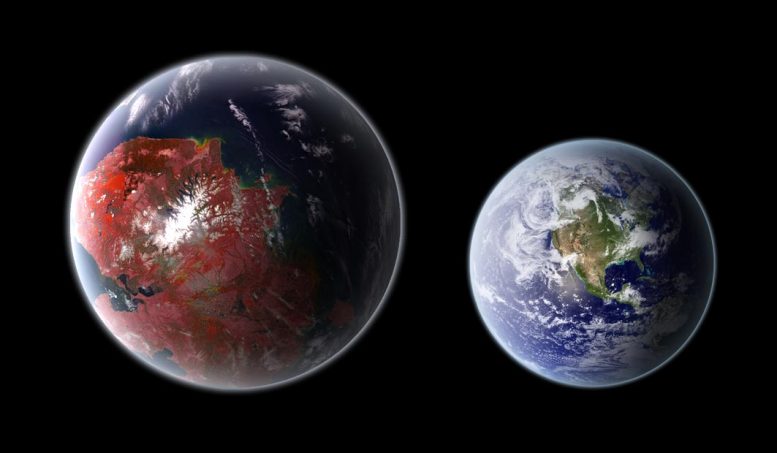
The study looked in detail at how much energy is received by a planet from its host star, and whether living organisms would be able to efficiently produce nutrients and molecular oxygen, both essential elements for complex life as we know it, via normal oxygenic photosynthesis.
Radiation and Lifespan Tradeoffs
By calculating the amount of photosynthetically active radiation (PAR) that a planet receives from its star, the team discovered that stars around half the temperature of our Sun cannot sustain Earth-like biospheres because they do not provide enough energy in the correct wavelength range. Oxygenic photosynthesis would still be possible, but such planets could not sustain a rich biosphere.
Planets around even cooler stars known as red dwarfs, which smolder at roughly a third of our Sun’s temperature, could not receive enough energy to even activate photosynthesis. Stars that are hotter than our Sun are much brighter, and emit up to ten times more radiation in the necessary range for effective photosynthesis than red dwarfs, however generally do not live long enough for complex life to evolve.
The “Sweet Spot” for Complex Life Is Narrow
“Since red dwarfs are by far the most common type of star in our galaxy, this result indicates that Earth-like conditions on other planets may be much less common than we might hope,” comments Prof. Giovanni Covone of the University of Naples, lead author of the study.
He adds: “This study puts strong constraints on the parameter space for complex life, so unfortunately it appears that the “sweet spot” for hosting a rich Earth-like biosphere is not so wide.”
Future missions such as the James Webb Space Telescope (JWST), due for launch later this year, will have the sensitivity to look to distant worlds around other stars and shed new light on what it really takes for a planet to host life as we know it.
Reference: “Efficiency of the oxygenic photosynthesis on Earth-like planets in the habitable zone” by Giovanni Covone, Riccardo M Ienco, Luca Cacciapuoti and Laura Inno, 19 May 2021, Monthly Notices of the Royal Astronomical Society.
DOI: 10.1093/mnras/stab1357
Never miss a breakthrough: Join the SciTechDaily newsletter.
Follow us on Google and Google News.
1 Comment
OOOPS! Lots of publishing plans just swooshed down the proverbial poor example of self-organizing information ……….aka known as the drain!
Mommy loves carbon!